Daisy Williams: An 1880 Winter in New York, and a Spring at Sweet Briar
This account of Daisy Williams’s life in the winter and spring of 1880 draws on her diary, transcribed by Tiffany Meadows, Sweet Briar College Class of 2008. Covering January 1 through May 13, the excerpts follow twelve-year-old Daisy from school, theaters, and shops in New York to the gardens, woods, and family routines of Sweet Briar. Her observations provide the foundation for this narrative, offering an intimate glimpse of the child whose memory would later inspire the founding of the college
The new year opened gently in New York. On January 1, 1880, the weather was mild, though the sidewalks were slippery. Twelve-year-old Daisy Williams began her morning at the dentist, then joined her family for a journey on the elevated railroad, traveling beyond Harlem to 165th Street. After lunch came an outing to the Aquarium to see Uncle Tom’s Cabin. By six o’clock, she was dressed in blue silk and ready for dinner.
Her days were filled with the pleasures and obligations of a well-provided childhood. School, music lessons, shopping, church, and visits kept her moving through the city. There were teeth to fill and shoes to mend, friends to find and invitations to arrange. Weather determined which coat she wore, whether she walked or rode, and how far an afternoon’s plans could take her.
Daisy’s parents, Henry and Indiana Williams, attended closely to their daughter’s needs. Her father had a little mosaic pin repaired and took her shoes to have their soles fixed. He supplied grapes, dates, peanuts, and candy, small gifts that punctuated the winter. Her mother accompanied her to lessons, walked with her through the shops, and helped choose the ribbons, gloves, and clothing that occupied so much of their attention.
At Stewart’s, mother and daughter bought red ribbon for five cents a yard. Other excursions brought worsted, handkerchiefs, little baskets, and fabric. Daisy acquired pins, a purse, a Chinese box, and a fan. These objects added color and interest to her everyday world. A new purchase could give an otherwise ordinary afternoon something to remember.
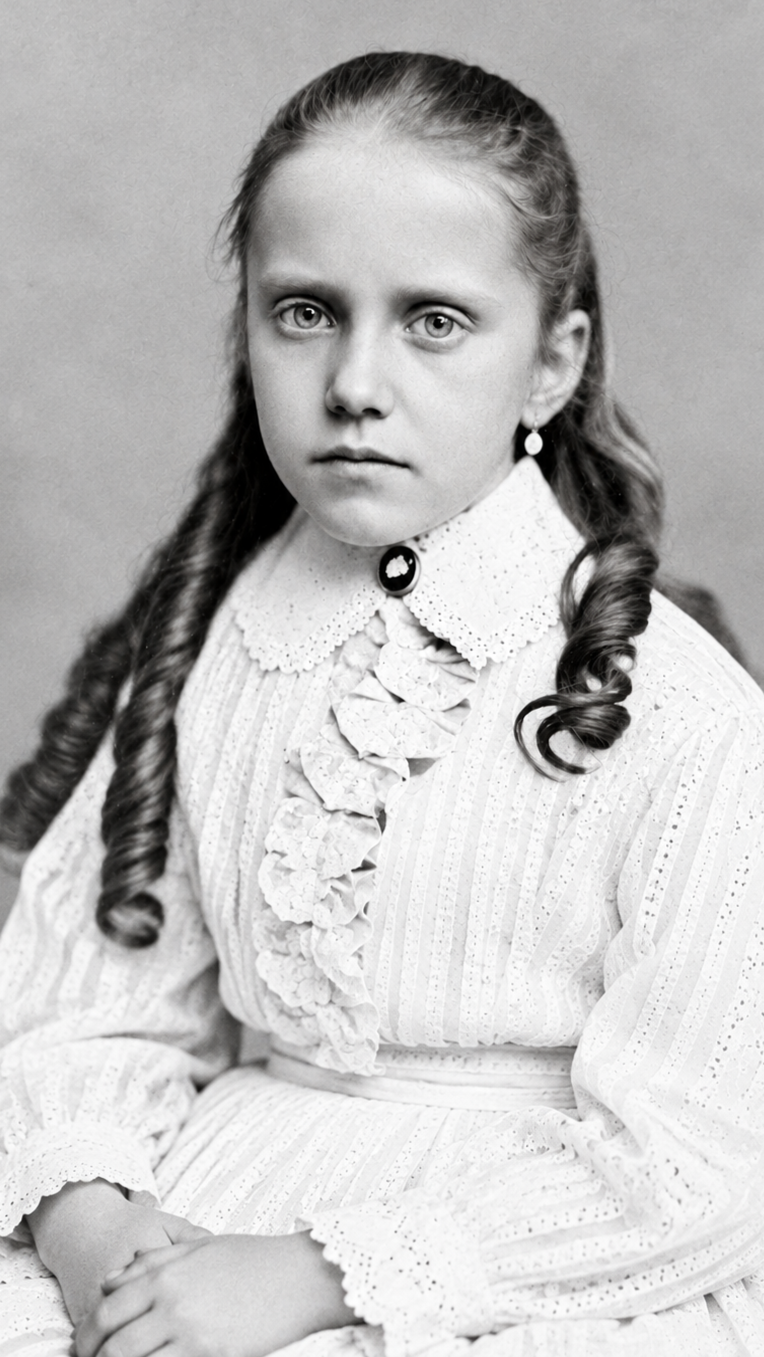
Daisy Williams, Kurtz Studio, NYC, 1883; digitally remastered C.M. Bell Studio, 2026
The city offered entertainment on a grander scale. In January, Daisy went to the Fifth Avenue Theatre with May and Helena to see The Pirates of Penzance. The house was crowded, and the girls enjoyed the performance. Earlier that day, while she and her father were getting tickets, a man who had stolen something ran past them, with a crowd chasing him. Such incidents added to the city’s pleasures and its unpredictability. Streets were slushy, crossings muddy, and journeys sometimes uncomfortable. Snow could make a school morning so difficult that pupils got extra marks for attending. Daisy put on leggings and went anyway. On other days, rain spoiled a visit or prevented the family from reaching church.
School gave the week its structure. Daisy often met Lola on the way, sometimes calling at her home before they set out together. Lunch might be a roll and an apple, cake and a pear, or a chocolate éclair. They had to buy books and pencils, and the classroom brought new girls, new desks, and a shift to more advanced work. Within the first weeks of January, Daisy advanced to a higher class and then a higher French class. She followed her marks closely. She liked her lessons, but missed work affected her standing. In February, her composition on Christopher Columbus earned fifteen marks and was judged the best. In March, she won the weekly medal and carried her report home.
She felt satisfaction in her achievement, along with the familiar impatience of a schoolgirl. A science lecture interested her; another lecture held little appeal and delayed her return home. By the end of March, she was glad that her New York school days were finished. Her books were so heavy she could scarcely carry them.
Music filled many afternoons. Daisy worked through books, practiced chords, and began new material as one course ended and another began. In January, drawing became part of her schoolwork. In February, she began painting lessons, decorating a little easel with sweet briars and then undertaking a china plaque with the same flowers. Painting soon became a sustained occupation. A small pitcher received forget-me-nots. Other projects included wild roses, a bird’s nest, and gifts for Aunt Lilybell. Daisy selected objects, ordered paints, and tracked her work through its various stages. She had opinions about designs and colors, and a finished piece could disappoint her when it failed to match her expectations.
One plaque proved particularly vexing. The wild roses emerged from firing purple instead of pink, a result Daisy attributed to the color her teacher had applied. The disappointment was precise. She knew what she had wanted and could see what had gone wrong. Later, at home, she would struggle to paint yellow jasmine satisfactorily. Flowers already linked her creative work with family affection. Her father gave Daisy flower books on his birthday, and her mother gave her flower books on hers. She sent Uncle Sing a wintergreen candy with a letter. Relatives and friends circulated paintings, fruit, sweets, and flowers, carrying attention from one household to another.
Visits could require persistence. Daisy called at Helena’s and found her absent more than once. May and Helena came to see her when she was out. Matinee plans depended on the weather and parental arrangements. Chickenpox kept Helena away. Friendship meant the practical business of locating someone, securing permission, and hoping the afternoon would go as planned.
The Williams family also went to church and concerts. At St. Alban’s, seventy wax lights and incense caught Daisy’s attention. A visit to Garden City brought a cathedral still under construction, with marble pillars below. At Chickering Hall, a harp matinee delighted her. The new Madison Square Theatre impressed her with its beauty and the orchestra's placement above. Soon afterward, news came that the theater’s curtain had burned during the gas lighting. The curtain was said to have cost $2,000. Even places built for pleasure could suffer sudden damage. Daisy’s winter included such small encounters with the fragility of things people admired.
Illness entered the household too. Her father developed a painful boil that required a doctor’s attention. Her mother suffered a sore throat. Daisy underwent extensive dental work and later endured swelling and pain in her face. During one snowy school day, both parents arrived with carriages to bring her home.
By Easter, her face had improved. The family tried Trinity Church, found it too crowded, and went to St. Paul’s. Later, they visited a cathedral and heard lovely music. Daisy wore her blue silk to dinner. Home in Virginia was approaching, and the coming Sunday already invited speculation about what she would be doing there. Departure brought a succession of errands. China had to be packed, presents collected, summer shoes purchased, and trunks prepared. Daisy obtained a straw hat with blue satin ribbon. Her paints and music needed gathering. Friends came to say goodbye, and acquaintances wrote in her autograph book.
On April 2, the trunks left at five o’clock. The evening held dinner and further farewells before a carriage arrived at nine. The train was to depart at ten. Daisy and her parents passed a reasonably pleasant night despite uncomfortable chairs, reached Washington for an early breakfast, and continued toward Virginia. They saw Uncle Sing at Glasgow and gave him grapes. By half past two in the afternoon, they had reached Amherst, where a carriage and Flora awaited them. Martha and Mary were at the house. Daisy washed her face and promptly went with Mary to Aunt Lilybell’s, carrying a basket of fruit and cake.
Frisk, her dog, failed to recognize her at first. Once she went inside, he recognized her and followed her home. That night, he slept in the house. The reunion brought Daisy back into a world of familiar animals, people, paths, and rooms. Sweet Briar was entering spring. Peach blossoms were open, strawberries were beginning to flower, and hyacinths, jonquils, and violets brightened the grounds. Daisy walked around the yard, then went with Mary into the mill field to gather watercress. When a shower overtook them, they sheltered in the barn. She painted apple blossoms in watercolors.
Horseback riding quickly became part of the daily routine. Daisy rode Byrd with her father, traveled toward Maiden’s Retreat, and explored routes through woods and fields. Sometimes she galloped. Sometimes she rode bareback. That freedom let her follow the season across the estate, seeing what had opened, what had faded, and what the cold had damaged.
Spring advanced unevenly. Warm days brought new leaves; frost injured apricot blossoms and checked other growth. Daisy changed from wool to green gingham, then put wool on again when the temperature fell. Fires returned to the parlor. The weather affected flowers, clothing, riding, and the household’s comfort all at once. Her mother directed changes in the garden, moving box trees and setting out rosebushes purchased from Peter Henderson’s. Some went into the vegetable garden and others into the flower garden. Daisy had visited the nursery in Jersey City with her parents during March. Now the plants joined the home's landscape, and their first blooms became occasions for close inspection.
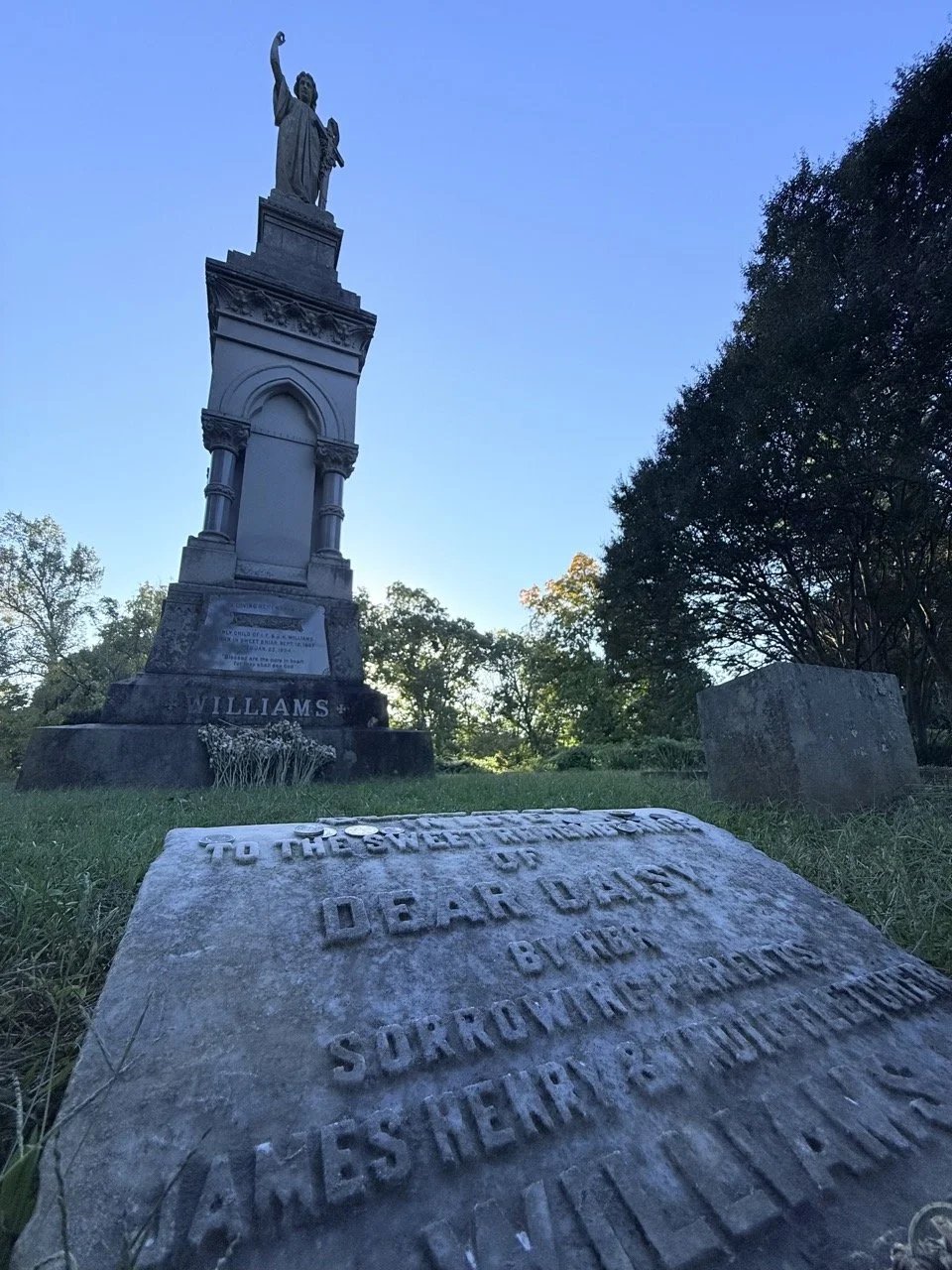
The grave of Daisy Williams, C.W. Bell, 2026
Daisy planted on her own in April. In the northwest corner of the old strawberry bed, she sowed vegetables and other seeds. She also weeded a little garden in the woods. That evening's rain pleased her because the seeds needed it. Within days, the radishes sprouted. Later, dry weather brought the responsibility of watering. She watched flowers with the familiarity of someone who knew where to look. A rare patch of double wild violets grew near a stream. Aunt Lilybell sent pink dogwood, providing a subject for painting. Lilies of the valley reached their finest bloom, then gradually disappeared. Wisteria scented the evening, while lilacs and jasmine furnished strings and wreaths for the house.
Birds added their own announcements. Bluebirds were plentiful early in April. Mockingbirds arrived as the family began sitting on the porch in the evening. Daisy heard a catbird and associated its appearance with the latter part of the month. A young canary hatched. New life appeared in the barns and pastures as well, with colts, calves, and a lamb.
Frisk remained a particular concern. When he vanished for a day, Daisy hoped he would return by nightfall. Uncle Sing eventually brought him back from Aunt Lilybell’s, and they happily reunited. Later, someone was sent to fetch him after another excursion. His burrs, his limp, and where he chose to sleep all mattered. Farm life could be harsh. A cow suffered a broken leg and had to be killed. Kittens died. Daisy and Mary killed a black snake. Caring for animals existed alongside injury and loss, while household routines continued around them.
Those routines depended on many hands. Logan carried goods, fetched supplies, repaired a bull’s yoke, and hauled wood. Ed collected mail and milked cows. Frank and Miller worked in the garden. Washing, ironing, cleaning, planting, and hauling sustained the household and grounds. Mary accompanied Daisy on walks and fishing expeditions, combining shared activity with her place in the household’s work. Martha was ill when Daisy returned. Daisy visited her, took pictures for her, and received a pretty basket. As April progressed, Martha recovered sufficiently to come down to the house and later remain for the day. Their connection took form through visits, concern, gifts, and time spent within reach of one another.
Education continued amid these activities. Daisy practiced music, translated French for Aunt Lilybell, and played sonatas during visits. By early May, she had finished her French grammar. She also fished, helped lengthen her green gingham dress, learned to milk Blossom, and made cake. Her days required movement among study, recreation, creative work, and practical tasks.
On May 12, her father left for New York. His trunk went by wagon, and the household felt his absence. Daisy visited Aunt Lilybell with wildflowers, played music, and translated French. The next day, she and her mother missed him very much. Around them, the season continued. Strawberries ripened in the garden, a calf was born, and they had to clear moths from the carriage cushions. They bought sweet potatoes and tomato plants. Daisy’s bonnet was washed. Then she and Helen climbed a cherry tree in the orchard and gathered ripe red cherries.
Still, so much remained to do. Seeds required watering, flowers invited painting, and lessons waited beside invitations and outdoor plans. At twelve, Daisy moved through a world abundant with small responsibilities and discoveries. Spring gave her something new almost every morning, and she met it with the energy of a child who expected tomorrow to bring another ride, another blossom, another letter from a friend.