

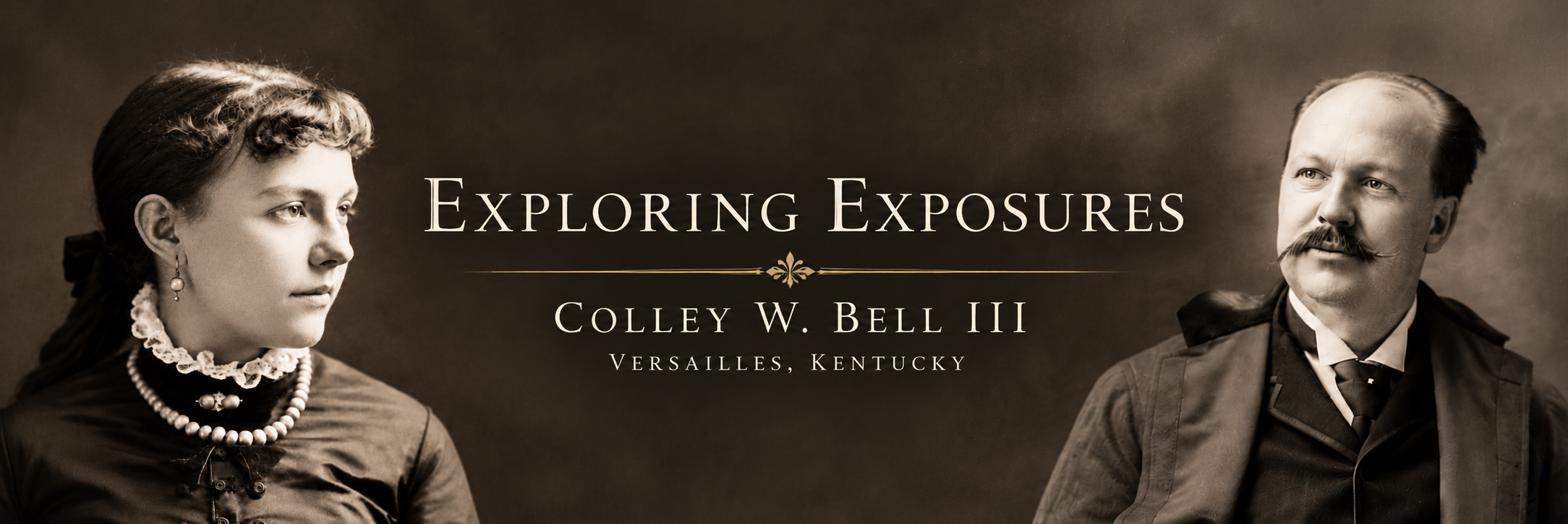
Annie Colley Bell
Entering C.M. Bell’s studio meant taking part in an occasion. Each sitting carried weight for both Bell and the subject, a deliberate moment before the lens fixed what now endures.
Charles Milton Bell
Of the roughly 80,000 negatives produced by the C. M. Bell studio, over 25,000 now reside in the Library of Congress. Even within that remarkable archive, however, identification can be sparse. A name scratched onto a negative may be all that remains. Sometimes there is not even that. From there, the work begins. We first turn to the historical record: newspapers, census records, city directories, genealogical sources, government documents, obituaries, published scholarship, and the scattered fragments of public life through which a name, a face, and a story may once again be joined.
Beginning in 2026, artificial intelligence became part of that research process. It helps locate connections, organize sources, compare records, and develop lines of inquiry. The articles and research presented here have been aided by AI, but AI is not treated as the final authority. Sources are evaluated, claims are checked where possible, and the resulting work is reviewed, thoughtfully compiled, and written and edited before publication. The purpose is not to manufacture certainty where the record does not support it. It is to use every responsible tool available to recover context, test identifications, and distinguish documented fact from reasonable inference. What follows is an effort to restore presence, to move from anonymity toward recognition from silver and glass, and, where the surviving record permits, to return something of a life to the image that once held it.

Ida McKinley: The First Lady Who Outlived Her World
She had buried two daughters before their father entered the White House. She buried an assassinated husband, She held one of the most visible positions in American public life while refusing to surrender entirely to the limitations imposed on her.

Daisy Williams: An 1880 Winter in New York, and a Spring at Sweet Briar
“The Girl Who Became a College.” A narrative of Daisy Williams’s life in the winter and spring of 1880 draws on her diary, transcribed by Tiffany Meadows, Sweet Briar College Class of 2008.

Daniel Wolsey Voorhees | The Tall Sycamore of the Wabash
Voorhees became a major congressional advocate for the Library of Congress and served as chairman of the Senate Committee on the Library.

Henry B. Payne and the Price of a Senate SeatWealth, Standard Oil, and Political Power in Gilded Age America
Payne's case was larger than Payne, as the nineteenth-century method of electing senators increasingly appeared vulnerable to money, corporate influence, and political machines. Legislative deadlocks were common. Accusations of bribery appeared in several states.

Uncle Joe and the Architecture of Power
He became Speaker of the House, presided over one of the greatest concentrations of power ever held by a Speaker, survived a revolt against his authority, served forty-six years in Congress, and eventually had one of the great congressional office buildings on Capitol Hill named for him.

Edith Bolling Wilson: Before the White House, at the Center of Power
She would spend the final thirty-seven years of her life defending Wilson, preserving his papers and possessions, shaping his public memory, and keeping his Washington home almost as a shrine.

Adlai and Letitia Stevenson: A Washington Marriage and an American Political Dynasty
He was a Democrat in a region where Lincoln Republicans were often dominant, yet his personal relationships crossed party lines. In 1874, he won election to the United States House of Representatives.

Frances Hodgson Burnett and the Family Behind the Stories
By the time Burnett published Little Lord Fauntleroy in 1886, the marriage of American wealth to English rank had become one of the most familiar social dramas of the age.

Faith, Politics, and Washington Portraits
The Parkinson family belonged to a generation that had grown up with the memory of migration, persecution, settlement, and the long struggle over Utah's place within the Union. Their religious faith was not a private matter confined to Sunday worship.

Reverend William Hammett Hunter: A Life of Faith in the Service of Freedom

Monticello and Peacefield

Wah Shem Gah and the Kaw Nation: A Portrait of Leadership, Memory, and Survival

The United States Soldiers' Home: A Refuge for Veterans, a Sanctuary for Lincoln, and a Living Piece of American History

John Austin Keliher: From Boston's Immigrant Streets to the Halls of Congress

Jouett Meekin: The Hard Thrower from Kentucky

Between Gettysburg and the West: The Unresolved Fate of Lt. Robert G. McKay

Annie Colley Bell: History Missed Her, The Camera Didn’t

Dr. Mary Edwards Walker, A Life That Refused Permission

George B. Cortelyou, Private Secretary to President McKinley
