Ida McKinley: The First Lady Who Outlived Her World
The extraordinary life, private sorrows, and quiet determination of America's twenty-fifth First Lady
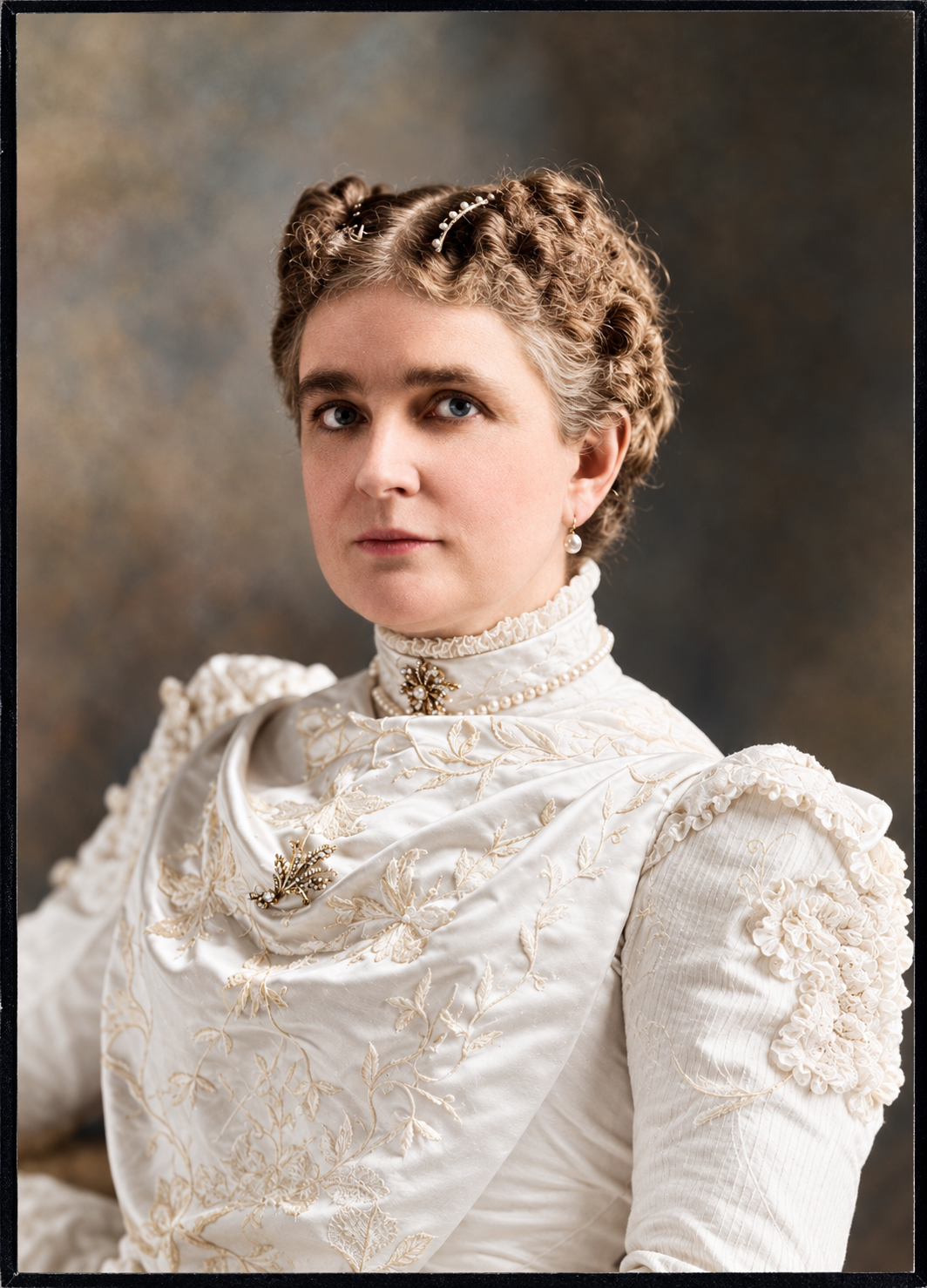
Ida McKinley, remastered and colorized, C.M. Bell Studios, 2025
There is something arresting about the face of Ida Saxton McKinley in the glass negatives preserved in the C. M. Bell studio collection. She looks directly toward the camera, composed and dignified, her hair carefully arranged, her elaborate white dress reflecting the unmistakable elegance of Gilded Age Washington. In another, earlier portrait, dressed in dark velvet and lace, she shows the same quiet assurance. She knew privilege, enjoyed a formidable education, traveled across Europe, and occupied the White House as America emerged as a world power in the 20th century. She had also endured tragedies that would have overwhelmed many others. She lost two daughters in childhood, endured years of debilitating illness, and finally faced the assassination of a husband whose devotion to her was one of the most tender stories in American presidential history. For nearly six years after William McKinley's murder, Ida lived in the shadow of his memory, returning almost daily to the temporary vault where he rested. Her story deserves more than a footnote in a president's biography. It is a story of love, sorrow, endurance, and a woman whose strength has too often been overlooked.
A Daughter of Canton
Ida Saxton was born on June 8, 1847, in Canton, Ohio, into a prosperous and progressive family. Her father, James Saxton, was a successful banker who believed his daughters deserved educational opportunities seldom offered to young women of their generation. Ida was an unusually capable student. She studied mathematics, literature, languages, music, and the arts, receiving an education that prepared her for a world considerably larger than the domestic expectations of nineteenth-century Ohio.
In 1869, Ida and her younger sister, Mary, began an extended journey through Europe. They traveled through England, Ireland, France, Switzerland, Germany, and Italy, encountering Europe's great cultural treasures and observing societies undergoing their own political and industrial transformations. The experience broadened Ida's understanding of the world. She developed interests in art, architecture, and the circumstances of working women, including those employed in the European lace industry. Upon returning to Canton, Ida took an unusual step. She began working at her father's bank.
At a time when respectable young women of comfortable means were generally expected to prepare for marriage, Ida handled accounts and financial transactions. Her father trusted her enough to put her in charge when he was away. In Canton, she attracted the attention of William McKinley, a young attorney and Civil War veteran. McKinley served in the Union Army in the Civil War, rising from an enlisted soldier to brevet major. After the war, he studied law and established himself in Canton, where his intelligence, steady temperament, and considerable personal charm made him a promising young man. They married on January 25, 1871, beginning a partnership that would carry them from a comfortable Ohio household to the highest office in the nation. Neither could have imagined the sorrows awaiting them.
Two Little Girls
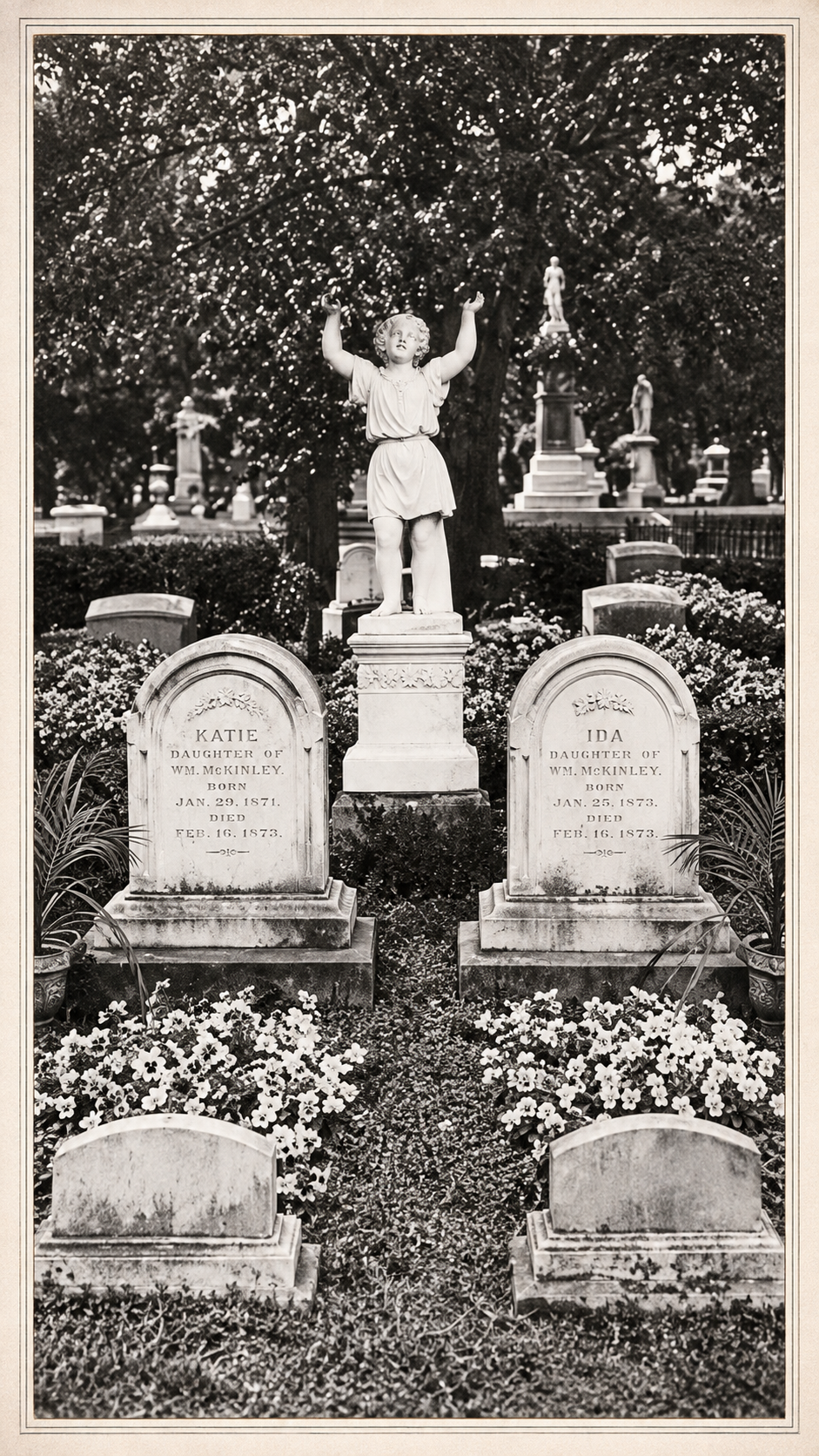
The temporary graves of Katie and Ida, West Lawn Cemetery, Canton, Ohio
Their first daughter, Katherine, known affectionately as Katie, was born on Christmas Day in 1871. For the young couple, it must have seemed an especially happy beginning. William was building his legal and political career, Ida was still a vibrant young woman, and a Christmas baby brought the ordinary pleasures of family life into their Canton home. A second daughter, named Ida after her mother, arrived in April 1873.
The McKinley household now had two little girls, but loss had already overshadowed their happiness. Ida's mother had died only weeks before the second baby's birth, and the pregnancy itself had been difficult. The infant was frail, and during the summer her condition worsened. In August 1873, little Ida died at about four months old. Her parents had scarcely begun to know her. The death of an infant was a terrible sorrow, made all the more frightening by the limited medical understanding of the age. We sometimes forget how precarious childhood could be in nineteenth-century America. A fever that we could diagnose and treat within hours today could become a desperate struggle lasting days or weeks. Typhoid fever, diphtheria, scarlet fever, measles, cholera, and gastrointestinal infections claimed thousands of young lives.
People could not take clean drinking water for granted. Germ theory was still gaining acceptance, antibiotics lay generations in the future, and even the most conscientious physicians possessed few reliable means of combating serious infection. Parents knew the familiar rituals of illness: a damp cloth upon a fevered forehead, a bedside vigil stretching through the night, whispered conversations with the family doctor, and the terrible uncertainty of whether a child would survive until morning.
Money and social position offered some protection. They could provide better housing, attentive nursing, and access to physicians. They could not guarantee a child's survival. The McKinleys knew that truth firsthand. For two more years, Katie remained the bright center of their family. One might imagine the little girl moving through their Canton home, her father returning from work, her mother tending to the countless routines of life. Such moments made up this precious family life that may have seemed so ordinary. Then Katie became seriously ill.
Accounts differ regarding the exact nature of her illness, with childhood fever and an underlying heart condition among the explanations offered by historians. Whatever the cause, she died on June 25, 1875, six months before her fifth birthday. William and Ida had now buried both their children in West Lawn Cemetery in Canton, Ohio.. The house that had once held the voices of two little girls was silent. No first days of school, no daughters growing into young women, no marriages, and no grandchildren gathering around the family table.
For the McKinleys, parenthood had lasted less than five years, yet its losses would accompany them for the remainder of their lives. In our own time, when modern medicine has made childhood survival so much more likely, it is difficult to recover the emotional landscape of an age in which parents lived with the possibility of losing a child to an illness they could neither understand nor stop. Nor should we mistake the frequency of childhood death for an absence of grief. Parents in the nineteenth century loved their children no less deeply than parents today.
For Ida, the deaths came amid serious physical difficulties of her own. Complications associated with her second pregnancy, earlier injuries, and the accumulated strain of family losses contributed to a marked deterioration in her health. She began experiencing recurring seizures, severe headaches, and periods of muscular weakness. The precise medical origins of her condition remain uncertain, although epilepsy has long been associated with her symptoms. Nineteenth-century medicine offered little relief. Physicians prescribed treatments that sometimes left her sedated, weakened, and increasingly dependent upon others. It was an especially cruel reversal for a woman who had once climbed mountains in Switzerland, traveled independently, and enjoyed the intellectual freedom her father encouraged. The McKinleys eventually gave up their newlywed home, a place burdened with too many memories, but their marriage endured for years to come.
William remained attentive to Ida's needs, frequently adjusting his schedule and public obligations to accommodate her health. Through his years in Congress, as governor of Ohio, and eventually as president, he was her companion, protector, and confidant. Their marriage became a familiar subject of admiration. It also became a partnership through which Ida continued to exercise considerable influence.
A First Lady in the Gilded Age
By the time William McKinley entered the White House in March 1897, the United States was entering an era of extraordinary economic ambition and international consequence. The country was becoming an industrial giant. Great fortunes were being assembled, new technologies were transforming daily life, and Gilded Age wealth and ambition increasingly shaped Washington society. Ida McKinley occupied a prominent place in this world. She appeared at receptions dressed in magnificent gowns, often seated because standing for extended periods was difficult. At formal dinners, she sat beside her husband, a departure from custom, so he could assist her if needed. Her disability was a subject the couple handled with discretion.
When Ida experienced a seizure, William sometimes shielded her face with a handkerchief until the episode passed. Those around them generally understood the need for privacy. Yet the conventional description of Ida as a helpless invalid tells only part of her story. She followed politics closely and advised her husband. She remained interested in women's suffrage, corresponded with reformers, and supported charitable causes. She was also an accomplished needleworker, producing thousands of crocheted slippers for friends and to raise funds for charities.
Her health varied, sometimes dramatically. During better periods, she traveled, attended public events, and participated actively in the social obligations of the presidency. For a woman contemporaries so often described as incapable, it was a remarkable life. The photographs preserved in the Bell collection invite us to look beyond the conventional judgments of her generation. Her expression shows poise, her eyes intelligence, and an unmistakable determination to present herself on her own terms.
The Last Days in Buffalo
On September 6, 1901, President McKinley attended the Pan-American Exposition in Buffalo, New York. The exposition celebrated technological progress, industrial achievement, and America's growing place in the modern world. The president was greeting visitors inside the Temple of Music when an anarchist, Leon Czolgosz, approached and fired two shots at close range. McKinley was gravely wounded. Ida was elsewhere in Buffalo when the shooting occurred. Even in the confusion of those first moments, the president worried about how the news would reach his wife. He knew how such a shock might affect her. For several days, Americans hoped that McKinley would survive. Early medical reports encouraged optimism, and the president appeared to be recovering. Then infection developed, and his condition deteriorated rapidly.
Ida stayed by his side in his final days, showing a composure that surprised those who had come to see her as entirely dependent on her husband. William McKinley died on September 14, 1901, at 58. His death brought Theodore Roosevelt to the presidency and, with it, a new, commanding personality to the American stage. Roosevelt's extraordinary energy, political ambition, and larger-than-life presence would come to dominate the historical imagination, gradually casting a shadow over McKinley's considerable achievements. Yet McKinley presided over America's emergence as a world power, guided the nation through war, and helped lay the economic and political foundations Roosevelt would build on. Amid Roosevelt's later fame, McKinley's quieter but consequential presidency too often fades from view.
His death placed Theodore Roosevelt in the presidency and brought a sudden end to an administration that had presided over the Spanish-American War, overseas expansion, and a dramatic transformation in America's international position. For Ida, the political consequences could scarcely have mattered. She had lost the man with whom she had shared thirty years of marriage, the man who had stood beside her through the deaths of their daughters, and the companion who had organized much of his life around her comfort and security. And at the age of 55, she faced a world emptied by death.
The Long Journey Home
The president's body was carried from Buffalo to Washington, where the nation paid its respects, and finally back to Canton, the Ohio city where the McKinleys' story had begun. Thousands gathered along the funeral route. Flags hung at half-staff, public buildings were draped in mourning, and Americans of every station came forward to honor the fallen president. Ida accompanied her husband's remains home, although she did not attend the funeral ceremonies in Canton. They placed him in a temporary receiving vault at West Lawn Cemetery while they planned a permanent national memorial.
The temporary tomb was a modest stone structure, guarded by soldiers at its entrance and decorated with patriotic mourning bunting. Historic photographs show ivy climbing over its walls, trees surrounding the building, and a uniformed sentry standing beside the entrance. The scene is remarkably quiet, and one can imagine autumn leaves stirring above the stone roof and footsteps approaching the entrance. Here, away from Washington's ceremonies and the headlines of a grieving nation, Ida McKinley returned again and again.
For the first several years of her widowhood, she visited her husband's temporary resting place almost daily. The visits became a ritual of remembrance. We cannot know precisely what she thought during those visits. Perhaps she remembered their courtship in Canton, their early happiness as parents, the long congressional years in Washington, or the terrible September days in Buffalo. And perhaps she thought of Katie and little Ida, the daughters whose absence had shaped so much of their life together. What we do know is that her devotion continued long after the ceremonies ended and the nation returned to its ordinary affairs. The presidency had passed to another man. Ida's attachment to William McKinley remained the organizing presence of her life.
Life After the White House
After returning to Canton, Ida moved into the house that had served as the headquarters of her husband's celebrated front-porch presidential campaign. Her younger sister, Mary Saxton Barber, and Mary's family supported her, having long provided companionship and assistance. For a time, Ida withdrew from public life.
The familiar domestic world of Canton offered protection from the demands of Washington and from the constant reminders of the tragedy in Buffalo. Yet it would be a mistake to imagine that she spent her remaining years entirely isolated. As the first years of mourning passed, Ida gradually resumed activities she had enjoyed throughout her life. She visited relatives, maintained friendships, and returned to the theater, an entertainment she had always loved. She remained interested in public affairs and occasionally used her influence to assist others.
The woman remembered primarily for her physical limitations continued to demonstrate an independence of mind that had distinguished her long before she became First Lady. Loneliness was undoubtedly present, and her health imposed limitations. Yet the surviving record suggests a life more varied than the traditional portrait of a permanently secluded widow. She had known extraordinary privilege and equally extraordinary grief. Now she sought some measure of continuity among the familiar streets, houses, and people of Canton. Her husband's grave remained central to that existence.
A Monument on the Hill
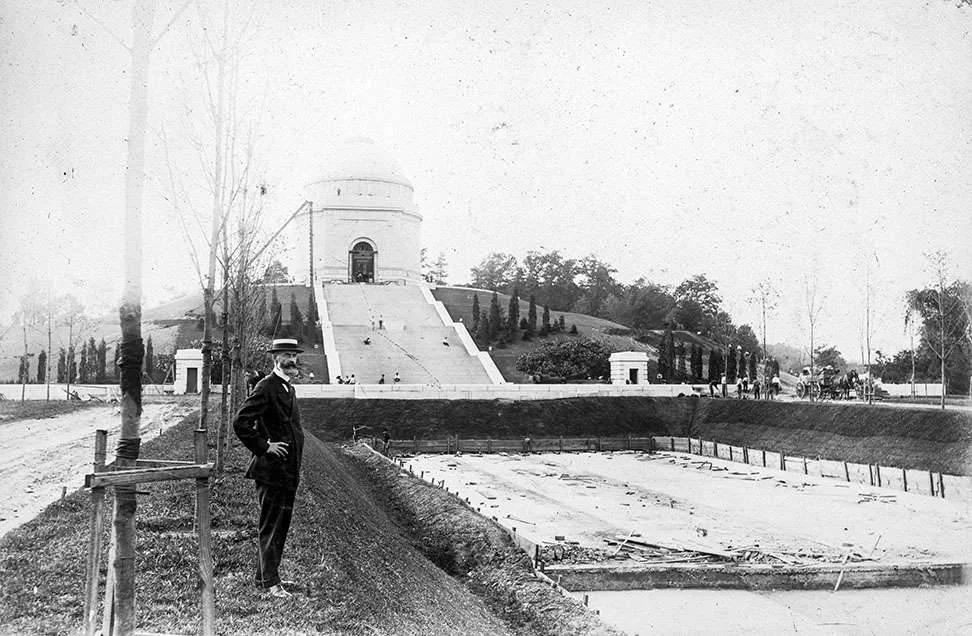
The McKinley Tomb, 1907
Almost immediately after McKinley's assassination, friends and political associates began planning a suitable national memorial. The undertaking reflected both the stature of the murdered president and the enormous affection with which Canton regarded its most celebrated citizen. They chose a commanding hill overlooking West Lawn Cemetery. Architect Harold Van Buren Magonigle designed an imposing circular mausoleum of granite and marble, approached by a monumental flight of steps.
Construction began in 1905. The memorial would become one of the most recognizable presidential tombs in the United States, a great domed structure rising above the landscape. Ida followed the project closely, attended the cornerstone ceremony in November 1905, and tracked the progress of the building that would eventually house her husband's remains.
In surviving photographs, the unfinished grounds seem almost stark. The broad staircase rises toward the circular monument, while workers and visitors appear as small figures against the massive structure. Other photographs record the tomb's interior, where two great sarcophagi would eventually occupy the central chamber. One would bear the name William McKinley. The other, Ida McKinley. The remains of their daughters would also be placed within the memorial.
The surviving photograph of Katie and little Ida's original graves is deeply moving. Two small headstones stand amid flowers and greenery, reminders that long before a nation mourned its president, a father and mother had mourned their children. The grand memorial on the hill would eventually bring all four family members together. But Ida would never witness its dedication.
The Final Spring
By the spring of 1907, Ida's health had again declined. Nearly six years had passed since the assassination. The former First Lady remained in Canton, surrounded by familiar people and places, as preparations continued to complete the memorial. She died on May 26, 1907, following an illness believed to have been influenza. She was 59, less than two weeks from her 60th birthday.
The monument on the hill was still unfinished. In September, four months after her death, they dedicated the completed McKinley National Memorial before a large gathering that included President Theodore Roosevelt. The president who had succeeded William McKinley now honored his predecessor in the city where McKinley had made his home. Inside the memorial, William and Ida would rest together, with their daughters nearby.
The family that had suffered so much separation in life was finally reunited in one place. Today, visitors climbing the great stone steps enter a chamber of remarkable simplicity and solemnity. The massive sarcophagi stand at its center, surrounded by pale stone walls and the imposing architecture of the dome - it is “presidential.” But it is also a memorial to a marriage, to two children whose lives were painfully brief, and to a woman who endured the loss of all three.
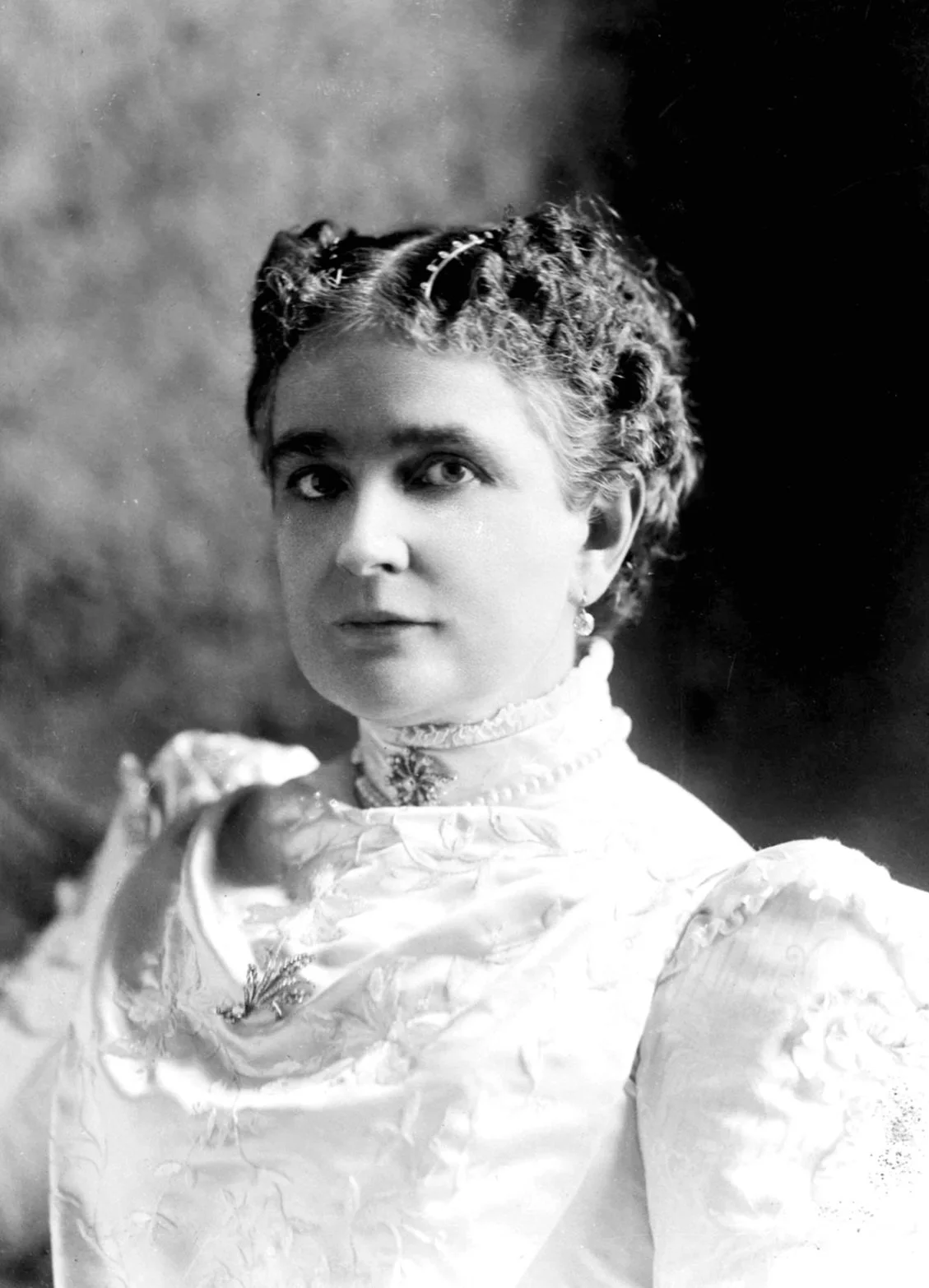
Ida McKinley, photo by C.M. Bell, c. 1893
The Woman in the Photograph
We finally return to the photographs. The glass negatives associated with the C. M. Bell Studio preserve something that marble monuments and official biographies cannot. They allow us to encounter the human presence of another age. In the portrait of Ida McKinley wearing white, the elaborate embroidery, high collar, carefully arranged hair, and restrained jewelry speak to the tastes and conventions of Gilded Age society. Yet her expression commands attention beyond the beautiful costume. Here was a woman who had once traveled through Europe as an adventurous young American, managed accounts at her father's bank, and became the wife and political confidante of a future president.
She had buried two daughters before their father entered the White House. She had endured illnesses poorly understood by her contemporaries and treatments that sometimes made her condition worse. She held one of the most visible positions in American public life while refusing to surrender entirely to the limitations imposed on her. The photographs preserve her before the final tragedy of September 1901. The images of the daughters' graves, the temporary vault, and the great unfinished memorial carry the story toward its inevitable conclusion. Taken together, they offer a moving photographic narrative.
In the glass negatives of C. M. Bell's Washington studio, she remains before us, composed and elegant, her gaze directed toward a future neither she nor the photographer could have foreseen. More than a century later, we are reminded that behind the public histories of presidents and nations lie deeply personal stories of people who loved, suffered, persevered, and carried on.
Ida McKinley was one of them.
Her story deserves to be remembered.