From the missionary communities of the Ottoman Empire to the frontier courts of Kansas, from the Supreme Court of the Gilded Age to the constitutional debates of the twenty-first century, David Josiah Brewer's story spans generations of American history.
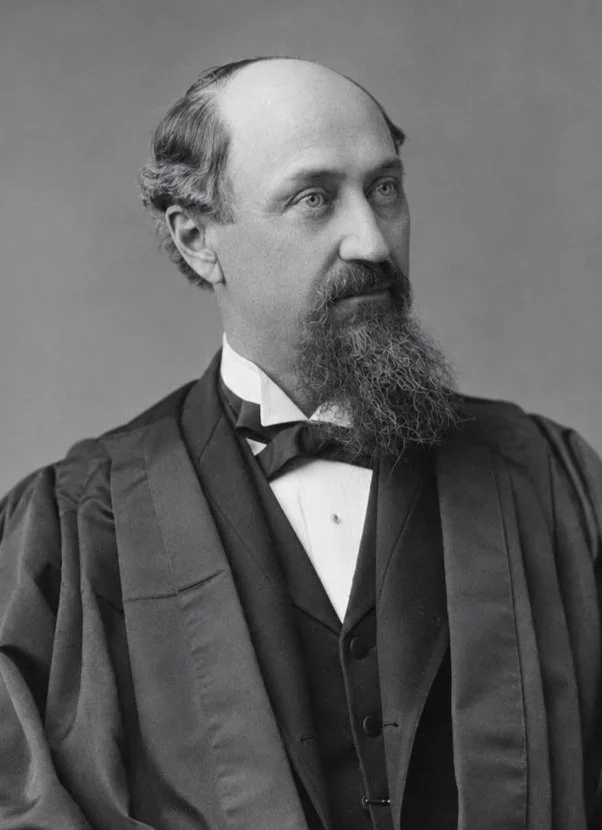
David Josiah Brewer, Justice, U.S. Supreme Court
David was born into a household where religious faith, education, public responsibility, and intellectual ambition were central to family life. On the Aegean coast of Turkey, on June 20, 1837, in the ancient port of Smyrna, David Josiah Brewer was born into an American family whose influence would eventually reach the United States' highest court. Smyrna, now İzmir, Turkey, was then part of the Ottoman Empire, a meeting place of civilizations, religions, languages, and commercial interests. American missionaries had traveled there to establish schools, spread Protestant Christianity, revitalize ancient Eastern Christian communities, particularly the Armenians and Greeks, and participate in the educational and religious movements of the nineteenth century. Among them was the Reverend Josiah Brewer, David's father, a Congregationalist minister educated at Yale. His mother, Emilia Ann Field Brewer, belonged to an extraordinary New England family whose sons would distinguish themselves in law, communications, religion, and public affairs.
The expansive roots of this Brewer family tree ran deep; his maternal grandfather, the Reverend David Dudley Field Sr., was a Congregational minister in Stockbridge, Massachusetts. Among the grandfather's children and David’s uncles were four men whose careers would help define nineteenth-century America. David Dudley Field II became one of the country's influential legal reformers, associated with efforts to codify legal procedure. Cyrus West Field helped organize the enterprise that successfully connected North America and Europe by transatlantic telegraph cable. Henry Martyn Field became a prominent clergyman and religious writer. Stephen Johnson Field traveled west, helped shape California's early legal institutions, and eventually became a justice of the United States Supreme Court. It was a remarkable inheritance. Law, religion, technological innovation, and national expansion were represented within his immediate family. The Field family stood at the intersection of several transformations that were remaking the United States.
In 1838, when young David was about a year old, his parents returned to New England so he could spend his childhood in Connecticut. It was an age of evangelical revivalism that shaped what would become known as the Second Great Awakening. His father served in religious and educational roles, including a period as chaplain of the state prison at Wethersfield. The elder Brewer was involved in antislavery work and education. These interests provided an important moral background to the younger Brewer's development, although David's eventual judicial record would reveal substantial tensions between the ideals of individual liberty and the limitations of nineteenth-century constitutional law.
The future justice attended Wesleyan University before transferring to Yale College, graduating in 1856. He studied law with his uncle David Dudley Field and completed his legal education at Albany Law School in 1858. He had been born abroad, raised in New England, and educated among some of America's most influential intellectual families. His future, however, lay on the frontier
Brewers of Kansas
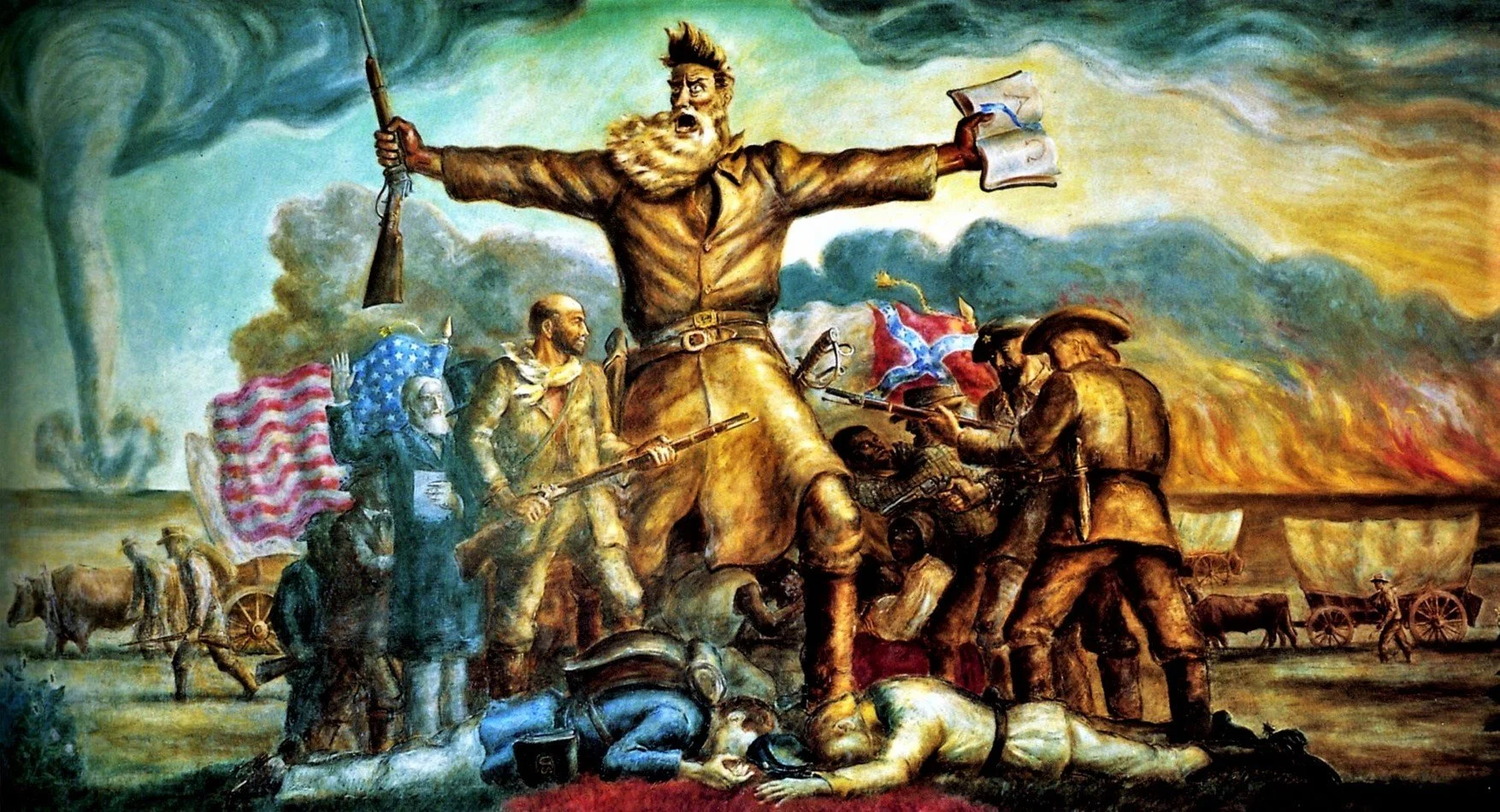
"Tragic Prelude," a painting by John Steuart Curry, depicts John Brown leading the anti-slavery movement in the Kansas Territory before the Civil War.
Kansas Historical Society
In 1859, David Brewer settled in Leavenworth, Kansas Territory. The timing was dubious, as Kansas was in the throes of its own Civil War, Bleeding Kansas. The newly formed state was emerging from one of the most violent political struggles in American history. During the preceding decade, proslavery and antislavery settlers had fought over whether the territory would enter the Union as a free or slave state. The violence of guns and broadswords made the territory a national symbol of the coming Civil War.
For a young lawyer, Kansas offered professional opportunities and direct exposure to the republic's most difficult questions. Brewer established a legal practice in Leavenworth. His career advanced rapidly. He became a federal circuit court commissioner, served as a probate and criminal judge, and then held a district judgeship. By 1870, he had been elected to the Kansas Supreme Court and had served for fourteen years. The responsibilities of a frontier judge were different from those of a justice working in Washington. Kansas was developing its legal institutions while railroads, agricultural interests, commercial enterprises, and new communities competed for resources and influence. Questions of property, contracts, public authority, and personal freedom were immediate and practical.
Brewer developed a strong belief that courts had a responsibility to protect individual rights from arbitrary government action. That philosophy would become central to his later opinions. He also participated earnestly in public education. In 1869, he served as president of the Kansas State Teachers' Association, and he was involved in the Leavenworth school system. His commitment to education reflected the family tradition he came from.
In 1884, President Chester A. Arthur appointed the 52-year-old Brewer to the federal circuit bench for the Eighth Circuit. Five years later, President Benjamin Harrison nominated him to the United States Supreme Court. The Senate confirmed him on December 18, 1889, and he took the judicial oath on January 6, 1890. His uncle Stephen J. Field was already serving on the Court. Their overlapping service created an unusual family connection within one of the country's most powerful institutions. Brewer would remain a Supreme Court justice for the next twenty years, until his death in 1910.
The Supreme Court in an Age of Great Change
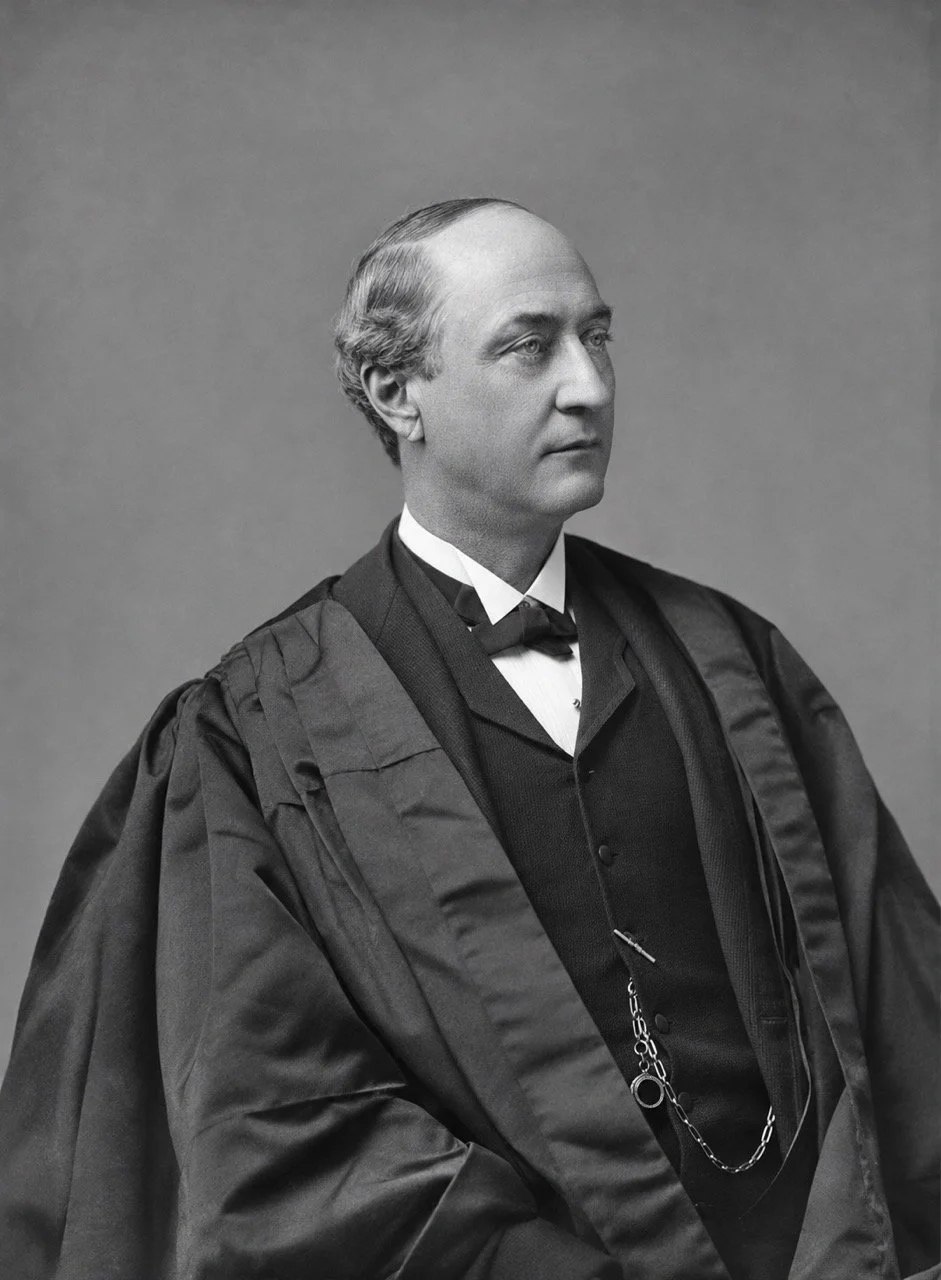
David Josiah Brewer, Justice, U.S. Supreme Court
The America that welcomed David Brewer to the Supreme Court in 1890 was experiencing extraordinary economic and social change. Railroads connected distant regions. Industrial corporations amassed unprecedented wealth. Immigration transformed cities. Labor unions challenged working conditions. African Americans struggled to preserve the citizenship rights promised after the Civil War. The constitutional system, designed in the eighteenth century, was being asked to govern an industrial nation. Brewer served during the period known as the Fuller Court, named for Chief Justice Melville Weston Fuller.
The Court frequently confronted disputes over the proper relationship between private property, corporate power, federal authority, and state regulation. Brewer believed strongly in the constitutional protection of individual liberty, including property and contractual rights. He was skeptical of government interference in economic arrangements and often supported judicial limitations on regulatory legislation. His jurisprudence was not entirely predictable, as it helped shape the constitutional understanding of the Gilded Age.
At times he defended personal liberty against the federal government. At other times, he supported far-reaching federal authority. He could be sympathetic to vulnerable individuals while accepting legal distinctions that modern Americans recognize as discriminatory. His opinions reflected the intellectual commitments and contradictions of his generation. Understanding David Brewer therefore requires examining individual cases, the problems they addressed, and the constitutional consequences they produced.
The Historic Cases of Justice Brewer
Holy Trinity Church v. United States (1892): Religion and the Meaning of American Law
One of Brewer's most frequently discussed opinions arose from a seemingly ordinary employment dispute. The Church of the Holy Trinity in New York had contracted with an English clergyman to serve as its rector. Federal officials argued that the arrangement violated the Alien Contract Labor Law of 1885, which restricted the importation of foreign workers under employment contracts. Writing for the Supreme Court in 1892, Brewer concluded that Congress had not intended the statute to prohibit a church from employing a foreign minister.
His reasoning went beyond the narrow dispute. He examined the history of American religious institutions, public traditions, and legislative practice, arguing that the nation's religious background helped explain Congress's intent. In the opinion, he described the United States as a Christian nation, a statement that would become one of his most enduring and controversial judicial expressions. The decision remains important in debates about statutory interpretation, particularly whether judges should rely primarily on a statute's words or consider its broader purpose and historical context.
Brewer's observation about Christianity was part of his explanation of national history and statutory purpose. The case did not establish Christianity as the country's official religion. The distinction matters today because Brewer's language still appears in discussions of religious liberty and the relationship between church and state.
The Debs Case (1895): The Federal Government and the Pullman Strike
In 1894, an industrial conflict involving the Pullman Palace Car Company developed into one of the most significant labor confrontations in American history. Workers protesting wage reductions found support from the American Railway Union, led by Eugene V. Debs. The resulting boycott disrupted rail transportation across much of the country. President Grover Cleveland's administration intervened, arguing that the disruption threatened interstate commerce and the movement of federal mail. A federal injunction was issued against the strike's leadership. Debs and others defied the order and were imprisoned for contempt.
When the case reached the Supreme Court, Justice Brewer wrote the unanimous opinion sustaining federal authority to intervene. The decision recognized the national government's power to protect interstate transportation and the mail from obstruction, including through federal court injunctions. The case strengthened federal authority at a time when the relationship between organized labor, industrial corporations, and the national government was being contested. For organized labor, the decision demonstrated how federal judicial power could be used to restrain strikes. For supporters of federal authority, it affirmed the government's responsibility to preserve essential national transportation systems. Brewer's opinion also revealed an important characteristic of his constitutional philosophy. His skepticism toward certain government regulations did not prevent him from endorsing substantial federal intervention when he believed the Constitution authorized it.
Muller v. Oregon (1908): Women, Labor, and Social Science
Perhaps Brewer's most historically influential opinion came in 1908. Oregon had enacted legislation limiting women employed in factories, laundries, and certain other workplaces to ten hours of labor per day. A laundry owner, Curt Muller, challenged the law, arguing that it violated the constitutional freedom to make employment contracts. The case reached the Supreme Court during a period when many judges viewed economic regulation with suspicion.
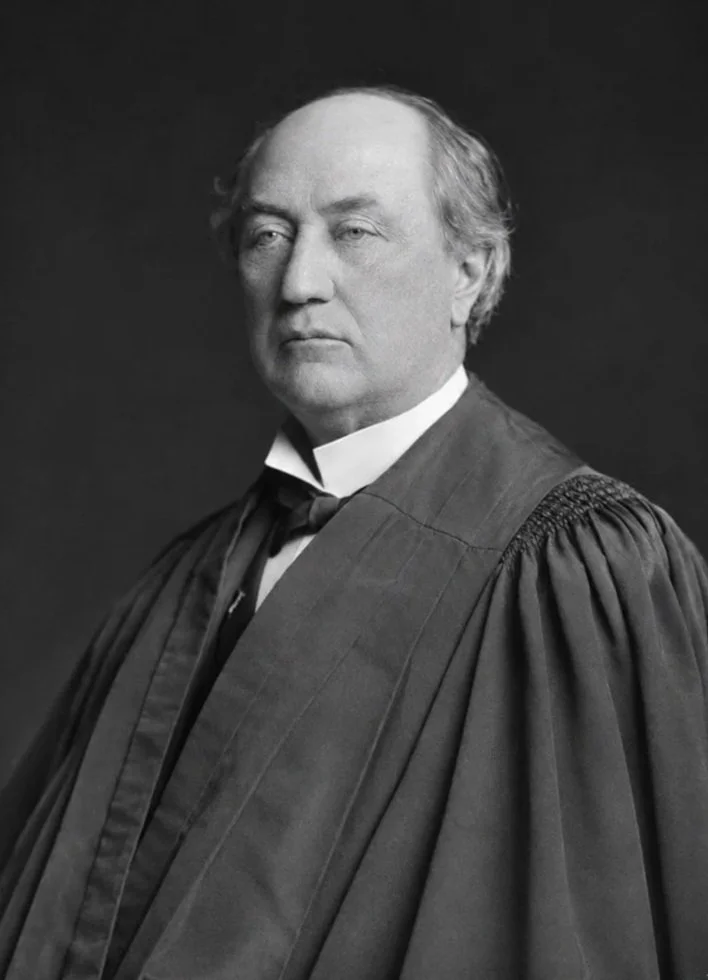
David Josiah Brewer, Justice, U.S. Supreme Court
Louis D. Brandeis, who would later become a Supreme Court justice, presented an unusually extensive legal brief that incorporated medical research, social studies, and evidence about industrial working conditions. The submission became famous as the Brandeis Brief. Brewer wrote the unanimous opinion upholding Oregon's law. He concluded that the state could regulate women's working hours because of concerns about their health and maternal responsibilities.
The decision marked an important development in constitutional law. It demonstrated how empirical evidence about social conditions could influence judicial consideration of regulatory legislation. Yet the reasoning was deeply connected to the gender assumptions of its time. Brewer considered women physically different from men and treated their expected responsibilities as mothers as a justification for special legislation. Later generations would question whether such protection also reinforced women's exclusion from equal economic opportunities.
The case illustrates a recurring problem in American reform history. Legislation intended to improve working conditions can simultaneously preserve social assumptions that restrict personal freedom. In 2009, Justice Ruth Bader Ginsburg examined this history in a lecture tracing the development of protective labor legislation into modern approaches to employment equality and family leave. More than a century after Brewer's decision, Muller remains a central example in discussions of women's legal status, workplace protection, and constitutional equality.
Kansas v. Colorado (1907): The Law of Shared Water
Brewer's work also extended to an issue that has only become more important in contemporary America: the allocation of water between states. Kansas and Colorado disputed the use of the Arkansas River. Colorado's upstream irrigation development affected water availability downstream in Kansas. The litigation required the Court to consider how competing states could exercise their rights over a shared natural resource. Brewer's opinion contributed to the development of equitable principles for resolving interstate water disputes. The Court weighed competing interests and evidence of injury rather than recognizing an absolute entitlement for either state.
The principle of equitable apportionment would become central to the Supreme Court's treatment of interstate water controversies. As drought, agricultural demand, urban development, and environmental pressures continue to strain American rivers, the legal questions addressed during Brewer's era remain relevant. His contribution reaches beyond the nineteenth-century industrial order into modern natural-resource law.
Lochner v. New York (1905): Economic Liberty and Constitutional Limits
Brewer also joined the majority in Lochner v. New York, which struck down a New York statute limiting the working hours of bakery employees. The Court reasoned that the law interfered with a constitutional liberty of contract. The ruling became closely associated with an era of judicial intervention against economic regulation. For many twentieth-century reformers, Lochner symbolized the judiciary's willingness to protect contractual freedom in ways that limited government responses to industrial working conditions. During the constitutional transformation of the New Deal era, the Supreme Court moved away from that approach, particularly in its 1937 decision in West Coast Hotel Co. v. Parrish.
Brewer's involvement places him within a continuing constitutional debate: how much authority should elected legislatures possess to regulate economic relationships, and when should courts intervene to protect individual liberty?
These questions have not disappeared, even as the legal doctrines governing them have changed.
Race, Segregation, and the Limits of His Jurisprudence
A complete account of Brewer must confront his decisions involving race. In Hodges v. United States (1906), Brewer wrote an opinion restricting the federal government's authority to prosecute private racial intimidation directed against Black workers. In Berea College v. Kentucky (1908), he wrote the Court's opinion sustaining the application of a state law prohibiting interracial education to an incorporated private college. The decision was a serious setback for Berea College, an institution founded in Kentucky upon a commitment to interracial education. These rulings contributed to the legal environment in which racial segregation and discrimination remained deeply entrenched.
Brewer's record was more complicated in cases involving Asian immigrants. He dissented in several decisions restricting procedural protections or judicial access for Chinese immigrants, expressing concern about the treatment of individuals under exclusion and deportation laws. One particularly important clarification concerns Plessy v. Ferguson (1896), the Supreme Court decision that approved state-mandated racial segregation in railway accommodations. Brewer did not participate in that decision. The Court's official record establishes his absence from its consideration. It would therefore be inaccurate to count him among the justices who approved the ruling or to assume how he would have voted.
His broader civil-rights record contains decisions that deserve critical examination, including those that limited protection against racial discrimination. His judicial legacy must be understood through the full record of his decisions, including their lasting consequences.
The Brewer Household: Marriage, Daughters, and Washington Society
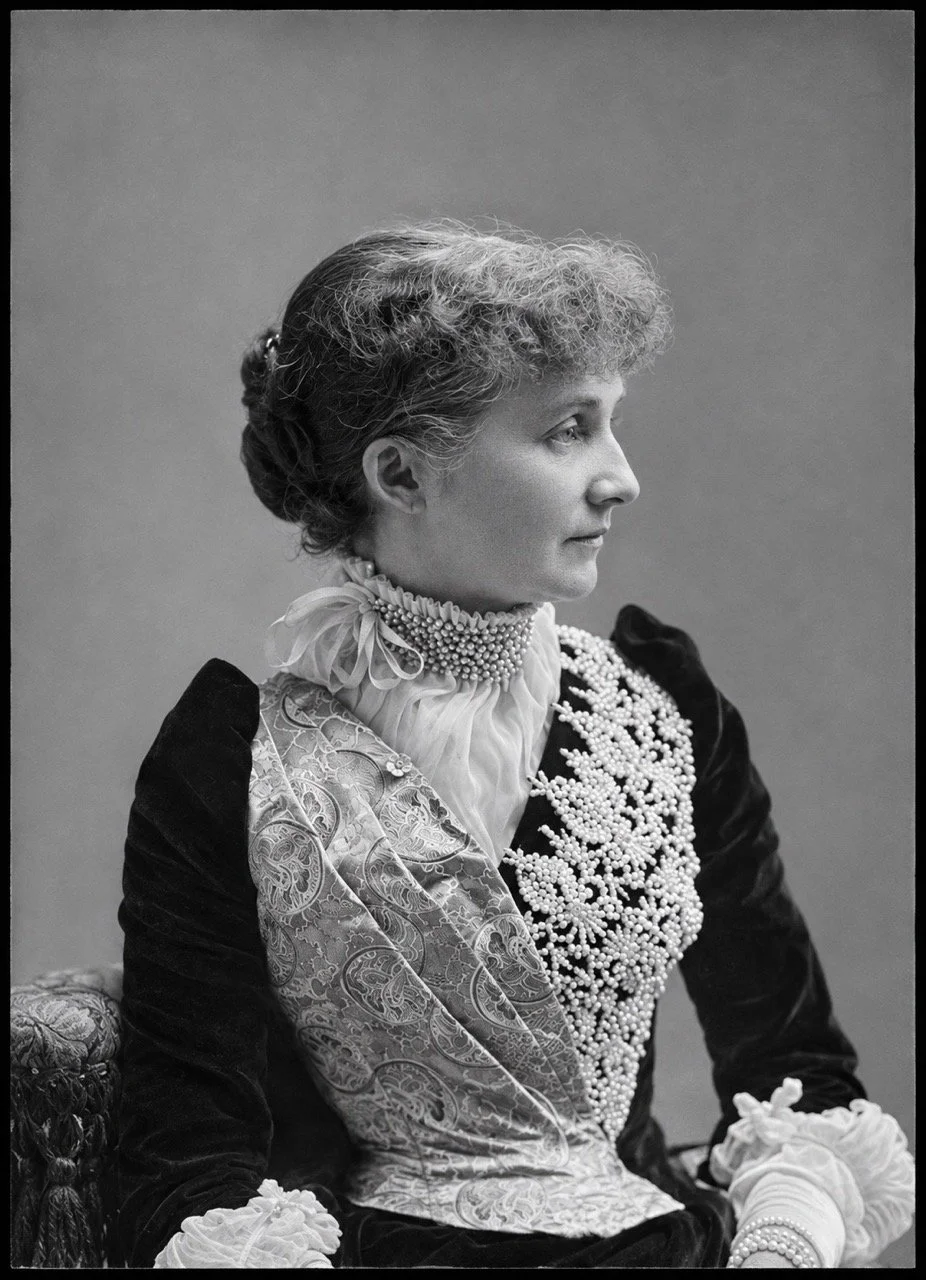
Louise Brewer
Behind Justice Brewer's public career stood a family whose history reveals another dimension of the Gilded Age. On October 3, 1861, Brewer married Louise R. Landon of Burlington, Vermont. Their marriage began during the opening months of the Civil War, when the United States faced the possibility of national disintegration. Together, they raised four daughters, whose lives would connect the Brewer household to families and communities across the country. Their children were Harriet Eurelia, Henrietta Louise, Frances Adele, and Elizabeth.
The eldest, Harriet Eurelia Brewer, was born July 21, 1863. She married A. P. Jetmore in 1889. Henrietta Louise Brewer, born December 2, 1865, married James Lawson Karrick in 1892. Frances Adele Brewer was born August 26, 1870. Elizabeth Brewer, born February 16, 1875, became affectionately known as Bessie. She would marry Wellington Wells in 1904.
The daughters were raised in a family that combined Midwestern public service with New England intellectual and religious traditions. When Brewer joined the Supreme Court, the family's social world expanded to Washington, D.C., where the capital's political, judicial, diplomatic, and cultural circles overlapped. For the women of such households, the social calendar could include receptions, church gatherings, musical events, charitable organizations, and visits between families.
Studio photography was an important part of this world.
The portraits preserved from the period, including those associated with the C. M. Bell photographic studio, offer an unusual opportunity to examine the Brewer family as individuals rather than merely as relatives of a celebrated judge. They record details that written biographies frequently overlook: the expressions of young women, their clothing, their companions, and the deliberate presentation of family relationships before the camera. These images are especially valuable because the surviving public historical record tends to emphasize the careers of prominent men.
Photographs can help restore the women of a household to the historical narrative, although appearances alone cannot establish personalities, relationships, or the circumstances of a sitting. Family correspondence and archival records provide the strongest basis for understanding the lives behind the portraits.
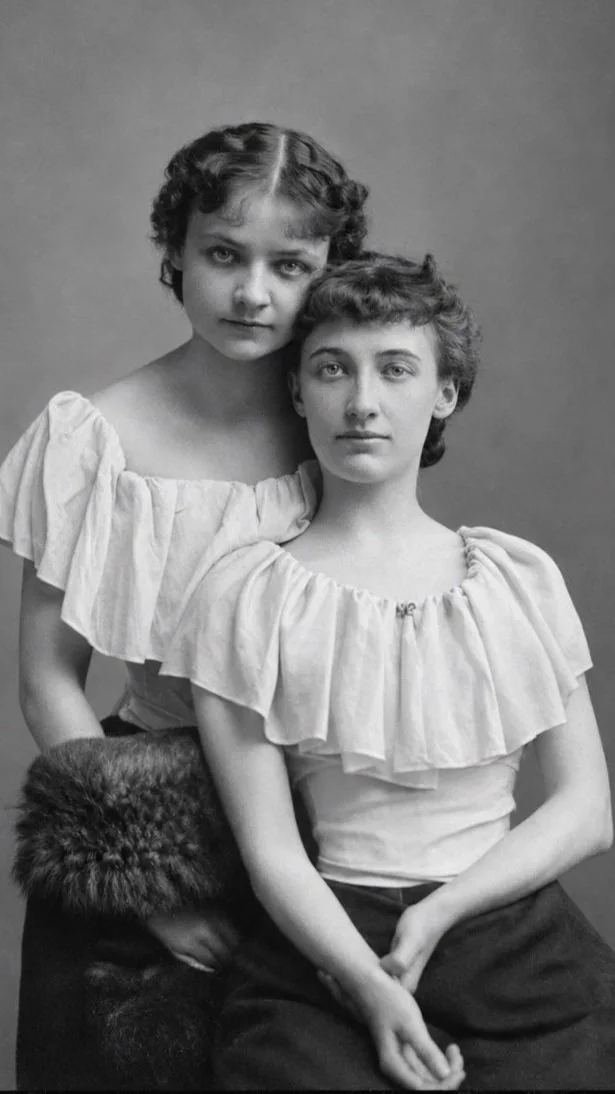
Bessie and Frances, c. 1892
The Brewer family experienced significant personal losses.
Frances Adele died on May 11, 1896, at only 25. Two years later, Louise Landon Brewer died on April 3, 1898, ending a marriage of more than thirty-six years. In 1901, the widowed justice married Emma Miner Mott of Washington. Emma's surviving scrapbooks, preserved among the Brewer family papers at Yale, contain materials relating to her marriage and Washington social activities. The collection provides a documentary window into the private life of a Supreme Court household during the early twentieth century.
The family had experienced prosperity, public recognition, and personal sorrow. Its history, like that of many prominent nineteenth-century households, was shaped by marriage, childbirth, illness, bereavement, and the continuing obligations of kinship.
Bessie Brewer Wells and the Next Generation
Among the Brewer daughters, Elizabeth, known as Bessie, offers a particularly compelling connection between the nineteenth-century family and the twentieth century. Born in Kansas in 1875, Bessie spent her childhood during her father's ascent through the judicial system. She was fourteen when President Harrison nominated him to the Supreme Court. Her adolescence therefore coincided with the family's emergence into Washington society.
Photographs of Bessie and her companions from the 1890s reveal the carefully arranged visual culture of young women of her generation. Group portraits often captured friendships and social associations otherwise poorly represented in historical records. In 1904, Bessie married Wellington Wells of Boston, MA. Their three children carried the family into the twentieth century. Henrietta Wells was born November 10, 1905. Wellington Wells Jr. followed on January 20, 1908, and Virginia Wells was born December 21, 1912.
Bessie's life, however, was brief. She died June 25, 1919, aged forty-four, leaving three children. Her death occurred less than a decade after her father's passing and shortly after the conclusion of the First World War, during a period of enormous social transformation. Her children would grow up in an America increasingly defined by automobiles, radio, mass communication, women's suffrage, and changing social expectations. Bessie's surviving portraits preserve the image of a young woman whose descendants would inhabit a different world from the one she was raised in.
A Family Legacy Across Generations
The Brewer family did not end with the justice's death. A published Landon family genealogy identifies children in three of his daughters' families, providing a documented starting point for following the bloodline into the twentieth century. The names Jetmore, Karrick, and Wells matter because a family's history cannot always be traced through its original surname. Marriage, migration, and the creation of new households carry family connections into communities far removed from their origins. By the early twentieth century, Brewer's grandchildren belonged to the generation that would experience two world wars, the Great Depression, and the rise of modern America.
Their children and grandchildren, where the family lines continued, would belong to subsequent generations living through the civil rights movement, the technological revolution, and the opening decades of the twenty-first century. The precise paths of those later generations require further genealogical work. The records consulted for this account establish named grandchildren and some marriages within the next generation, but they do not establish a complete, verified lineage of living descendants in 2026. That limitation is important. Shared surnames and family traditions alone are insufficient evidence of descent. Fortunately, substantial archival material survives to support further investigation.
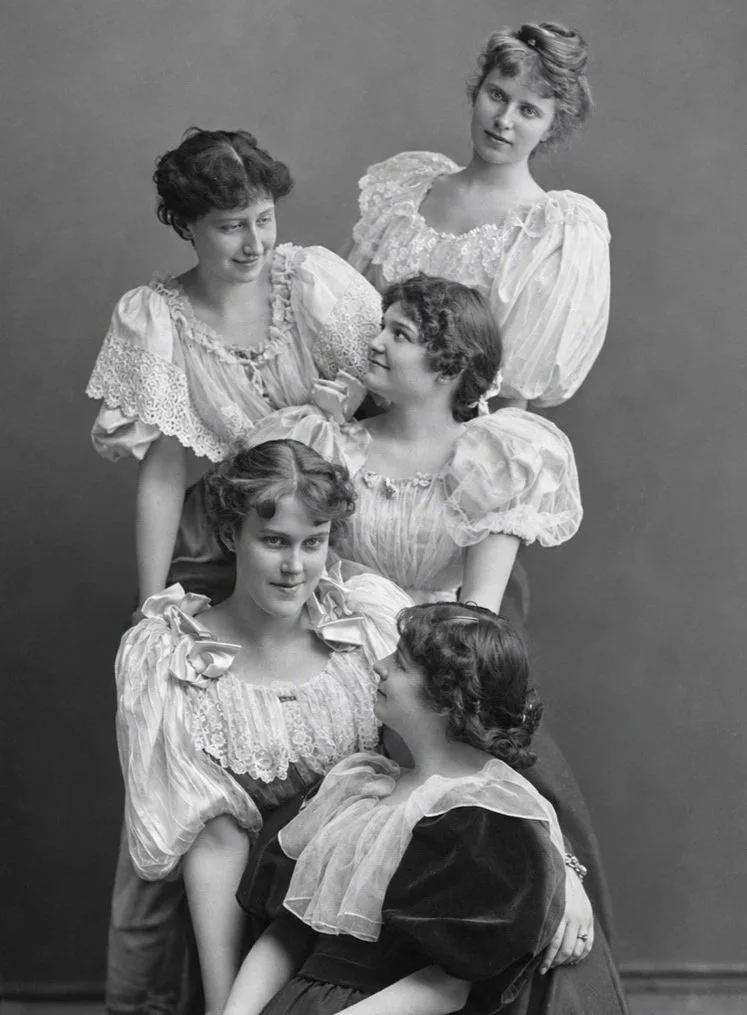
The Brewer Daughters, c. 1892
The Brewer Family Papers and the Preservation of Memory
One of the most valuable resources for understanding David Brewer and his descendants is the Brewer Family Papers collection at Yale University. The collection covers materials dating from 1714 to 1954 and includes correspondence, writings, speeches, photographs, diaries, scrapbooks, and other family records. It contains material relating to five generations of the Brewer family. Its value extends far beyond the justice’s Supreme Court opinions.
Personal letters may reveal how family members understood the events of their time. Diaries can document everyday activities overlooked in public biographies. Photographs establish visual evidence of people whose names might otherwise appear only in genealogies. The collection also provides a way to examine how the family remembered itself. This is especially important for the Brewer women, whose identities and experiences are often overshadowed in accounts centered on the justice. For researchers using photographs from the C. M. Bell Studio, the Yale archive offers a way to connect an image to a fuller historical record.
A studio portrait establishes that someone appeared before the camera. A letter, diary, or family record may explain who accompanied the sitter, what occasion prompted the photograph, or how the person related to Washington society. Combining photographic evidence and written documentation can transform an anonymous historical likeness into a meaningful biography. The collection's breadth, extending across centuries and generations, makes it an essential resource for following the Brewer story into the modern era.
Justice Brewer's Legacy in Contemporary America
More than a century after his death, David Josiah Brewer continues to occupy a meaningful place in American constitutional history. His decisions contributed to legal doctrines governing interstate commerce, labor regulation, federal judicial authority, statutory interpretation, and the allocation of shared natural resources. Some of those doctrines survive in substantially modified form. Others have been rejected or displaced by later constitutional developments. His understanding of economic liberty influenced an era in which the Supreme Court frequently limited legislative regulation of business. His ruling in Muller v. Oregon contributed to the use of social science in constitutional litigation, even as its assumptions about women were later criticized. His decisions involving racial segregation reveal the limitations of constitutional protection during the Jim Crow era.
The influence of his work can also be seen in the conversations that followed him. The New Deal transformed American constitutional thinking about economic regulation. The civil rights movement challenged legal structures that had permitted racial inequality. Modern legal scholars continue to examine the balance between religious tradition and constitutional government. Brewer's career is relevant to each of these developments because it illustrates the assumptions against which subsequent generations argued. His legacy also reaches into American international relations. He participated in efforts to settle the Venezuela and British Guiana boundary dispute through arbitration, demonstrating his interest in resolving international conflicts through law rather than warfare. His support for international arbitration reflected a lifelong concern with peace, public service, and the responsibilities of government.
The Lasting Image
David Josiah Brewer died in Washington on March 28, 1910, at the age of 72. His body was returned to Kansas, where he was buried at Mount Muncie Cemetery near Leavenworth, the community in which his judicial career had begun. His life had carried him from the Ottoman Empire to New England, from the Kansas frontier to the highest court in the United States. He had witnessed slavery's destruction, the Civil War, Reconstruction, western expansion, industrialization, and America's emergence as an international power.
He had served alongside his uncle on the Supreme Court, represented a remarkable American family tradition, and participated in decisions that would influence generations of constitutional scholarship. But his story was never confined to the courtroom. It continued through Louise Landon Brewer, their four daughters, and the grandchildren whose lives extended the family into a new century. It survives in letters, diaries, family papers, legal opinions, and photographs.
The photographic record is especially moving because it preserves moments that the formal historical record seldom captures. The justice in his robes, his daughters before the camera, Bessie with her friends, and the faces of an extended family reveal the human dimensions of a life otherwise measured in judicial decisions. Today, the legal opinions remain available to scholars, attorneys, and students, while the family papers await further examination by historians and descendants.
David Josiah Brewer lived in an age when the United States struggled to reconcile its founding principles with the demands of an industrial society. His decisions reveal both the possibilities and limitations of that effort. His family history reminds us that the legacy of a public figure is also carried by people whose own lives deserve to be remembered. More than a century after his death, the questions that occupied Brewer's generation remain familiar: What is liberty? What are the proper limits of government? How should the law protect individuals? And how will future generations judge the decisions we make today? The answers continue to evolve. The historical record remains.
And through the preservation of his opinions, his family's writings, and the extraordinary photographs of Gilded Age Washington, the story of Justice David Josiah Brewer continues to unfold.
••••••
Research notes and further reading.
The most useful starting points for developing this into a fully documented historical publication are the [Federal Judicial Center biography](https://www.fjc.gov/history/judges/brewer-david-josiah?utm_source=chatgpt.com), the [Supreme Court Historical Society profile](https://supremecourthistory.org/associate-justices/david-j-brewer-1890-1910/?utm_source=chatgpt.com), and Yale's [Brewer Family Papers, MS 99](https://hdl.handle.net/10079/fa/mssa.ms.0099?utm_source=chatgpt.com).
For deeper research, Michael J. Brodhead's David J. Brewer: The Life of a Supreme Court Justice, 1837-1910 (1994) provides a full-length scholarly biography. The original Supreme Court opinions and historical family genealogies are important primary sources for checking the legal and family chronology.
Editorial note: This narrative connects Brewer's documented ancestry, four daughters, grandchildren, and constitutional legacy to the present. A complete genealogy extending to named living descendants remains to be established. That would be a separate research undertaking involving later marriage, census, obituary, and archival records, particularly within the Jetmore, Karrick, and Wells families.
Bell, C. W., III. “Beyond the Bench: Justice Brewer, His Daughters, and Their American Legacy.” C. M. Bell Studio, November 15, 2026. https://cmbellstudio.com.
© 2026 C. W. Bell III, C. M. Bell Studio. Historical research and narrative examining the judicial career, family heritage, and enduring legacy of Supreme Court Justice David Josiah Brewer (1837–1910). Prepared with AI-assisted research and editing, drawing upon historical court records, genealogical sources, and archival collections.
For the C. M. Bell Studio historical series, the family photographs offer an especially compelling way to tell this story, with the individuals and their relationships at the center of the narrative.