Adlai and Letitia Stevenson: A Washington Marriage and an American Political Dynasty
Among the thousands of faces preserved on the glass plates of the C. M. Bell Studio are two portraits identified with remarkable simplicity: "Hon. A. E. Stevenson" and "Mrs. A. E. Stevenson." To a nineteenth-century Washington audience, little more needed to be said. Adlai Ewing Stevenson was one of the best-known Democrats in the capital, a congressman, senior postal official, and eventually Vice President of the United States. His wife, Letitia Green Stevenson, occupied an equally conspicuous place in Washington society and became a national leader in the Daughters of the American Revolution.
Seen together, the Bell portraits preserve something more interesting than a prominent political couple. They introduce a family whose public life spanned four generations, eventually producing another governor, a United States senator, and one of the most celebrated presidential candidates of the twentieth century. Yet the story began far from Washington.
Adlai Ewing Stevenson was born on October 23, 1835, in Christian County, Kentucky. Its local economy relied heavily on its cavernous limestone soil in what is now Hopkinsville, KY. Like Lincoln, his family moved to Illinois in 1852, when the town of Bloomington was still developing into an important commercial and political center. Stevenson attended Illinois Wesleyan University and later Centre College in Danville, Kentucky. His studies at Centre were interrupted by the death of his father, and he returned to Illinois, studied law, and was admitted to the bar in 1858.
It was at Centre College that his life intersected with that of Letitia Green. Letitia was born in Allegheny, Pennsylvania, on January 8, 1843, the daughter of the Reverend Lewis Warner Green and Mary Peachy Fry Green. Her father was a prominent Presbyterian clergyman and educator who became president of Centre College in 1855. The Green household valued learning, religion, history, and public service, and Letitia received an education unusually extensive for a young woman of her generation. She studied in Kentucky and later in New York, acquiring not only the social accomplishments expected of a woman of her class but a serious grounding in literature and the classics.
As Adlai came to know Letitia at Centre, their courtship stretched across years and the upheaval of the Civil War. The border state of Kentucky occupied an uneasy position between North and South, and Danville experienced the presence of both Union and Confederate forces. Letitia returned home during the war and witnessed a community transformed by military occupation, hospitals, and the uncertainties of a divided nation. The nearby Battle of Perryville filled the region with wounded and sick soldiers. College buildings were converted into military hospitals, and Green remained at his post, preaching, teaching, visiting the sick, comforting the dying, and helping bury the dead. By spring 1863, disease had spread through Danville, and Green suddenly fell ill. After several days of chills, fever, delirium, and paralysis, he died on May 26, 1863, at the age of fifty-seven. After her father died, she and her mother eventually came to Illinois, where Letitia lived with her sister Julia Scott in Chenoa.
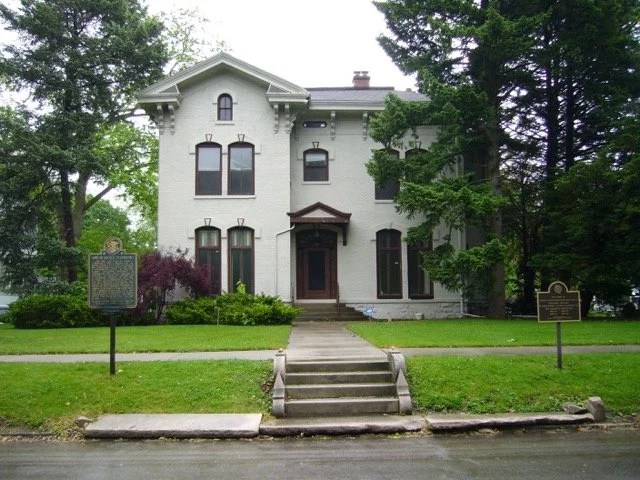
Letitia’s and Adlai’s home in Bloomington at the intersection of North McLean Street and East Chestnut Street
Adlai continued his courtship, and in December 1866 the couple married at the Scott home. Their marriage would last forty-seven years. The Stevensons first lived in Metamora, Illinois, where Adlai practiced law and served in local government. He had already begun the political career that would define much of their married life, serving as master in chancery and later as district attorney. In 1869 the family moved to Bloomington, where Stevenson established a law partnership with his cousin James S. Ewing. Bloomington remained their true home even when political office repeatedly drew them to Washington.
Adlai and Letitia had four children. Their son, Lewis Green Stevenson, was born in 1868, followed by daughters Mary Ewing, Julia Scott, and Letitia Green. The family eventually occupied a substantial Italianate house facing Franklin Square in Bloomington. It was the sort of household in which politics, law, religion, family history, and civic affairs were difficult to separate.
Letitia was not content to be a decorative political wife. She placed enormous importance on motherhood and domestic responsibility, yet she also held views that were progressive for her time. She supported higher education for women and argued that women were intellectually capable of far more than contemporary custom sometimes allowed. Her life would eventually demonstrate the point.
Adlai, meanwhile, discovered that he possessed one of the most valuable qualities in nineteenth-century politics: he was likable. He was a Democrat in a region where Lincoln Republicans were often dominant, yet his personal relationships crossed party lines. In 1874 he won election to the United States House of Representatives. He served from 1875 to 1877, lost his bid for another term, then returned to Congress from 1879 to 1881. His congressional career was not revolutionary, but it established him as a durable Democrat who could compete successfully in difficult political territory.
Stevenson's greatest political opportunity before the vice presidency came with the election of Grover Cleveland in 1884. Cleveland appointed Stevenson First Assistant Postmaster General in 1885. The title sounds bureaucratic today, but the Post Office Department possessed one of the largest patronage systems in the federal government. Thousands of local postmasters across the country owed their positions, directly or indirectly, to political appointment. Stevenson embraced the old spoils system with enthusiasm. According to the Senate's historical account, he became known as the "Headsman of the Post Office" for removing Republican officeholders and replacing them with Democrats. Contemporary estimates credited him with replacing roughly 40,000 Republican postmasters. Civil service reformers were appalled, Democrats were delighted, and Stevenson emerged from Cleveland's first administration with a formidable network of political friends.
The episode reveals something important about Stevenson. He was no detached statesman floating above party politics. He was a Gilded Age political operator, comfortable with patronage, loyalty, organization, personal relationships, and the expectations of party service. Yet the same man who could wield the patronage axe with enthusiasm was remembered for extraordinary courtesy in person. That combination, fierce partisan underneath, genial gentleman on the surface, would serve him well.
When Democrats again nominated Grover Cleveland for president in 1892, they selected Stevenson as his running mate. The choice gave the ticket political balance. Cleveland was closely associated with civil service reform and the gold standard. Stevenson represented the party regulars and sympathized with expanding the currency through silver. Their political differences were real, but together they helped reunite competing Democratic factions. Cleveland and Stevenson won the election, defeating President Benjamin Harrison and his running mate Whitelaw Reid. Stevenson became the 23rd Vice President of the United States, serving from March 1893 to March 1897.
In the Senate, Stevenson developed a reputation quite different from his partisan record at the Post Office. He presided with dignity and fairness and was well liked by senators from both parties. The Senate's own history describes him as courteous and nonpartisan in his rulings, a man who enjoyed the institution and understood its customs. His relationship with Cleveland was cordial rather than intimate. Stevenson later joked about the traditional irrelevance of vice presidents, and Cleveland was known to tease him about the circle of silver advocates who surrounded him.
Behind the humor lay a serious political difference. During the financial crisis of 1893, Cleveland sought repeal of the Sherman Silver Purchase Act and defended the gold standard. Stevenson sympathized with the silver wing of the Democratic Party and did little to assist the administration in suppressing Senate resistance. That disagreement became dramatically important during the summer of 1893. Cleveland developed cancer of the mouth and secretly underwent major surgery aboard a yacht in New York Harbor. The operation was concealed from the public partly because administration officials feared the financial consequences if markets realized that Stevenson, associated with the silver movement, might suddenly become president. Stevenson himself apparently did not understand how close he had come to succeeding Cleveland. For a brief moment, therefore, the man looking calmly into Bell's camera stood remarkably close to the presidency.
While Adlai presided over the Senate, Letitia entered a national public life of her own. In 1893 she joined the National Society of the Daughters of the American Revolution, an organization founded only three years earlier. Her Revolutionary ancestry qualified her for membership, but her abilities and national standing quickly moved her into leadership. That same year she was elected President General of the DAR. The position was not ceremonial. The organization was expanding rapidly and attempting to establish its structure, membership rules, historical mission, and national presence. Letitia became one of the principal figures shaping that formative period. She would ultimately be elected President General four times, becoming the only woman in DAR history to serve nonconsecutive terms in that office.
Her service was interrupted in 1895 by family sorrow. Her daughter Mary died, and illness also affected her son Lewis. Letitia withdrew temporarily from national leadership, then returned in 1896. The DAR later created the title of Honorary President General in her honor. Her work included strengthening membership standards, building the organization nationally, encouraging historical preservation, and helping lay the groundwork for what would become the DAR's permanent presence in Washington. She eventually published a short history of the organization.
At the same time, she fulfilled the demanding social responsibilities associated with the vice presidency. Washington political life depended heavily upon receptions, dinners, calling rituals, correspondence, and personal introductions. The wife of the vice president could receive hundreds of visitors at public receptions. Letitia did so while suffering from severe arthritis and other physical difficulties that at times required her to wear a leg brace. The DAR remembered her as a woman whose physical limitations did not prevent sustained public service.
There is something particularly striking about Bell's portrait of her in this context. She is not presented merely as an appendage to her husband. She sits independently, composed and alert, dressed with considerable care, her gaze directed beyond the camera. The photograph belongs to an era when women had not yet won the national right to vote, yet Letitia Stevenson already presided over a national organization and exercised influence in Washington society.
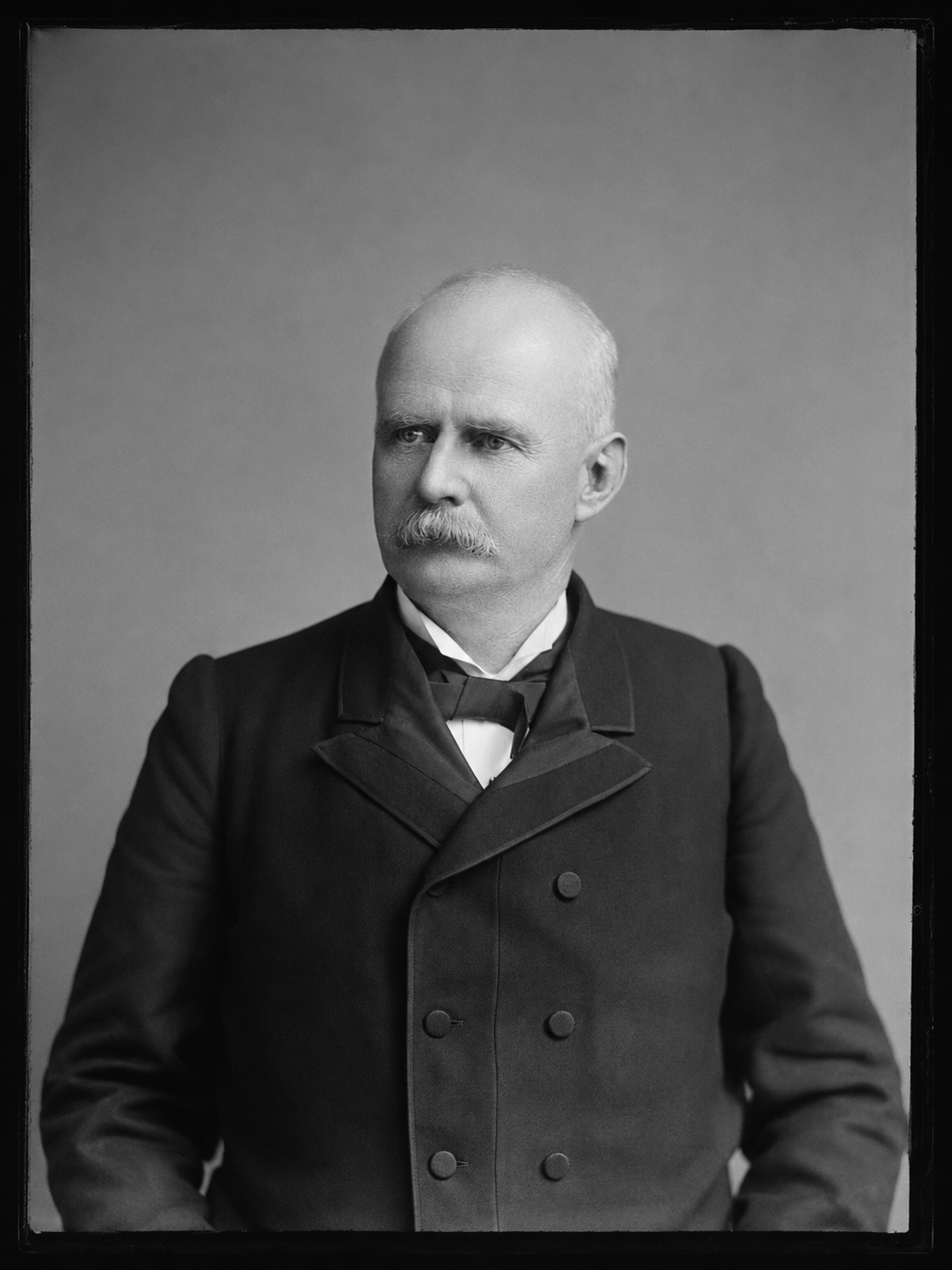
Adlai Ewing Stevenson, 1894
Politics After the Vice Presidency
Adlai Stevenson left office in 1897, but he did not leave politics. He had received some support for the Democratic presidential nomination in 1896, but the convention instead turned to the young Nebraska orator William Jennings Bryan, whose famous "Cross of Gold" speech electrified the party. Stevenson supported Bryan. Four years later, history produced an unusual reversal. In 1900, Bryan became the Democratic presidential nominee again, and the party selected the former vice president, now in his mid-sixties, as Bryan's running mate.
The ticket placed Stevenson back in a national campaign eight years after his election with Cleveland. This time the Democrats lost to President William McKinley and Theodore Roosevelt. Stevenson made one more significant bid for office, running unsuccessfully for governor of Illinois in 1908. After that defeat, his long political career drew toward its close. Letitia remained active in civic and historical work. Her influence in the DAR endured long after her presidency, and the Bloomington chapter carried her name.
The political story did not end with Adlai and Letitia. Their son Lewis Green Stevenson served as Illinois Secretary of State from 1914 to 1917. Lewis, in turn, named his son after his distinguished father. That grandson was Adlai Ewing Stevenson II, born in 1900.
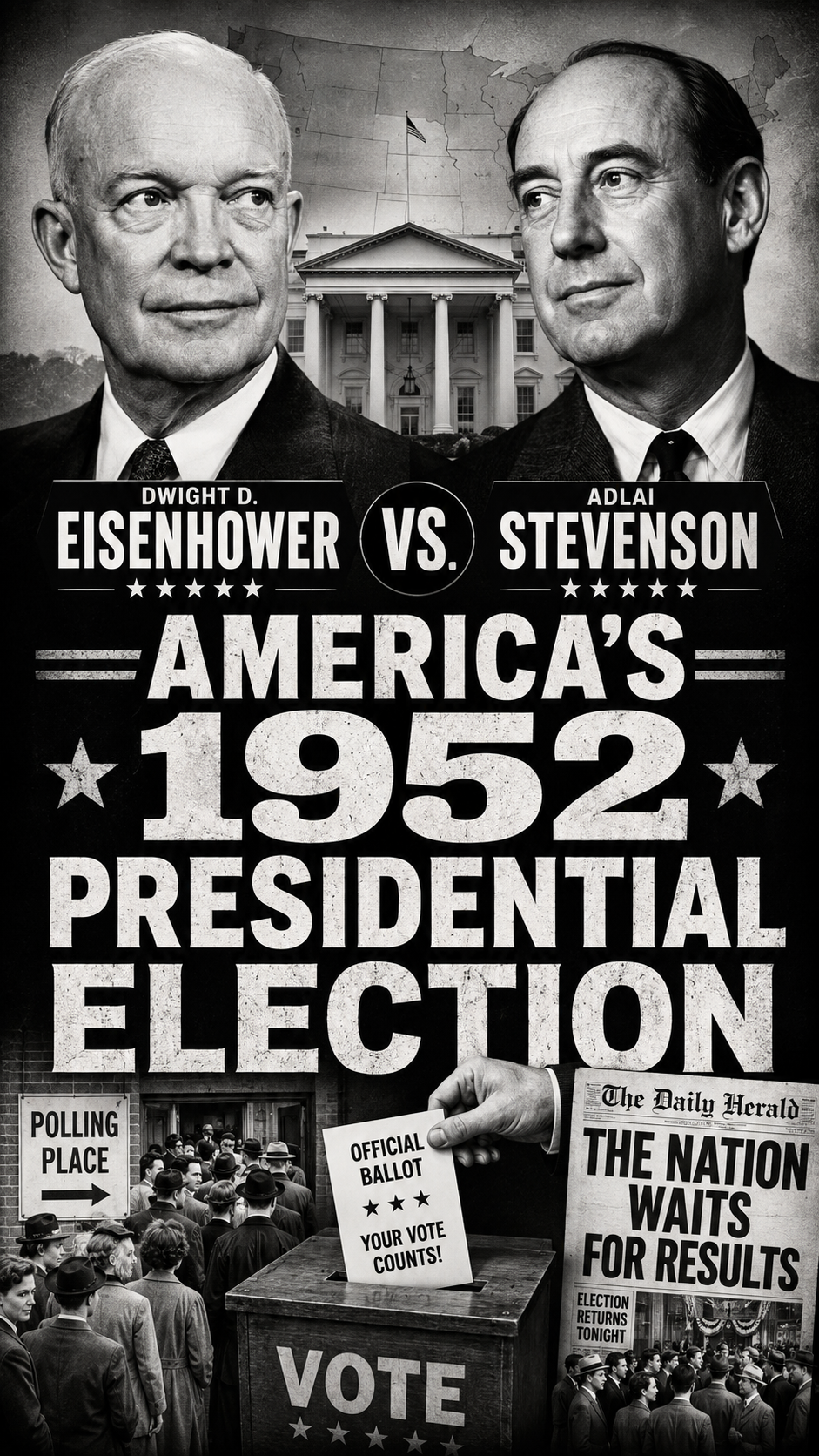
Half a century later, the Stevenson name returned to the center of American politics. Adlai Stevenson II became governor of Illinois and then the Democratic nominee for President of the United States in 1952 and 1956. Both times he faced Dwight D. Eisenhower. Both times he lost, but his intelligence, wit, eloquence, and thoughtful approach to public affairs made him one of the defining political personalities of his generation. He later served as United States Ambassador to the United Nations under Presidents John F. Kennedy and Lyndon Johnson.
The line continued still further. Adlai Stevenson II's son, Adlai Ewing Stevenson III, represented Illinois in the United States Senate from 1970 to 1981. Thus the couple photographed by Bell stood near the beginning of one of America's longest-running political families.
The Final Years
Letitia Stevenson died at the family home in Bloomington on Christmas Day, 1913, after months of declining health. She was seventy. Contemporary reports emphasized not only her status as the wife of a former vice president but her own accomplishments as a former President General of the DAR. Her death devastated Adlai. William Jennings Bryan wrote to his former running mate expressing sympathy and acknowledging how closely their lives had been joined. The Abraham Lincoln Presidential Library notes that Stevenson never truly recovered from the loss.
Six months later, on June 14, 1914, Adlai Ewing Stevenson died in Chicago. He was seventy-eight. He and Letitia were buried in Bloomington, the Illinois community that had remained the center of their family life through decades of political triumphs, defeats, campaigns, and Washington service.
Two Faces on Glass
The C. M. Bell portraits return us to the Stevensons before history had finished with their name.
Adlai appears every inch the nineteenth-century statesman, bald, mustached, formal, controlled, and unmistakably conscious of public presentation. Letitia's portrait is different, softer in setting but no less assured. Her elaborate dress and carefully arranged hair belong unmistakably to the Gilded Age, yet there is nothing anonymous about the woman Bell recorded. Together, they represent two varieties of public service available in their time.
Adlai worked through elections, party organization, law, federal appointment, Congress, and the vice presidency. Letitia worked through family, social influence, historical preservation, education, civic organization, and national leadership at a moment when women remained excluded from most formal political power. Their lives also remind us that a photographic plate can contain a history far larger than the instant it records.
Bell could not have known that the name attached to these negatives would one day appear on presidential campaign buttons, television screens, United Nations broadcasts, and another desk in the United States Senate. He photographed Adlai and Letitia Stevenson, a political couple of the Gilded Age. In doing so, the C. M. Bell Studio preserved the faces of the grandparents of a future presidential nominee, the founders of an American political dynasty, and two people whose lives became deeply entwined with Washington and the public life of the United States.