
Frances Hodgson Burnett and the Family Behind the Stories
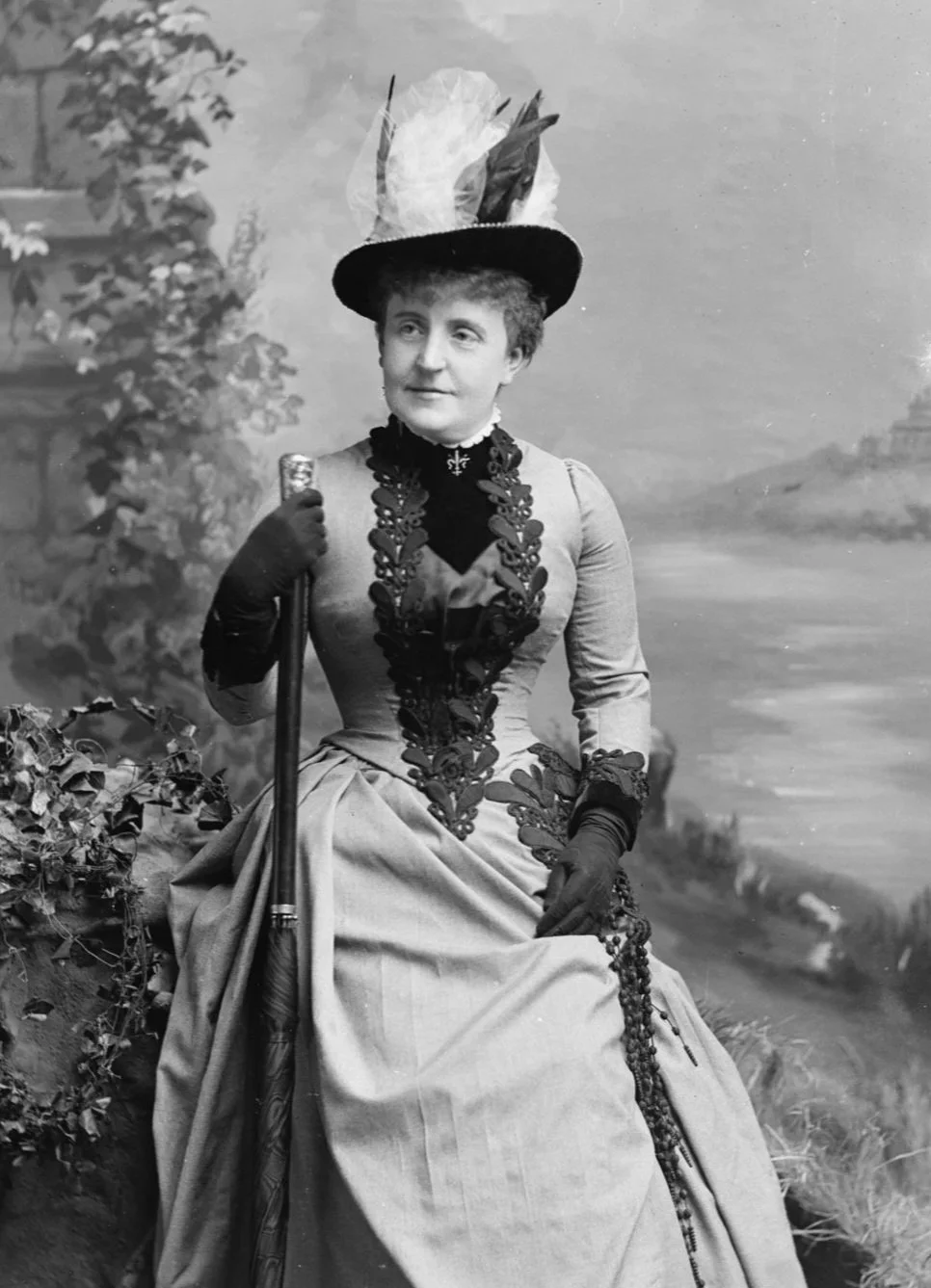
Frances Hodgson Burnett
In the C. M. Bell studio in 1888, Frances Hodgson Burnett appears exactly as one might expect a celebrated late Victorian novelist to appear. Her gown is elaborate, her hat rises in a mass of feathers, and her pose is theatrical without seeming uncertain. In one photograph she stands alone against a painted landscape, resting one gloved hand upon a closed parasol. In another she stands beside a seated woman identified in the studio record only as her "friend." Burnett occupies the higher position, one hand planted firmly upon her hip. That confidence had been hard won. For behind the fashionable clothes stood a woman who had known financial collapse, immigration, relentless work, a troubled marriage, the awful death of a child, and the peculiar burden of becoming more famous and prosperous than almost anyone around her. Her family story also included a husband whose accomplishments have been largely lost beneath hers, and two sons whose lives were permanently shaped by their mother's imagination.
From Manchester, England to Rocky Top
Frances Eliza Hodgson was born in Manchester, England, on November 24, 1849, the third of five children of Edwin and Eliza Hodgson. Her father operated a prosperous business selling ironmongery, brass goods, and household furnishings. The family lived comfortably during Frances's earliest years, with domestic servants and access to the books, gardens, and material comforts that would later reappear in her fiction. Edwin Hodgson died suddenly in 1853, leaving his widow with five children and a business she was poorly prepared to manage.
The family's decline unfolded gradually. Manchester in 1849 was the engine room of industrial capitalism, a place where cotton, steam, railways and global trade created unprecedented wealth, while smoke, disease, insecure labor and overcrowding imposed much of the cost upon workers and immigrants. Queen Victoria had ascended the throne in 1837, and for Frances Hodgson Burnett, this emerging Victorian age of her childhood would animate her imagination, which was her world.
This cotton kingdom of early Victorian Manchester and the interruption of American cotton supplies during the Civil War contributed to severe hardship in Lancashire. Eliza Hodgson sold the family business and moved her children into increasingly modest accommodations. Frances later remembered both the industrial poverty around her and the gardens that seemed to offer hidden worlds beyond it. The combination became central to her imagination: harsh social realities existed, but so did locked doors, secret places, transformation, and escape.
Edwin Hodgson’s death in 1853 had left Eliza struggling to support five children while managing the family ironmongery. The war then produced the Lancashire Cotton Famine. Because Manchester depended heavily upon cotton imported from the American South, the Union blockade and the Confederate withholding of cotton brought mill closures, mass unemployment and a severe contraction in local spending. Even businesses outside the textile trade suffered as workers lost their wages and merchants reduced their purchases.
In May 1865, as the American Civil War was drawing to a close, the family situation was so desperate that Eliza Hodgson left England with her five children and sailed for the United States. They had already endured more than a decade of declining circumstances following Edwin Hodgson’s death, but Manchester’s wartime Cotton Famine deepened their difficulties, closing mills, eliminating wages, and reducing trade throughout the city. Eliza sold the family business in 1863, and two years later accepted her brother’s invitation to begin again near Knoxville, Tennessee. There was a certain irony in the move: the war that had helped cripple Manchester’s cotton economy was ending, and the Hodgsons now sought their future in a country still scarred by that very conflict.
America did not provide the immediate rescue they had expected. The family settled near New Market, Tennessee, and spent time in a log cabin. Frances tried teaching, raising chickens, and giving music lessons, but it was her ability to invent stories that finally brought money into the household. While still in her teens, she submitted fiction to American magazines. Her first two accepted stories earned $35, a modest sum that proved her imagination could be converted into income. After her mother's death in 1870, Frances became increasingly responsible for supporting the family.
Swan Moses Burnett, a husband
Living near the Hodgsons in Tennessee was the family of Dr. John M. Burnett. His son, Swan Moses Burnett, had been born on March 16, 1847. Quiet, studious, and physically limited by a childhood knee injury that left him with a permanent limp, Swan shared Frances's interest in books. She introduced him to writers she had known in England, among them Dickens, Scott, and Thackeray. Swan fell in love with the lively English girl, though she appears to have regarded marriage with greater hesitation than he did.
Swan intended to follow his father into medicine. He studied at Miami Medical College in Cincinnati and later at Bellevue Hospital Medical College in New York, receiving his medical degree in 1870. He practiced in Tennessee, treated patients during the cholera epidemic of 1873, and became Knoxville's first specialist in diseases of the eye, ear, nose, and throat. He and Frances married on September 19, 1873. Their first son, Lionel, was born in September 1874.
Their marriage began as a partnership built upon hope, affection, and financial uncertainty. Frances was already the more reliable earner. Her stories paid household expenses and financed Swan's further medical education. In 1875 they went to Paris, where he studied with European eye and ear specialists. Their second son, Vivian, was born there in 1876. The family returned to the United States later that year, carrying debt but also professional ambitions that could not easily be fulfilled in rural Tennessee.
Swan went ahead to Washington to establish a practice while Frances and the children remained temporarily with his parents. In April 1877, the family reunited in the capital. Frances's first novel, That Lass o' Lowrie's, appeared that year and established her as a serious writer. The family moved through a succession of Washington houses as its fortunes improved, eventually occupying fashionable residences and entertaining politicians, physicians, artists, and authors. The Burnett boys reportedly played with the children of James A. Garfield, who later allowed them to ride their bicycles through the White House corridors.
“Publicly married while privately free.”
Frances wrote at a punishing pace. Adult novels, magazine stories, children's tales, and stage adaptations poured from her pen. She later described herself as a "pen-driving machine," an accurate expression of both her productivity and the pressure she felt. Her income supported the household, funded travel, paid for the boys' education, and enabled the increasingly elaborate life she created around herself. She became known for her Tuesday literary gatherings and moved easily through Washington society.
Swan's achievements were quieter but substantial. In 1878, he founded Washington's first eye and ear clinic at the Central Dispensary and Emergency Hospital. He became the first professor of ophthalmology at Georgetown University's medical school, published widely, improved the clinical understanding of astigmatism and refraction, and helped advance the use of the ophthalmoscope. He treated poor patients and African Americans as well as paying clients, and became a recognized teacher, researcher, and medical administrator.
In 1892, he founded and equipped a hospital-associated clinical laboratory, one of the earliest in the nation. He was also a bibliophile and collector whose library contained rare editions, prints, paintings, Americana, and Japanese art. By the time of his death, dozens of his scientific articles had been cataloged by the Surgeon General's Library. He was not an unsuccessful husband living upon his wife's fame. He was an important physician whose careful professional life attracted less public attention than Frances's flamboyant literary career.
Their success did not preserve their marriage. Frances was social, impulsive, restless, and drawn repeatedly back to England. Swan was methodical, locally rooted, and more conservative in temperament. Her long journeys often left him as the parent responsible for the boys in Washington. She regarded him as cautious and provincial; he appears to have found her expenditures, absences, and unconventional friendships increasingly difficult. One modern biographer has described their eventual arrangement as being publicly married while privately free.
Lionel and Vivian
The two Burnett sons grew up amid this unusual mixture of medicine, literature, social ambition, and transatlantic travel. Lionel, born in 1874, was the elder. Vivian, born in Paris on April 5, 1876, was the younger. Frances adored both boys, though her motherhood did not conform to the domestic expectations of her time. She could be intensely affectionate and indulgent, then absent for months while pursuing theatrical, literary, or social projects. Swan provided greater continuity and discipline during many of those absences.
Frances took a particular interest in the boys' appearance. She designed clothing for them, arranged their hair in curls, and dressed them in velvet suits with broad lace collars. Such clothing was fashionable among some upper-class children, but Frances transformed it into an international phenomenon through Little Lord Fauntleroy. By the 1870s, cash-poor British aristocrats had begun looking across the Atlantic for wealthy American brides, exchanging ancient titles and social position for the fortunes needed to preserve their estates. By the time Burnett published Little Lord Fauntleroy in 1886, the marriage of American wealth to English rank had become one of the most familiar social dramas of the age.
Published as a serial beginning in 1885 and as a book in 1886, the novel told the story of Cedric Errol, an American boy who discovers that he is heir to an English earldom. Cedric's generosity and democratic confidence gradually reform his aristocratic grandfather. The book sold in enormous numbers, appeared in multiple languages, inspired stage productions, and created a market for clothing, toys, playing cards, perfume, and other merchandise.
Vivian supplied much of the visual model. Illustrators drew upon photographs of him wearing the clothes his mother favored. The C. M. Bell portrait shows him standing with one hand on his hip, dressed in close-fitting breeches, stockings, buckled shoes, a dark jacket, and a cascading lace collar. He appears self-possessed, almost defiant, rather than delicate. Still, the association with Fauntleroy followed him for the remainder of his life and became a source of embarrassment.
Lionel was often mistakenly described as the original Fauntleroy, but Vivian carried the stronger connection. The fictional Cedric was not a complete portrait of either boy. He was an idealized creation, part American democrat, part English heir, and part embodiment of Frances's belief that moral courage could transform an embittered adult. Yet Vivian's appearance gave the character a recognizable face, one that Victorian mothers admired and generations of boys resented.
Lionel's Illness and Death
The family's greatest tragedy came in 1890. Lionel developed tuberculosis, then commonly called consumption, was one of the most feared and familiar diseases of the Victorian age. It spread readily through the crowded homes, workshops and poorly ventilated factories of rapidly growing industrial cities such as Manchester. Its victims often declined over months or years, growing pale and thin as the illness appeared to consume them from within. With no effective cure and little understanding of contagion before Robert Koch identified the tuberculosis bacterium in 1882, the disease entered nearly every level of Victorian life and became a recurring presence in its families, literature and imagination. Frances pursued every possible remedy for her son. She took him to physicians in America and then to European spas and specialists, moving from hope to hope in an era when no effective cure existed. Lionel died in Paris in December 1890 at the age of sixteen, reportedly in his mother's arms. Swan, who had remained in Washington, received the news by cable.
His death changed both parents. Frances fell into profound grief and began searching more intensely among Spiritualism, Christian Science, New Thought, and other religious or metaphysical systems for assurance that personality and love survived death. This was much in the familair excercise of Mary Tood Lincoln who never recovered from her husband’s assassination. Her later writing repeatedly returned to sick or lonely children, the power of thought, natural healing, and the possibility that life continued beyond what could be physically seen. Her Anglican leanings in the Church of England would give way. She dedicated her 1893 memoir, The One I Knew Best of All, to Lionel.
Swan memorialized his son through medicine. The laboratory he established at the Emergency Hospital was named the Lionel Laboratory. It conducted clinical, bacteriological, and pathological research and became the first institution of its kind associated with a Washington hospital. The parents responded differently: Frances through narrative and spiritual searching, Swan through scientific work, but both carried Lionel into what they created afterward.
The End of the Marriage
After Lionel's death, the distance between Frances and Swan became permanent. Swan moved out of their Massachusetts Avenue home in 1895. The divorce came in 1898, formally on grounds of desertion and failure to provide, though the separation had been arranged by mutual consent after years of living largely independent lives. The press treated Frances as a representative of the troubling "New Woman," financially independent, professionally successful, and unwilling to remain within a conventional marriage.
Frances married the English physician and aspiring actor Stephen Townesend in 1900. He had assisted with her theatrical work and had been close to her during Lionel's illness. The marriage rapidly became unhappy. Burnett's private letters portray Townesend as controlling, unstable, and interested in the authority and financial advantages marriage gave him. Some biographers believe he pressured or blackmailed her into marrying him. They separated and divorced after roughly two years.
Swan married an old family friend, Margaret Brady, in 1904. Their marriage lasted only two years. On January 18, 1906, he died from pulmonary edema at the age of fifty-eight. Frances's response reveals that bitterness had not erased tenderness. She wrote to Vivian, imagining that Lionel might be the first soul to meet his father, and asked her surviving son to kiss Swan's cheek for her.
Vivian's Adult Life
Vivian had meanwhile reached adulthood beneath the long shadow of Fauntleroy. He entered Harvard, suffered an illness that delayed his studies, and graduated in 1898. Both parents helped finance his education, Frances more generously and Swan more cautiously. He learned to navigate their hostility without openly choosing between them. ([Wikipedia][4])
He entered publishing and later persuaded his mother to become involved with Children's Magazine. He also worked with her on publishing projects, including The Children's Book. After Frances settled at Plandome on Long Island, she built a cottage nearby for Vivian, his wife, Constance Buel Burnett, and their family. He remained devoted to his mother through her later years. ([University of Southern Mississippi][6])
Frances became an American citizen in 1905 and eventually made Plandome her principal home, while continuing to spend winters in Bermuda. There she wrote and revised some of her most enduring works. A Little Princess appeared in its expanded form in 1905, and The Secret Garden followed in 1911. Gardens had become more than settings for her. They represented recovery, privacy, rebirth, and a world in which neglected things could be restored through attention and love. ([Encyclopedia][1])
She died at Plandome on October 29, 1924, at the age of seventy-four, and was buried beside Lionel in Roslyn Cemetery. Three years later, Vivian published The Romantick Lady: The Life Story of an Imagination, a substantial biography of his mother. Its title captured the quality that had governed her life. Frances did not merely write romances. She constructed herself, her homes, her gardens, her friendships, and even her family's public appearance through an imagination that continually remade the world around her. ([Google Books][7])
Vivian died in 1937 during a boating emergency on Long Island Sound. Reports stated that he maneuvered his yawl to help four people whose craft had overturned, then collapsed at the helm. The newspapers inevitably announced the death of the "original Fauntleroy," the identity he had spent much of his life trying to outgrow. The description was unfairly narrow. He had become an editor, writer, husband, father, sailor, and custodian of his mother's legacy. ([Encyclopedia][1])
The Family Preserved in Glass
The Bell photographs preserve the Burnetts before much of the sorrow had unfolded. Frances stands richly dressed and unmistakably in command. Vivian poses in the costume that linked him forever to his mother's most sensational success. Lionel, though not present in these particular images, remains essential to the family story, the beloved elder boy whose early death left a mark upon both literature and medicine.
Together, Frances, Swan, Lionel, and Vivian formed a family shaped by two powerful disciplines. Frances used imagination to turn poverty into security, grief into stories, and gardens into places of resurrection. Swan used scientific study to relieve suffering and built institutions that survived beyond him. Their marriage failed, but their shared life produced more than conflict. It produced two sons they loved, a medical legacy, and books that continue to carry lonely children through hidden doors into worlds where illness, neglect, and sorrow need not have the final word.
[1]: https://www.encyclopedia.com/women/encyclopedias-almanacs-transcripts-and-maps/burnett-frances-hodgson-1849-1924 "Burnett, Frances Hodgson (1849-1924) | Encyclopedia.com"
[2]: https://jamanetwork.com/journals/jamaophthalmology/fullarticle/424617 "Swan M. Burnett, MD, PhD: The Forgotten Father of Little Lord Fauntleroy | Acid Base, Electrolytes, Fluids | JAMA Ophthalmology | JAMA Network"
[3]: https://www.loa.org/news-and-views/1585-the-childrens-literature-of-frances-hodgson-burnett-values-that-we-need-and-can-relate-to-today/?utm_source=chatgpt.com "The children's literature of Frances Hodgson Burnett"
[4]: https://en.wikipedia.org/wiki/Frances_Hodgson_Burnett?utm_source=chatgpt.com "Frances Hodgson Burnett"
[5]: https://www.shakespearetheatre.org/blog/in-the-garden-the-life-of-frances-hodgson-burnett/ "In the Garden: The Life of Frances Hodgson Burnett - Shakespeare Theatre Company"
[6]: https://www.lib.usm.edu/legacy/degrum/public_html/html/research/findaids/burnett.htm "USM de Grummond Collection - FRANCES HODGSON BURNETT PAPERS"
[7]: https://books.google.com/books/about/The_Romantick_Lady.html?id=NFJAAQAAIAAJ&utm_source=chatgpt.com "(Frances Hodgson Burnett) the Life Story of an Imagination"