
Between Gettysburg and the West: The Unresolved Fate of Lt. Robert G. McKay
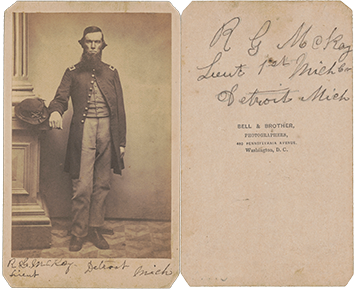
Lt. McKay, original card
Robert G. McKay steps into the historical record the way many Civil War soldiers do, briefly illuminated, then obscured again by the limits of the archive. A name. A rank. A regiment. A photograph. And then, a fracture in the story. For McKay, that fracture comes at the Battle of Gettysburg, where one account places him among the dead, while another suggests he survived, moved west, and lived on beyond the war. Between those two possibilities lies not only the story of one man, but the deeper challenge of reconstructing lives from a century and a half ago.
To understand McKay, one begins in Detroit, a city in transition during the mid-1800s. Detroit was not yet the industrial giant it would become, but it was already a place of movement, a frontier-adjacent city tied to the Great Lakes, trade routes, and the expanding American interior. It was a place where immigrants arrived, where young men found work, and where identities were still being formed. A man enlisting at age twenty-eight, as McKay reportedly did, was not a boy swept up in patriotic fervor. He was an adult, likely with trade skills, connections, and responsibilities. He had lived through the tensions of the 1850s, the debates over slavery, union, and expansion. When war came, his decision to enlist would have been measured and deliberate.
He joined the 1st Michigan Cavalry, a regiment that would become closely associated with aggressive mounted operations in the Eastern Theater. Michigan cavalry units developed a reputation for discipline and effectiveness, and later, for their association with a young and rising commander.
The early experience of McKay's service includes capture during the Second Battle of Bull Run. This is a crucial detail. Capture in 1862 did not necessarily mean the end of a soldier's service. At that point in the war, the prisoner exchange system still functioned, allowing captured men to be paroled and later exchanged. If McKay was captured and released, he would have re-entered the army altered. Captivity, even short-term, left a mark. It meant dislocation, uncertainty, and a firsthand encounter with the precariousness of survival in war. Yet he returned. That return tells us something about him, or at least about the expectations placed upon him. The war did not release its participants easily. By 1863, the 1st Michigan Cavalry was part of a larger mounted force under the command of George Armstrong Custer. Custer, young and audacious, brought an aggressive style to cavalry operations. Under him, the Michigan Brigade would gain a reputation for decisive charges and close combat.
The climax of McKay's known service comes at Gettysburg. On July 3, 1863, while infantry lines were locked in the famous struggle that would include Pickett's Charge, a separate but equally intense battle unfolded to the east of the main field. There, Union cavalry met the forces of J.E.B. Stuart. Stuart's objective was to move around the Union flank, to strike the rear at a critical moment. To stop him, Union cavalry, including the 1st Michigan, engaged in a series of mounted clashes that culminated in one of the most dramatic cavalry charges of the war. Accounts describe the moment vividly. Custer, reportedly shouting "Come on, you Wolverines," led his men forward into a collision of horses, sabers, and pistols. The fighting was close, chaotic, and deadly. Units intermingled. Lines dissolved into knots of men struggling at arm's length.
It is here that the record diverges.
Some regimental accounts and later compilations list a Robert G. McKay among those killed in action on July 3. The losses for the regiment were real, including officers and enlisted men alike. In the aftermath of such fighting, identifying the dead and accurately recording their names was not always straightforward. Yet other evidence complicates this conclusion.
A studio portrait attributed to Bell & Brother shows a man identified as "R. G. McKay, Detroit, Mich., Lieut." The image presents a composed figure, standing beside his equipment, gaze steady, posture controlled. It is a formal representation, one meant to fix identity and status. The photograph matters for several reasons. First, it suggests that McKay held the rank of lieutenant, at least at the time the image was made. Second, it places him within a particular visual culture, that of Washington studios documenting officers and notable soldiers. But most importantly, it provides a tangible anchor. A face. A presence. Something that resists the abstraction of names on a roster.
If this lieutenant is the same man listed as killed at Gettysburg, then the photograph becomes a prelude to loss. If not, if there were multiple men of similar names, then the photograph may represent a different individual entirely, one whose life extended beyond the war.
Civil War records are notoriously difficult. Names are repeated. Spellings vary. Initials are inconsistent. Clerks working under pressure made errors that were never corrected. "Robert G. McKay" is not an impossibly unique name. Within a large regiment or across multiple units, duplication is entirely plausible. A private or trooper might share a name with an officer. A middle initial might be omitted or altered. A man might be listed under a variant spelling, McKay, McKie, Mackay. This creates a fundamental problem. When a roster lists a man as killed, how certain can we be that it refers to the same individual seen in a photograph, or mentioned in another record? The answer is often not entirely certain.
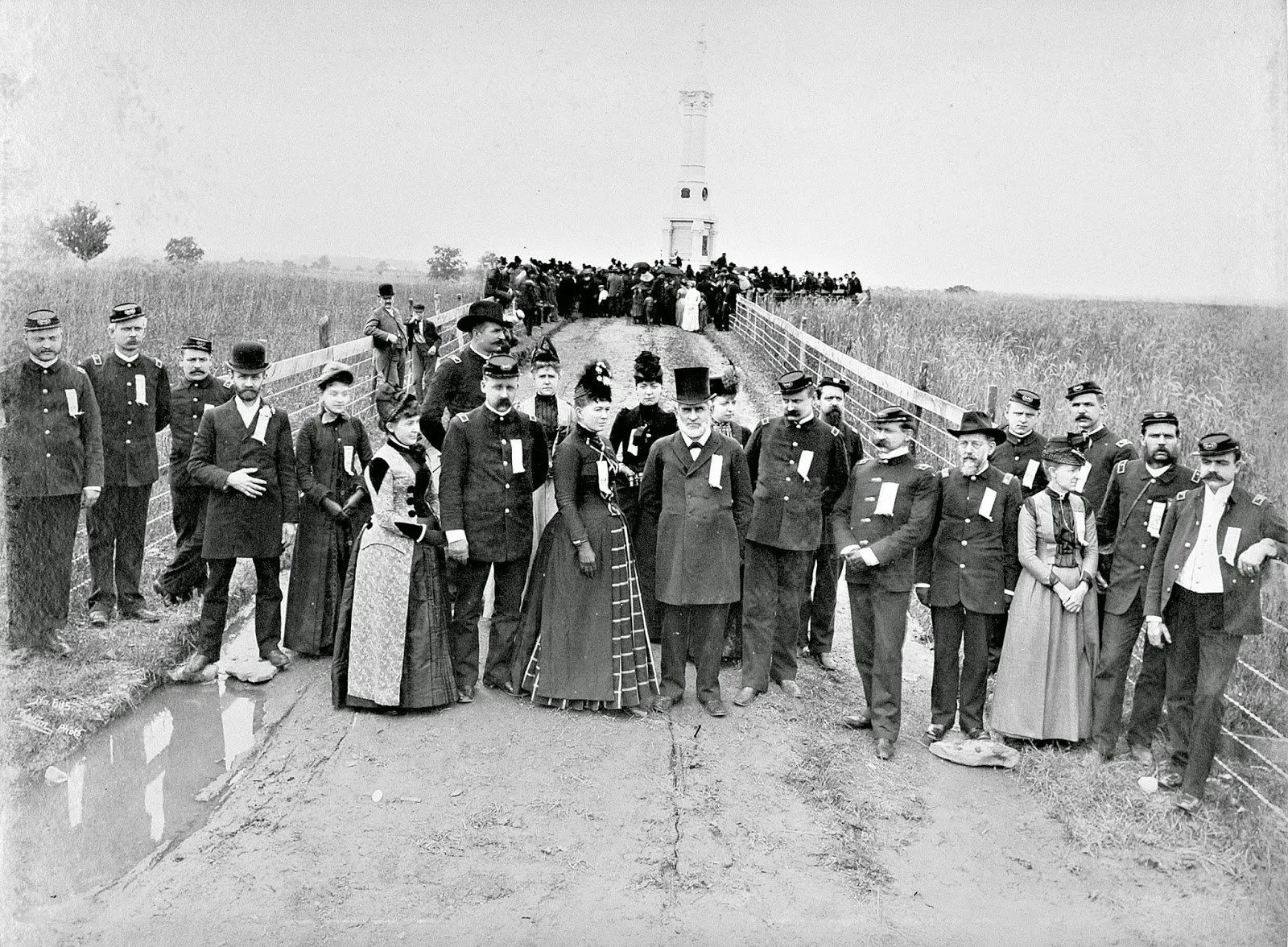
A Michigan reunion at the dedication of the state’s battlefield monument
Against the claim of death at Gettysburg stands another possibility, that McKay survived and later moved west. This is not an implausible path. After the war, many veterans did exactly that. The West offered land, opportunity, and distance from the memories of war. Former soldiers became settlers, lawmen, laborers, and participants in the continuing expansion of the United States. Some Michigan cavalry units, or elements of them, were indeed involved in postwar service or movement westward. Even when not formally assigned, veterans often followed the broader currents of migration. There are references, though not always firmly connected, to a Robert G. McKay appearing in later records, including in places far from Michigan. A listing in a Signal Corps context, for example, places a man of that name in Rhode Island, suggesting postwar activity and survival.
But again, the question returns. Is this the same man?
By the late nineteenth century, veterans began to return to battlefields, especially Gettysburg, for reunions. These gatherings were acts of memory, of reconciliation, and of identity. Men stood again on the ground where they had fought, now older, altered, but still connected by shared experience. Photographs from these reunions show groups of veterans, sometimes organized by regiment, sometimes more loosely gathered. They stand beside monuments erected to mark their positions, their sacrifices, their claims to history.
If McKay survived, he might have been among them. If he died at Gettysburg, he was remembered by them.
The reunion photograph becomes, in this sense, a counterpoint to the studio portrait. One shows the individual at the beginning or middle of his service. The other shows the collective, years later, carrying forward the memory of those who did not return. McKay is not seen in this photo.
The tension between these two possible fates, death at Gettysburg or survival into a western life, reveals something essential about historical work. We often want certainty. A clear line from birth to death, a narrative that resolves itself. But the archive does not always provide that. Instead, it offers fragments that overlap and are sometimes contradictory.
For McKay, those fragments include:
A place of origin in Detroit
Enlistment in a known regiment
Capture and release in 1862
Participation in the Gettysburg campaign
A photograph identifying him as a lieutenant
A roster entry suggesting death
Later records suggest survival
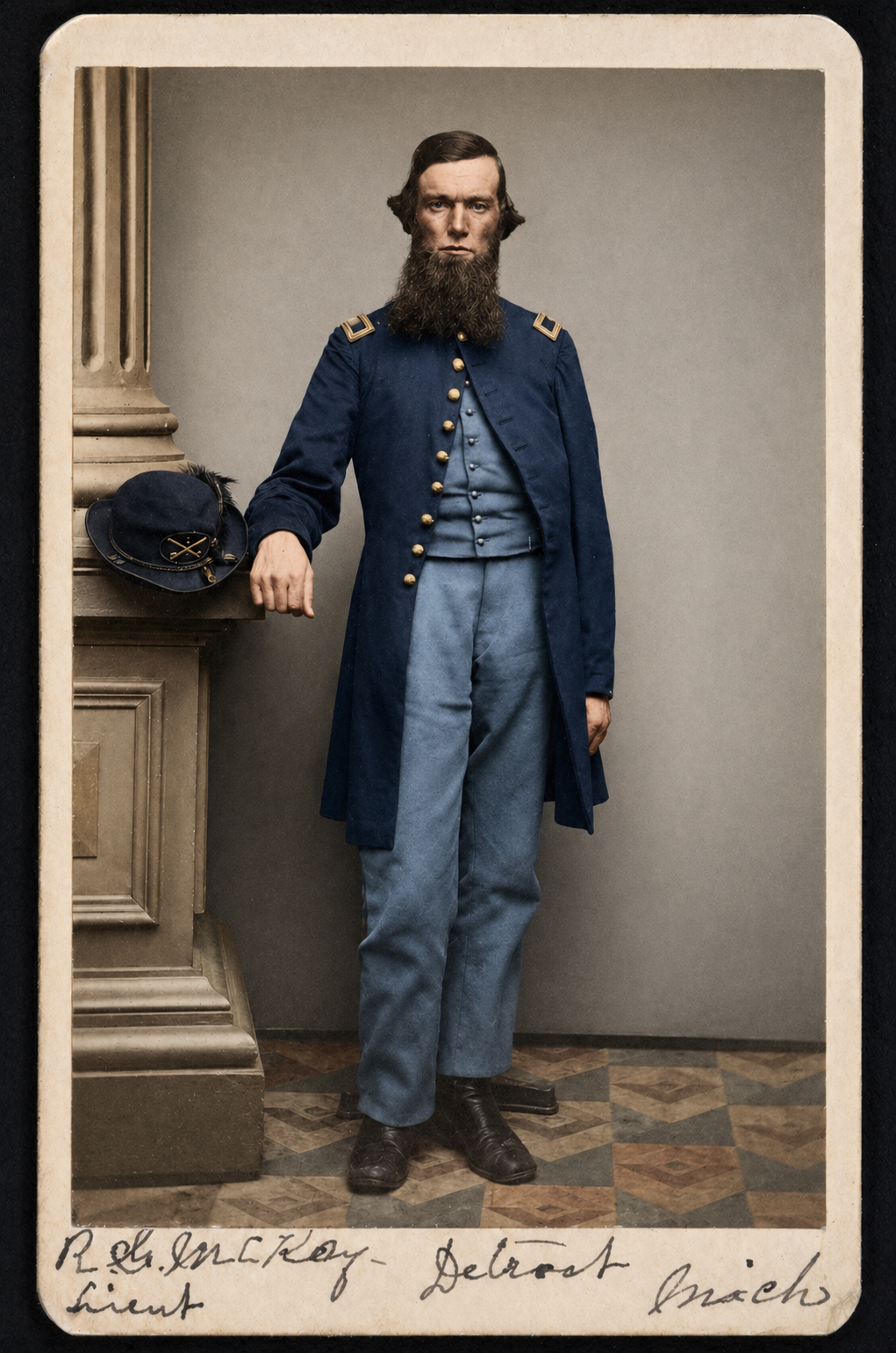
Colorized version of the 1863 photo
Each piece is real. The challenge is how to assemble them.
In one version of the story, Robert G. McKay dies on July 3, 1863, in the chaos of East Cavalry Field. He is one of many, his life ending in a moment of violent collision. His name is recorded, his service noted, and his story closes there. In another version, he survives. He continues through the war, perhaps through its final campaigns. Afterward, he moves west, or east, or somewhere beyond the immediate reach of his original records. He lives a longer life, one less visible to the historians who would later try to trace him.
Both versions are plausible. Both are grounded in elements of the record.
The Bell & Brother portrait does not resolve the question. It cannot. But it does something else.
It fixes a moment when the future was still open. The man stands there, not yet reduced to a line in a roster, not yet divided between competing accounts. He is present, fully, in that instant. The uniform, the posture, the gaze, all speak to a life in motion. Whether that motion ends at Gettysburg or continues beyond it is something the photograph does not say.
Robert G. McKay represents a kind of historical figure that resists closure. He is not entirely lost, but neither is he fully recoverable. His story sits at the intersection of record and uncertainty. In tracing him, we encounter not only the details of his service but the broader reality of Civil War history, where documentation is incomplete, where names blur, and where lives are sometimes split between competing narratives.
Did he fall with Custer's men at Gettysburg, one more casualty in a war defined by such losses?
Or did he survive, carrying his experience westward into a different chapter of American history?
The honest answer is that we do not know with certainty.
What we do have is a name, a regiment, a photograph, and a set of possibilities. And in that space, between what is known and what is uncertain, the past remains alive, not as a fixed story, but as a question still worth asking.