
Jouett Meekin: The Hard Thrower from Kentucky
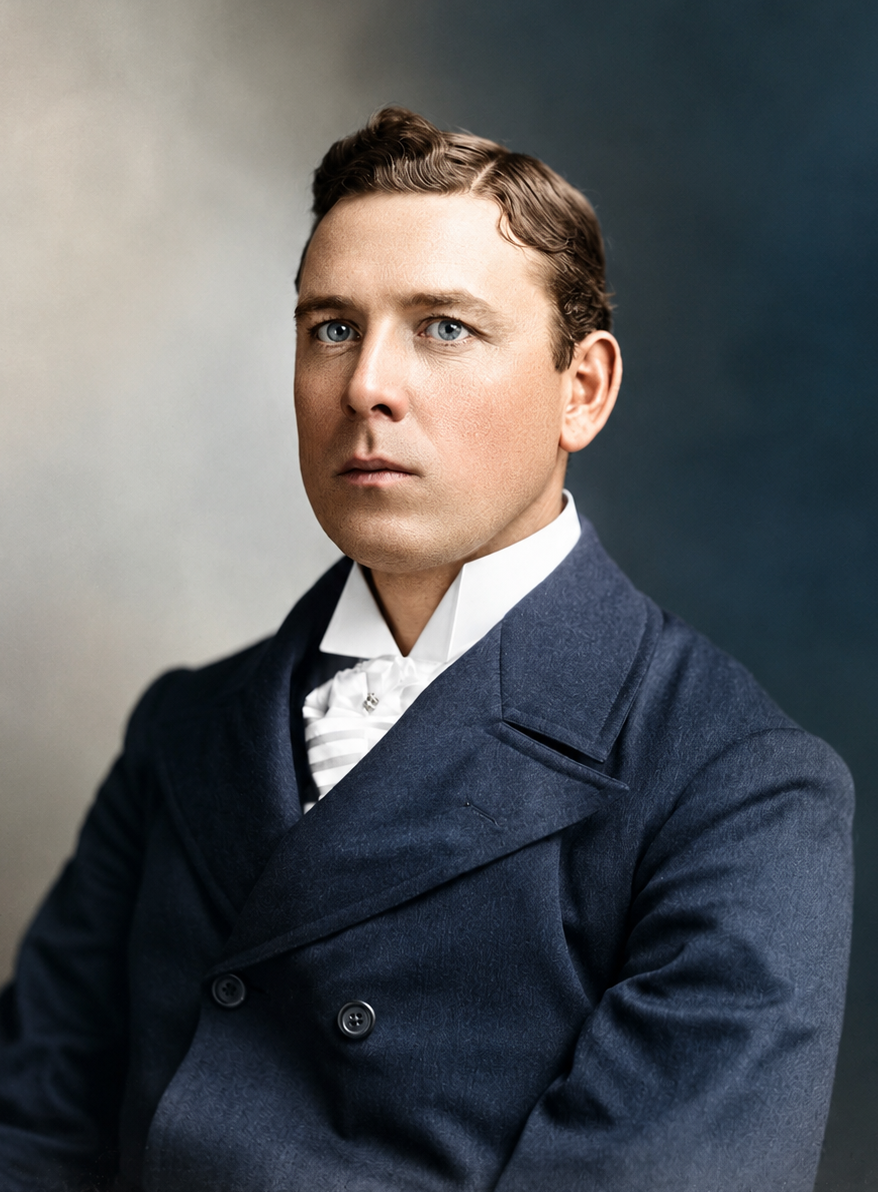
Jouett Meekin, colorized version of C.M. Bell photo taken in Washington D.C.
Long before baseball became an industry, before players signed contracts worth fortunes and before every pitch could be measured by radar guns and algorithms, there was Jouett Meekin. Today his name survives mostly among devoted baseball historians, yet for a brief and remarkable period in the 1890s he stood among the finest pitchers in America. He was one of the game's great power arms at a time when power itself was transforming baseball. His career unfolded during the sport's turbulent adolescence, when baseball was shedding its rough-and-tumble origins and becoming the national pastime.
The photographs remain. One portrait, made in the Washington studio of Charles Milton Bell, shows a young man in a dark suit staring directly at the camera. The face is serious, the eyes alert. There is no smile, no theatrical pose, no attempt at self-promotion. Bell's photograph reveals a quality common to many nineteenth-century athletes, a restrained confidence. These men had not yet learned to be celebrities. They had simply learned to win. Another portrait, made by Boston photographer Elmer Chickering, presents Meekin in uniform. The transformation is striking. The businessman becomes the ballplayer. The collar is replaced by the jersey. Together, Bell and Chickering preserved two sides of a man who lived during baseball's first great age and helped create the visual language of American sports celebrity.
Jouett Meekin was born in Kentucky in 1867, only two years after the Civil War. America itself was still rebuilding. Railroads were stretching across the continent, cities were expanding, and professional sports barely existed. Baseball, however, was beginning its rise. Like many young men of his generation, Meekin discovered that athletic ability could become a profession. He entered organized baseball during an era when players traveled by train, endured primitive conditions, and played schedules that would exhaust even modern athletes. There were no luxury hotels, no charter flights, and no personal trainers. The game demanded resilience as much as talent, and Meekin possessed both.
Standing more than six feet tall, an imposing figure for his era, Meekin developed a reputation as a hard thrower. That distinction became even more important in 1893 when baseball permanently moved the pitching distance back to sixty feet six inches. Many pitchers struggled with the adjustment, but Meekin thrived. The increased distance rewarded genuine velocity, and contemporary accounts frequently described his fastball as one of the most formidable in the game. In an age before radar guns, speed was measured by reaction. If hitters complained, if catchers winced, and if opposing players spoke about a pitcher's fastball with respect, that was evidence enough.
His success carried him through the major leagues, including stops with Louisville, Cincinnati, Pittsburgh, and New York. Baseball in the nineteenth century was often unstable. Teams appeared and disappeared, leagues reorganized, and players moved frequently. Through all that uncertainty, Meekin established himself as one of the game's premier pitchers. His finest season came in 1894 when he won thirty-three games for the New York Giants. To modern fans, the number seems almost impossible. Today's starters rarely reach twenty victories. Thirty-three wins belong to another baseball universe. Yet even in an era when pitchers carried enormous workloads, such a total represented excellence.
The Giants of 1894 were one of the strongest clubs in baseball, and Meekin stood at the center of their success. The season concluded with the Temple Cup, an early postseason championship series between the National League champion and runner-up. New York defeated the powerful Baltimore Orioles, and Meekin played a critical role in the triumph. For a moment, he stood at the summit of the baseball world, one of the most successful pitchers in the country and a key figure on a championship club.
“George” was his first given name, but it was common in the 19th century for men to go by their middle name, particularly when it was a family name. In Meekin’s case, “Jouett” was a tribute to the prominent Kentucky Jouett family, descendants of the Revolutionary War hero Jack Jouett.”
What makes Jouett Meekin especially fascinating, however, is not simply the statistics. The 1890s marked a turning point in American culture. Baseball was becoming more than a game. Newspapers devoted increasing space to sports. Fans followed teams with growing passion. Photographers produced portraits that circulated far beyond local ballparks. Athletes were becoming public figures. This is where Bell and Chickering enter the story. Charles Milton Bell photographed presidents, generals, politicians, and social leaders in Washington. When he photographed Meekin, he was documenting a changing America in which star athletes increasingly occupied the same cultural space as statesmen and military heroes. Chickering performed a similar role in Boston. His cabinet cards became some of the most recognizable sports portraits of the era, helping transform ballplayers into national figures long before radio or television existed.
Through their cameras, Meekin's image traveled farther than he ever could have imagined. Fans who never saw him pitch could still know his face. They could collect his portrait, display it in family albums, and connect the image to newspaper stories describing victories and championships. That was something entirely new. These photographs remind us how different baseball once appeared. Modern athletes often project carefully managed public personas. Meekin's generation did not. Their portraits reveal a directness and sincerity that feels almost foreign today. The expressions suggest men who still regarded baseball as work, albeit extraordinary work.
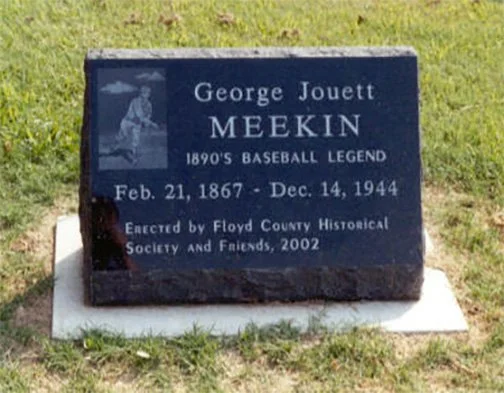
George Jouett Meekin, Fairview Cemetery in New Albany, Indiana,
As the century drew to a close, younger stars emerged, and the game continued to evolve. Meekin's career gradually faded from the headlines, as all athletic careers eventually do. Yet his accomplishments remained substantial. Over more than a decade in the major leagues, he won nearly two hundred games and established himself as one of the premier pitchers of his generation. Historians naturally remember legends such as Cy Young, Kid Nichols, and Amos Rusie, but beneath those giants stood a second tier of remarkable performers whose contributions were equally important to the game's development. Jouett Meekin belonged firmly in that company.
His story illustrates one of baseball's enduring truths. Fame is temporary; achievement lasts longer. Millions of fans today know the names of current stars, yet few recognize Jouett Meekin. A century from now the same may be true of today's heroes. Baseball moves relentlessly forward. What remains are the records, the stories, and occasionally the photographs. In Bell's portrait, the young man gazes toward the future, unaware that historians would still study his image more than a century later. In Chickering's photograph, the athlete stands ready to represent one of baseball's great franchises. In the championship scene that followed, the victory flag rises above a cheering crowd.
Together, those images tell the story of a remarkable life. Jouett Meekin was not merely a pitcher who won games. He belonged to the generation that transformed baseball from a regional pastime into a national obsession. He played during the years when the modern game took shape, thrived after the pitching distance changed forever, helped lead championship clubs, and became part of the visual record of American sports. The fastball is gone now. The crowds have dispersed. The ballparks of his era have vanished. But the photographs endure, and in those photographs Jouett Meekin still looks ready for the next pitch.
The remarkable thing about Jouett Meekin is not that he won thirty-three games in 1894. It is not that he helped the Giants win a championship. It is not even that contemporaries considered him one of the fastest pitchers of his age.
The remarkable thing is that he lived long enough to watch baseball become something entirely different.
When Meekin first stepped onto a professional diamond, players traveled by rail and fans followed games through next-day newspapers. When he died in 1944, Americans listened to the World Series on the radio, Babe Ruth had become a national icon, and baseball was woven into the fabric of American life.
In many ways, Jouett Meekin's lifetime mirrored baseball's own journey, from uncertain beginnings to national institution.
Today, he rests in Fairview Cemetery in New Albany, Indiana, far from the grand ballparks and cheering crowds. Yet through the photographs of Charles Milton Bell and Elmer Chickering, the young pitcher remains frozen in time, forever poised between the old century and the new, between baseball's beginnings and its golden age