
Dr. Mary Edwards Walker, A Life That Refused Permission
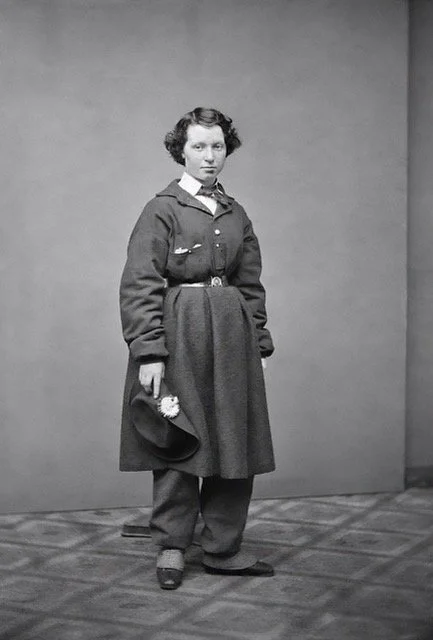
Mary Edwards, Mathew Brady
Few Americans of the nineteenth century unsettled their own age quite like Mary Edwards Walker. Long before the language of modern equality movements entered public life, Walker moved through the United States with uncompromising certainty that women possessed not merely the right to participate in public life, but the ability to stand fully equal within it. She did not ask for approval. She rarely softened herself for the comfort of others. And in an age intensely concerned with propriety, appearance, and social boundaries, she seemed almost determined to provoke the nation into confronting its own contradictions. Today, she is remembered most often as the only woman ever awarded the Medal of Honor. Yet the medal alone cannot explain her historical presence. Walker was at once a physician, reformer, prisoner of war, public lecturer, suffragist, and cultural irritant. She crossed lines that respectable society insisted women could not cross, then seemed genuinely puzzled that others found her behavior controversial.
The surviving photographic record of her life captures this transformation with remarkable clarity. In one portrait, likely made during the Civil War years in the studio of Mathew Brady, Walker appears young, direct, and confrontational in posture and dress. She stands in clothing that rejected the restrictive conventions imposed upon women of her era. More than a decade later, before the lens of Charles Milton Bell, she sits older and more severe, the Medal of Honor resting upon her chest. The years between those portraits encompass war, imprisonment, public ridicule, national recognition, and decades of relentless activism. Together, the two photographs form a visual biography of one of the most singular Americans of the nineteenth century.
Walker was born in 1832 in Oswego, New York, into a family already inclined toward reformist thinking. Her parents encouraged education for both sons and daughters, unusual in an era when many Americans still viewed advanced learning for women with suspicion. Even more striking, the family rejected aspects of traditional women's fashion. Tight corsets and heavy dresses, Walker later argued, damaged women physically and symbolized broader forms of social restriction. That belief would shape the rest of her life.
In the mid-nineteenth century, medicine remained overwhelmingly male. Female physicians existed, but they occupied a marginal and frequently mocked position within American society. Walker nonetheless entered medical training at Syracuse Medical College, graduating in 1855. Her achievement alone placed her among a tiny number of formally trained female physicians in the United States. Yet possessing credentials and being accepted were entirely different matters. Walker struggled to establish a successful medical practice before the Civil War. Patients often distrusted women doctors. Male physicians viewed them as intruders. Newspapers caricatured them. Even many women hesitated to seek treatment from someone so visibly outside accepted norms. Walker's marriage also deteriorated quickly, due in part to her refusal to adopt traditional expectations regarding obedience and domestic life. Eventually separated from her husband, she retained her own identity and increasingly embraced public advocacy.
Then came war. The outbreak of the Civil War in 1861 transformed American society with astonishing speed. Institutions collapsed under pressure. Old assumptions weakened. New opportunities emerged amid catastrophe. For Walker, the war created an opening that peace had denied her. At first, the Union Army resisted allowing women physicians into official service. Walker volunteered anyway. She initially worked without formal commission, serving in hospitals and near battle zones where casualties overwhelmed available medical personnel. The scale of suffering was unlike anything the nation had previously experienced. Disease spread through camps. Field hospitals overflowed after major engagements. Limbs piled beside surgical tables.
Walker entered that world not as a symbolic figure, but as a working physician. Eventually, she secured an appointment as a contract surgeon, becoming one of the first female surgeons employed by the U.S. Army. Even then, controversy followed her constantly. Newspapers criticized her clothing. Officers questioned her authority. Civilians stared openly when she appeared in modified men's attire or practical reform dress. Yet Walker continued to work among the wounded.
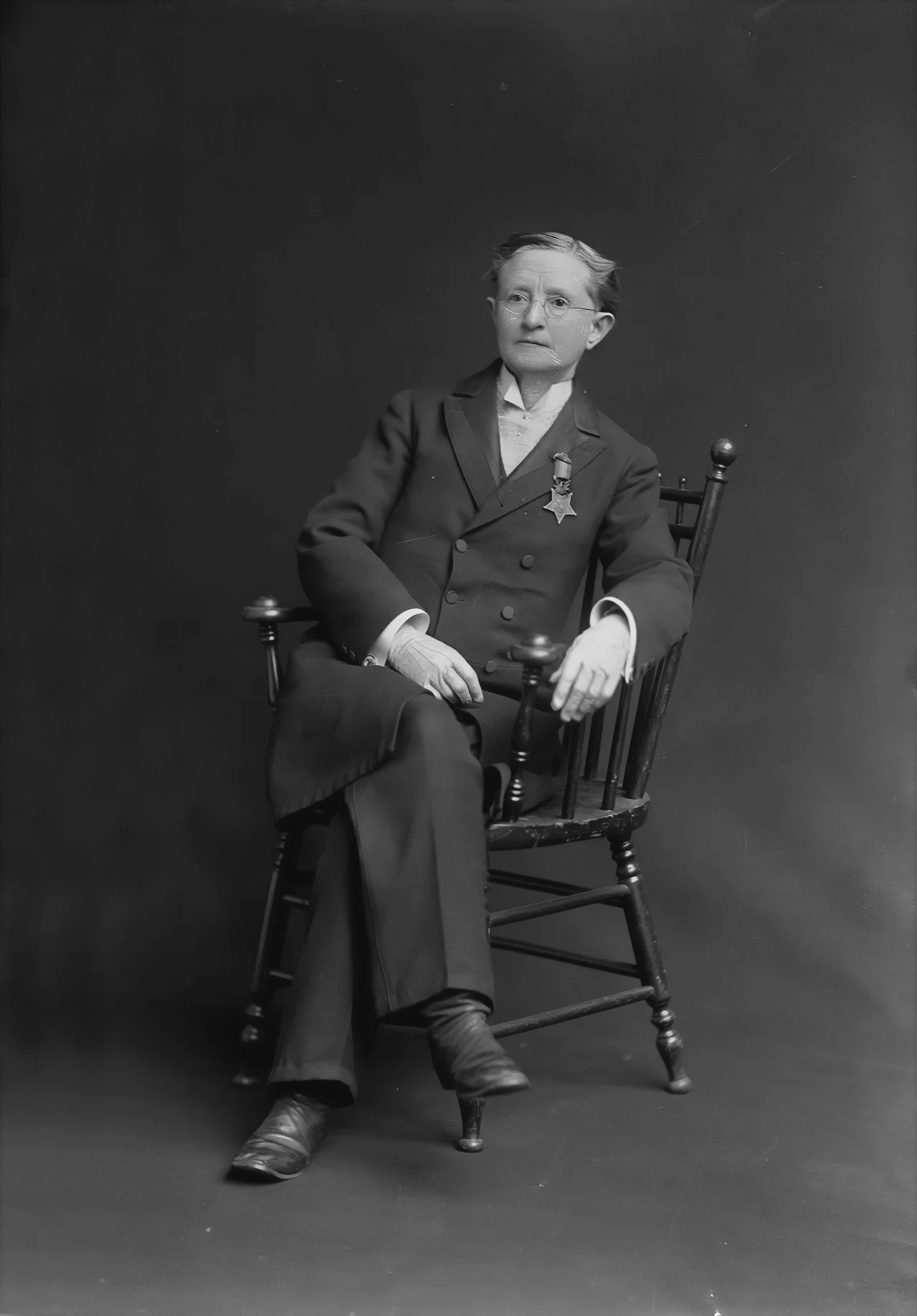
Dr. Mary Edwards, Charles Milton Bell
The war pushed her directly into danger. Unlike many physicians who remained behind major lines, Walker often traveled into contested regions to treat civilians and soldiers alike. In 1864 Confederate forces captured her near the Georgia front lines after suspecting her of espionage. Whether Confederate authorities truly believed she was a spy remains unclear, though her unusual appearance and independent movement through military zones undoubtedly fueled suspicion. She spent months imprisoned in Richmond, Virginia, before eventually being exchanged for Confederate medical personnel.
The imprisonment hardened Walker's public identity further. She emerged not subdued, but emboldened. Her wartime service had proven both her competence and her endurance. She had entered the war as an outsider seeking recognition. She emerged from it as a national figure impossible to ignore. In 1865, President Andrew Johnson awarded Walker the Medal of Honor for her wartime service. At the time, the criteria for the decoration differed from later standards focused specifically on combat valor. Walker's award recognized both her medical service and her devotion under dangerous wartime conditions.
The medal transformed her public image. For supporters, it validated her extraordinary contribution during the nation's greatest crisis. For critics, it intensified resentment toward a woman who already violated conventional expectations regarding dress, profession, and public conduct. Walker herself wore the medal constantly. It became not merely a decoration, but a declaration. After the war, she redirected her energies toward reform movements that increasingly defined the late nineteenth century. She lectured widely on women's rights, dress reform, health, and suffrage. Yet Walker often differed sharply even from fellow reformers. While many suffragists pursued carefully measured public strategies designed to reassure mainstream audiences, Walker embraced confrontation more readily.
She believed clothing itself represented political oppression. Victorian women's fashion imposed physical burdens through corsets, heavy skirts, and restrictive tailoring. Walker adopted forms of dress incorporating trousers, shorter skirts, and jackets styled after men's clothing. Public reaction was intense. Newspapers mocked her relentlessly. Crowds harassed her in public. On several occasions she was even arrested for impersonating a man, despite the fact that she made no effort whatsoever to conceal her identity as a woman. To Walker, the arrests merely proved her broader point. Society enforced gender expectations not through natural law, but through social pressure and legal intimidation. Her public image became increasingly polarizing. Admirers saw courage and intellectual independence. Critics saw arrogance, eccentricity, and provocation. Yet even those who ridiculed her could not fully dismiss her. Walker occupied an uncomfortable place in American life precisely because she exposed contradictions many preferred not to examine.
The same society that celebrated freedom recoiled at women who exercised it too openly. The same nation that praised wartime sacrifice questioned whether a female surgeon belonged in uniform. The same public that honored reform in abstraction frequently condemned reformers in person. Walker forced Americans to confront those tensions directly. By the time she appeared before the camera of C.M. Bell in Washington, the youthful intensity visible in Brady's wartime portrait had evolved into something sterner and more settled. Bell's portrait reveals a figure who had survived decades of controversy without retreating from herself. The Medal of Honor hangs visibly from her jacket. Her posture is composed but unsentimental. She does not appear eager to charm the viewer. That quality mattered.
Nineteenth-century portraiture often sought to soften subjects into forms acceptable to public taste. Bell, however, seems to have understood that Walker's significance rested precisely in her refusal to soften. The portrait carries neither theatricality nor apology. Instead, it presents a woman fully conscious of the life she had lived and entirely unwilling to diminish it. The irony of Walker's later life only deepened her historical significance.
In 1917, decades after the Civil War, the federal government reviewed thousands of Medal of Honor awards under stricter standards. Walker's medal was revoked alongside many others considered outside revised combat criteria. She was asked to return it. She refused. For Walker, the medal represented service honestly rendered to the nation during its gravest crisis. Bureaucratic revision could not erase lived experience. She continued wearing the medal publicly for the rest of her life.
In time, history shifted again. In 1977, the U.S. government formally restored her Medal of Honor, acknowledging the injustice of its revocation and reaffirming her place within the nation's military history. Yet perhaps the most remarkable aspect of Walker's legacy lies not in eventual recognition, but in the sheer persistence of her convictions across a lifetime. Many reformers moderate with age. Public pressure exhausts them. Isolation tempers their positions. Walker seemed almost constitutionally incapable of retreat. She endured ridicule that would have silenced most public figures. Editorial cartoons mocked her appearance. Audiences heckled her lectures. Critics portrayed her as unnatural, unstable, or absurd. Yet she continued traveling, speaking, writing, and appearing publicly in the clothing she chose and the identity she claimed.
In this sense, Walker belonged to a distinctly American tradition of radical individualism. She trusted her own moral judgment more than prevailing custom. That confidence often alienated others, including allies. But it also gave her unusual durability. She did not require consensus before acting. Modern audiences sometimes attempt to place historical figures neatly within contemporary ideological categories. Walker resists such simplification. She was progressive in some ways, deeply idiosyncratic in others. She embraced reform, yet frequently quarreled with reform movements. She sought equality, but on terms entirely her own.
What remains undeniable is her courage. Not simply battlefield courage, though she possessed that too. More difficult still was the social courage required to live publicly against the expectations of one's age. Walker risked reputation, livelihood, arrest, and humiliation repeatedly. She did so not for a temporary spectacle, but across decades. That persistence gives the two surviving portraits their unusual emotional power.
In Brady's image, we see ambition, challenge, and defiance before history fully unfolded around her. In Bell's portrait, we see the consequence of that defiance carried through an entire lifetime. The war sits invisibly between them. So too do years of public battle waged not with rifles, but with appearance, speech, and stubborn refusal to yield. Together, the photographs preserve something larger than biography. They capture the evolution of an American woman who insisted on inhabiting public life fully before the nation possessed language broad enough to understand her.