Edith Bolling Wilson: Before the White House, at the Center of Power
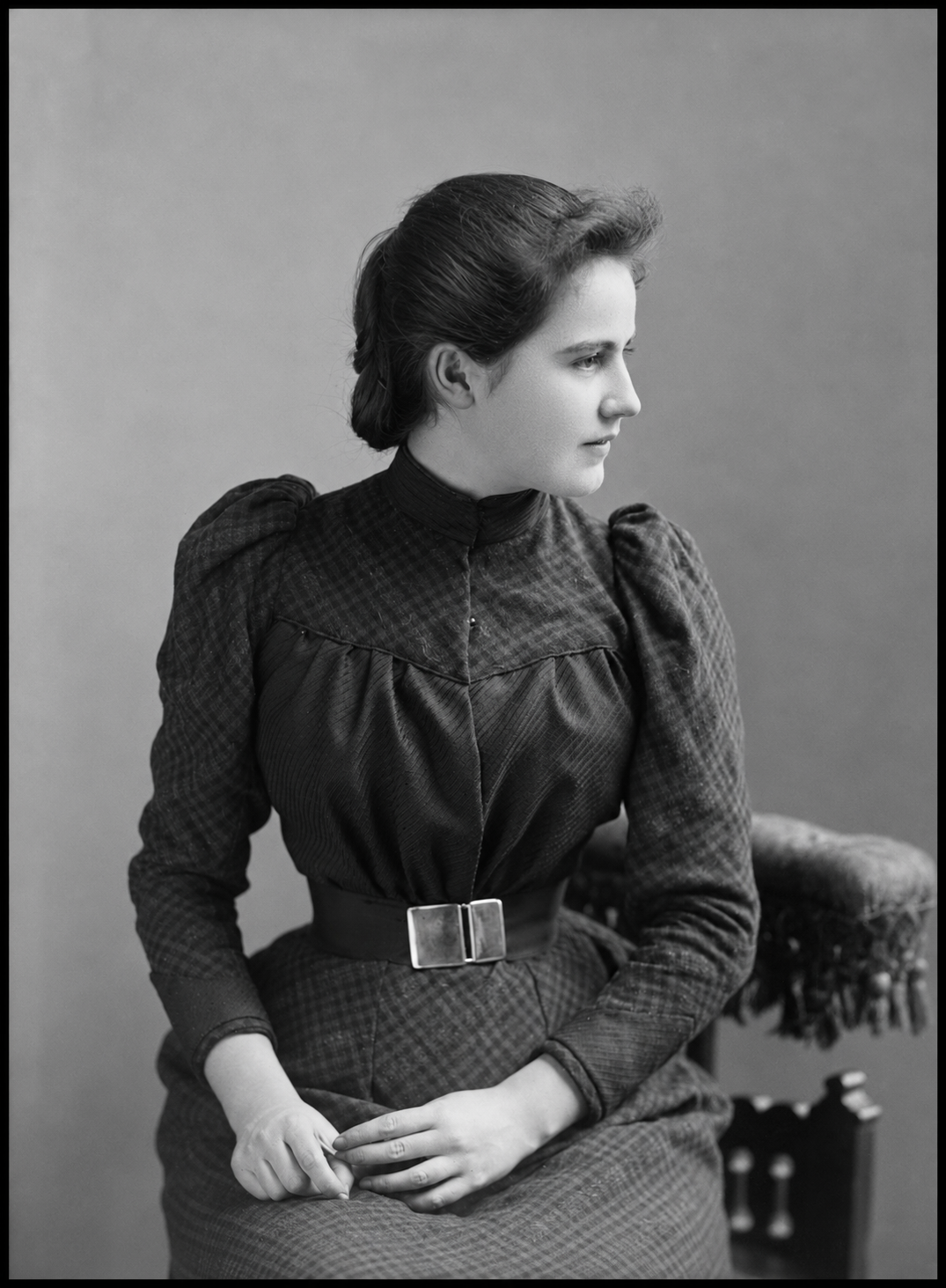
Edith Bolling, 1892, C.M. Bell Studio
C. M. Bell’s glass plates, tucked away in the Library of Congress, preserve a young Virginia woman and her mother decades before Edith Bolling Wilson became First Lady. She was there in the making of the postwar world, and occupied one of the most extraordinary and constitutionally troubling positions ever held by a presidential spouse.
Long before the White House, Versailles, the League of Nations, and the illness that would place her at the center of presidential power, Edith Bolling sat before the camera of Washington photographer C. M. Bell. The surviving Bell negatives are striking because nothing obviously political appears in them. Edith is young, composed, fashionably dressed, and unmistakably comfortable in front of the camera. Bell also photographed her mother, Sallie White Bolling, creating a small family group within an archive otherwise filled with thousands of Washington politicians, military officers, diplomats, businessmen, families, and anonymous citizens.
The Library of Congress broadly dates at least one of the Bell portraits of Edith to between 1886 and 1896. Edith, born in 1872, would therefore have been somewhere between fourteen and twenty-four. The range ends in the year of her first marriage. Whatever the exact date, Bell's camera encountered Edith Bolling long before anyone could have imagined the peculiar place she would eventually occupy in American history. In retrospect, the photographs acquire a gravity they could not have possessed when the glass plates were exposed. The young woman looking quietly beyond Bell's camera would become the wife of a president, cross the Atlantic as First Lady during the settlement of a world war, and, after Woodrow Wilson's catastrophic stroke in 1919, determine who and what reached the incapacitated chief executive at precisely the moment the United States was deciding whether to join his proposed League of Nations.
She would spend the final thirty-seven years of her life defending Wilson, preserving his papers and possessions, shaping his public memory, and keeping his Washington home almost as a shrine. Edith Bolling Wilson's story is therefore not simply the story of a First Lady. It touches questions of presidential disability, constitutional succession, marriage and political power, the creation of historical memory, and the considerable authority that can exist without ever appearing in law.
A Virginia daughter comes to Washington
Edith Bolling was born in Wytheville, Virginia, a small town in the far reaches of southwest Virginia on October 15, 1872, the seventh of eleven children of Judge William Holcombe Bolling and Sallie Spiers White Bolling. The Bollings belonged to an old Virginia family whose social standing had survived the Civil War more successfully than its wealth. The family lived above commercial premises on Main Street in Wytheville, surrounded by siblings and extended family. Edith's formal education was brief. Educated largely at home in Wytheville, she entered Martha Washington College in Abingdon at fifteen, where she studied music, and later attended the Richmond Female Seminary, commonly known as Powell's School. She never attended college in the modern sense or earned a degree.
Her southern upbringing remained important to her throughout her life. It also complicates modern attempts to make Edith into a straightforward symbol of women's political advancement. She was not originally a suffragist, and her attitudes reflected many social assumptions of the post-Civil War Virginia world in which she was raised. The President Woodrow Wilson House today notes both her opposition to women's suffrage and her later involvement with organizations devoted to Confederate memory. Her subsequent exercise of extraordinary political influence was therefore less the culmination of a feminist political philosophy than the consequence of personality, marriage, circumstance, and crisis.
As a young woman, Edith frequently visited her married sister in Washington. There she met Norman Galt, a member of the family associated with the prominent Washington jewelry firm Galt & Bro. They married on April 30, 1896. The marriage brought Edith securely into Washington society and gave her a degree of independence unusual for many women of her generation.
Their private happiness included tragedy. In September 1903, Edith gave birth to a son who survived only two days. She did not discuss the child in her later memoir. Five years later, in 1908, Norman Galt died unexpectedly. Edith was only thirty-five. Widowhood left her financially comfortable and increasingly self-reliant. She had experience with the family business, traveled, maintained an active Washington social life, and famously drove her own electric automobile through the capital.
This emerging independence would shape her in ways she did not anticipate. When Edith later entered the White House, she was not an inexperienced young bride adapting herself to a powerful husband. She was a mature widow of forty-three who had already endured marriage, motherhood, bereavement, business responsibilities, and years of running her own household.
A widower in the White House
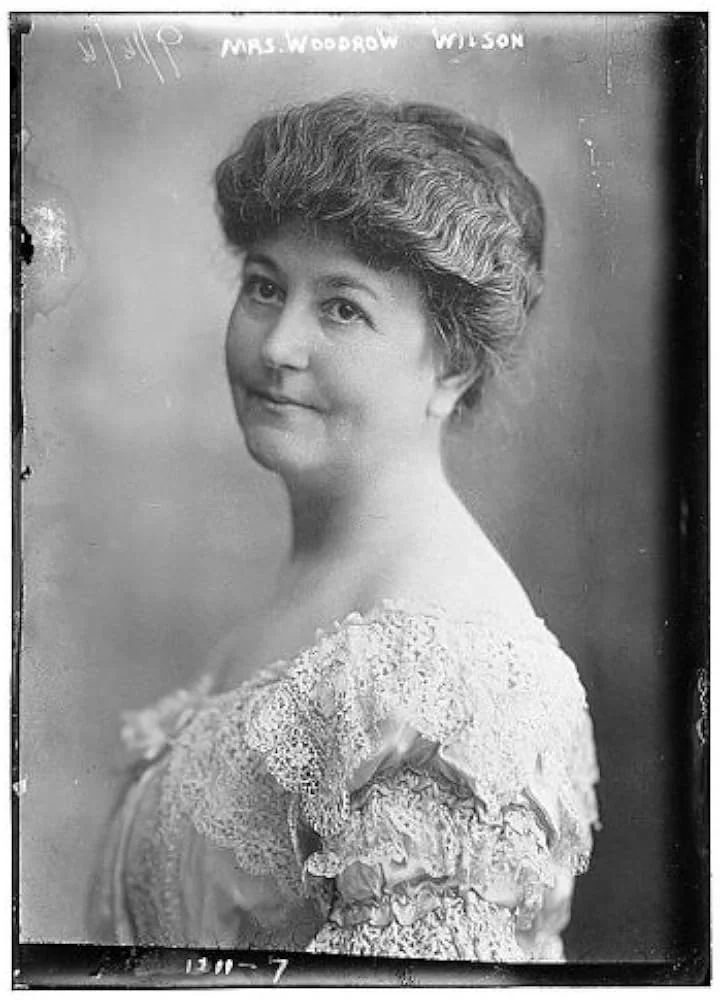
Mrs. Ellen Axson Wilson, 1913
President Woodrow Wilson had suffered a devastating personal loss of his own. His first wife, Ellen Axson Wilson, died in the White House in August 1914. Wilson was profoundly lonely afterward. Edith entered his circle in the spring of 1915. The attraction was remarkably quick. Wilson pursued her with an intensity evident in the substantial surviving correspondence between them. Politics and intimacy mixed freely. The Library of Congress preserves their letters, including discussions of political and international affairs, demonstrating how rapidly Edith became more than a social companion. They married at Edith's Washington home on December 18, 1915. Edith was forty-three, Wilson fifty-eight.
Within a year, the United States entered the First World War. Edith's years as First Lady were therefore dominated not by the White House's conventional social calendar but by war, mobilization, diplomacy, and eventually peace negotiations. She participated in wartime conservation campaigns and accompanied Wilson abroad after the Armistice, becoming the first sitting First Lady to make such a presidential journey to Europe. She met monarchs, statesmen, soldiers, and enormous crowds as Wilson tried to translate American intervention in the war into a new international order.
At the center of that vision stood the League of Nations.
Wilson believed some permanent association of nations was necessary to prevent another catastrophe like the war that had ended in 1918. He personally participated in the Paris negotiations and made the League covenant an integral part of the Treaty of Versailles. The decision carried immense political risk at home. Versailles and the battle with the Senate. Under the Constitution, treaties require the advice and consent of two-thirds of the Senate. Wilson returned from Europe facing a Senate controlled by Republicans and led on foreign affairs by Massachusetts senator Henry Cabot Lodge, a formidable adversary.
Wilson had made his task harder by declining to include leading senators among the American peace negotiators. Lodge and others objected particularly to provisions of the League covenant that they feared could compromise congressional authority over American involvement in future conflicts. On July 10, 1919, Wilson personally carried the Treaty of Versailles into the Senate chamber, an extraordinary gesture meant to emphasize the agreement's importance. The Senate Historical Office notes that even during that address, Wilson appeared physically diminished and struggled to read portions of his prepared remarks. The ensuing fight became deeply personal. Lodge was prepared to accept the treaty with reservations.
At the center of the Senate's resistance to the Treaty of Versailles stood a question larger than partisan hostility toward Wilson: collective security. Senator Henry Cabot Lodge did not oppose international cooperation in principle. Before the war he had spoken favorably of arrangements that might place international force behind the preservation of peace. His objection in 1919 centered on whether membership in Wilson's League of Nations could commit the United States to defend other nations without preserving Congress's constitutional authority to decide when to use American military power.
The critical provision was Article X of the Covenant of the League of Nations. It required League members to respect and preserve the territorial integrity and political independence of other members against external aggression. In the event of aggression, the League Council would advise members on the means by which that obligation should be fulfilled. Wilson regarded the provision as fundamental. The terrible lesson of the First World War, as he understood it, was that aggression against one nation could no longer be treated as someone else's problem. Peace required nations to accept a shared responsibility to resist aggression. This was the principle of collective security. A potential aggressor would know in advance that an attack on one member of the international community could bring a response from the others. Wilson believed such a system offered an alternative to the balance-of-power diplomacy and competing alliances that had helped bring Europe to catastrophe in 1914.
Lodge saw the constitutional difficulty immediately. The Constitution gave Congress the power to declare war. If the United States ratified a treaty promising to preserve the territory and political independence of every League member, Lodge feared that Congress might in practice be committed before it had ever voted. A president confronted with aggression abroad could point to Article X and argue that the United States had already pledged itself to act. Congress might retain its legal power to refuse, but it would do so only by repudiating an international obligation the nation had previously accepted.
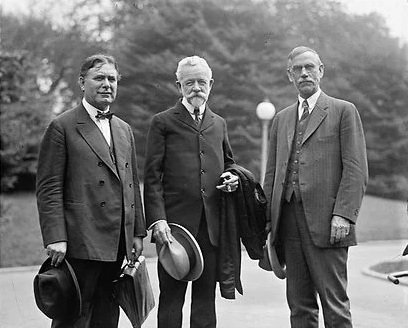
National Photo Company/Library of Congress Senator William Borah of Idaho, left, and Senator Henry Cabot Lodge of Massachusetts, center, formed the primary opposition to the Treaty of Versailles supported by President Woodrow Wilson.
Lodge therefore sought to place an explicit safeguard around the congressional war power. His reservations made clear that the United States would assume no obligation to preserve another nation's territorial integrity or political independence, or to employ American military or naval forces under the League Covenant, unless Congress authorized such action. The Senate's historical account identifies this as one of the most consequential of Lodge's reservations because it required congressional approval for American military action undertaken through the League.
To Wilson, that reservation struck at the very purpose of the League. Collective security depended upon credibility. If every nation could reconsider its obligations after aggression occurred, Wilson feared that the promised guarantee would carry little weight. An aggressor might gamble that individual governments would hesitate, delay, or decline to act, leaving the League incapable of preserving the peace it had been created to defend.
The disagreement therefore went well beyond a simple contest between an internationalist president and an isolationist Senate. Wilson and Lodge argued over how an American system of constitutional government could participate in a new international system of collective security. Wilson believed the League Council could recommend action without superseding Congress's constitutional powers. Lodge believed the treaty obligation itself could create political and diplomatic commitments that would effectively constrain Congress's freedom of action. The State Department's historical account identifies Article X and precisely this concern over the transfer of American war-making authority as central to Senate opposition.
Personal and partisan antagonism unquestionably deepened the conflict. Wilson and Lodge disliked one another intensely, and Lodge had no intention of allowing Wilson to return from Europe as the unchallenged architect of a new international order. Yet reducing Lodge's reservations to obstructionism misses the dispute's constitutional substance. Lodge was willing to consider an international organization, but he would not accept one he believed could place American military commitments beyond Congress's effective control.
Wilson increasingly resisted any compromise that, in his view, weakened the League. Believing that public opinion could break the Senate opposition, he embarked upon a punishing national speaking tour.
A Constitutional Crisis
Edith worried about his health. Her concern proved justified. Wilson collapsed in Pueblo, Colorado, on September 25, 1919. He was rushed back to Washington. Then, on October 2, he suffered a massive stroke. The consequences were catastrophic. Wilson was partially paralyzed. His vision and speech were affected, and his emotional and physical capacities were severely impaired. He would never fully recover. The United States now confronted a question for which its constitutional machinery provided no satisfactory answer: What happens when the president is alive but cannot adequately perform the duties of the presidency?
Edith's "stewardship"
There was no Twenty-Fifth Amendment in 1919. The constitutional language on presidential "inability" was ambiguous, and no accepted procedure existed to determine that a living president was disabled and temporarily transfer his powers to the vice president. Vice President Thomas R. Marshall did not assume presidential authority. Wilson did not resign. Instead, Edith, Wilson's physician, Admiral Cary Grayson, and a small circle around the sickroom tightly controlled access to the president.
It was here that Edith Bolling Wilson entered one of the strangest chapters in the history of the American presidency. Cabinet officers could no longer see the president casually. Documents destined for Wilson passed through Edith. She decided which questions were sufficiently important to disturb him, which papers he should see, and when they should be presented. Messages and presidential responses traveled back through the same narrow channel. Edith later called this arrangement her "stewardship."
In My Memoir, published in 1939, she insisted that she had "never made a single decision regarding the disposition of public affairs." Her claim deserves serious attention, but not uncritically. Modern scholarship generally rejects the sensational notion that Edith simply became president and personally dictated national policy. It also recognizes that deciding which information reached the president, which people saw him, and which questions were postponed was itself an exercise of substantial political power.
The distinction is important. There is no constitutional basis for calling Edith Wilson president. She did not take the oath of office. She did not possess presidential authority. She did not independently sign legislation or formally issue executive orders as president. Yet neither was she merely a nurse sitting beside her husband's bed. She became the indispensable gatekeeper between the constitutional president and the government he was supposed to lead.
Wilson's condition was not fully disclosed to Congress or the American public. For a considerable period, even senior officials had little direct opportunity to judge his capacity. The consequences could be serious. Secretary of State Robert Lansing began convening Cabinet meetings without Wilson. The president eventually dismissed him. Other governmental business was delayed or left to department heads.
The official constitutional history of the Twenty-Fifth Amendment now treats the Wilson episode as a major example of presidential incapacity, demonstrating the weakness of the original constitutional arrangement. Congress began debating possible solutions to presidential disability after Wilson's illness, although a definitive constitutional solution did not arrive until ratification of the Twenty-Fifth Amendment in 1967.
The treaty dies
The timing could scarcely have been more consequential. While Wilson lay stricken in the White House, the Senate continued debating the treaty around which he had built the conclusion of his presidency. Lodge offered reservations. A political compromise remained conceivable. Wilson, however, resisted accepting the treaty in a form he believed compromised the League. His illness likely magnified his rigidity. Historians continue to debate how much responsibility belongs to Wilson and how much to Lodge and the treaty's other opponents, but the central political fact is unmistakable: the necessary coalition for ratification never came together.
The Senate rejected the treaty on November 19, 1919, and again failed to approve it in March 1920. The United States never joined Wilson's League of Nations. Edith could control access to Wilson. She could not deliver the Senate.
From the White House to S Street
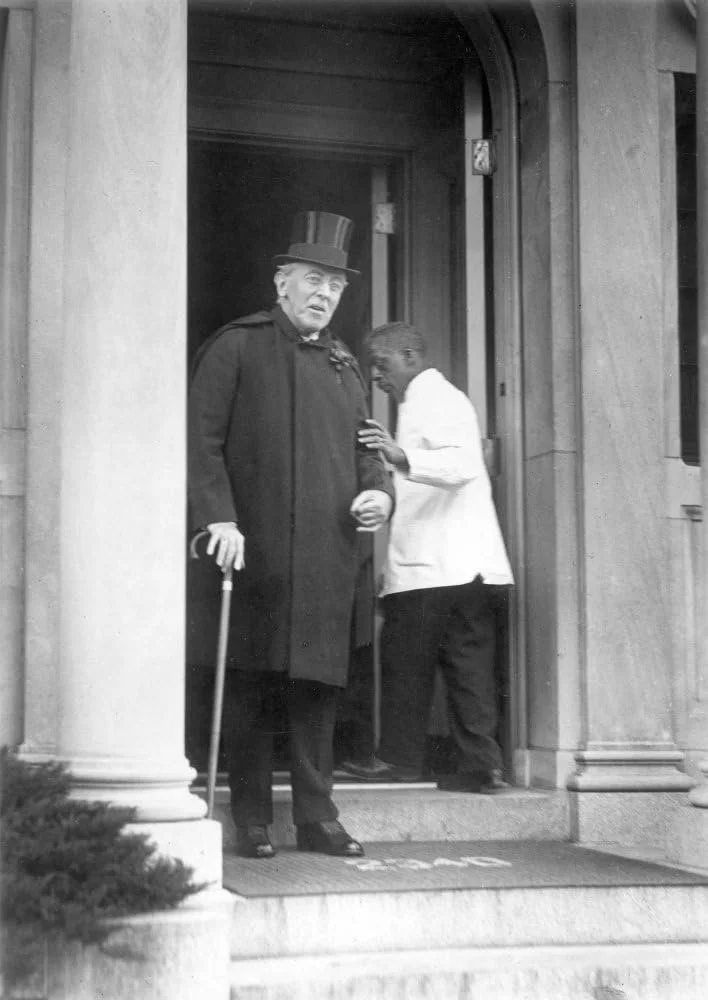
Woodrow Wilson (1856-1924) N28Th President Of The United States Photographed In 1921 Leaving His Home In Washington DC Poster Print by (24 x 36)
Wilson's term expired on March 4, 1921. He and Edith moved only a short distance from the White House to 2340 S Street NW, in Washington's Kalorama neighborhood. The house had to accommodate the former president's disabilities. They converted a trunk lift shaft into an elevator because Wilson had difficulty with stairs. There, Edith's role changed from presidential gatekeeper to full-time companion and caretaker.
But no matter the accommodations of their new home, Woodrow Wilson survived less than three years after leaving office. He died at the S Street house on February 3, 1924, aged sixty-seven. Edith was fifty-one. Her mother, Sallie Bolling, was still alive. The woman photographed by Bell decades earlier therefore lived to see her daughter marry a president, become First Lady, travel to Europe amid the settlement of the First World War, and emerge from the unprecedented crisis surrounding Wilson's incapacity. Sallie died in 1925, shortly after her presidential son-in-law.
Edith, however, had another thirty-seven years ahead of her. And those years are essential to understanding her.
The keeper of Woodrow Wilson
After Wilson's death, Edith devoted enormous energy to controlling, preserving, and promoting his historical legacy. Her determination was evident almost immediately. When Henry Cabot Lodge planned to attend Wilson's funeral as a representative of the Senate Foreign Relations Committee, Edith objected. According to the Senate's own historical account, she informed Lodge that his presence would be unwelcome. The old struggle over Versailles had followed Wilson to the grave, and Edith had not forgiven his chief antagonist.
More consequential was her management of Wilson's papers. In 1924 she selected journalist Ray Stannard Baker as Wilson's authorized biographer. With Edith's approval, Wilson's papers were shipped to Baker in Amherst, Massachusetts, in March 1925. She gathered additional materials and worked to document her husband's life. In 1929, she agreed that the papers should begin passing to the Library of Congress as Baker completed his work. Those records would eventually form the heart of one of the nation's great presidential manuscript collections.
Edith therefore became something more than Wilson's widow. She became an architect of the historical record through which later generations would encounter him. That point requires care. Preservation and interpretation are not the same thing. Edith revered her husband, defended his decisions, and had strong opinions about those who had opposed or criticized him. Her memoir is invaluable precisely because it is both testimony and advocacy.
Published in 1939, My Memoir offered Edith's account of her childhood, marriage, White House experiences, the peace conference, Wilson's illness, and his death. Historians use it extensively, but they read it alongside Cabinet records, medical evidence, correspondence, presidential papers, contemporary journalism, and recollections of other participants. Her commemorative work extended beyond papers. She supported Wilson memorial organizations, commissioned and encouraged representations of her late husband, and maintained the S Street house much as it had appeared during his lifetime.
She also remained politically and socially active. In 1924 she became head of the board of governors of the Woman's National Democratic Club, an organization founded only a few years after women gained the constitutional right to vote. The irony is considerable for a woman who had once been unsympathetic to the suffrage movement.
She traveled again, including journeys to Europe and China, and remained a recognized figure in international and Washington society. Her voluminous surviving papers document correspondence with an extraordinary succession of presidents, first ladies, politicians, diplomats, and public figures, including Franklin and Eleanor Roosevelt, Harry and Bess Truman, Dwight and Mamie Eisenhower, John and Jacqueline Kennedy, and Adlai Stevenson. The Library of Congress holds about 19,000 items in the Edith Bolling Galt Wilson Papers, with most dating from after 1925. She had become an institution.
The last First Lady of another age
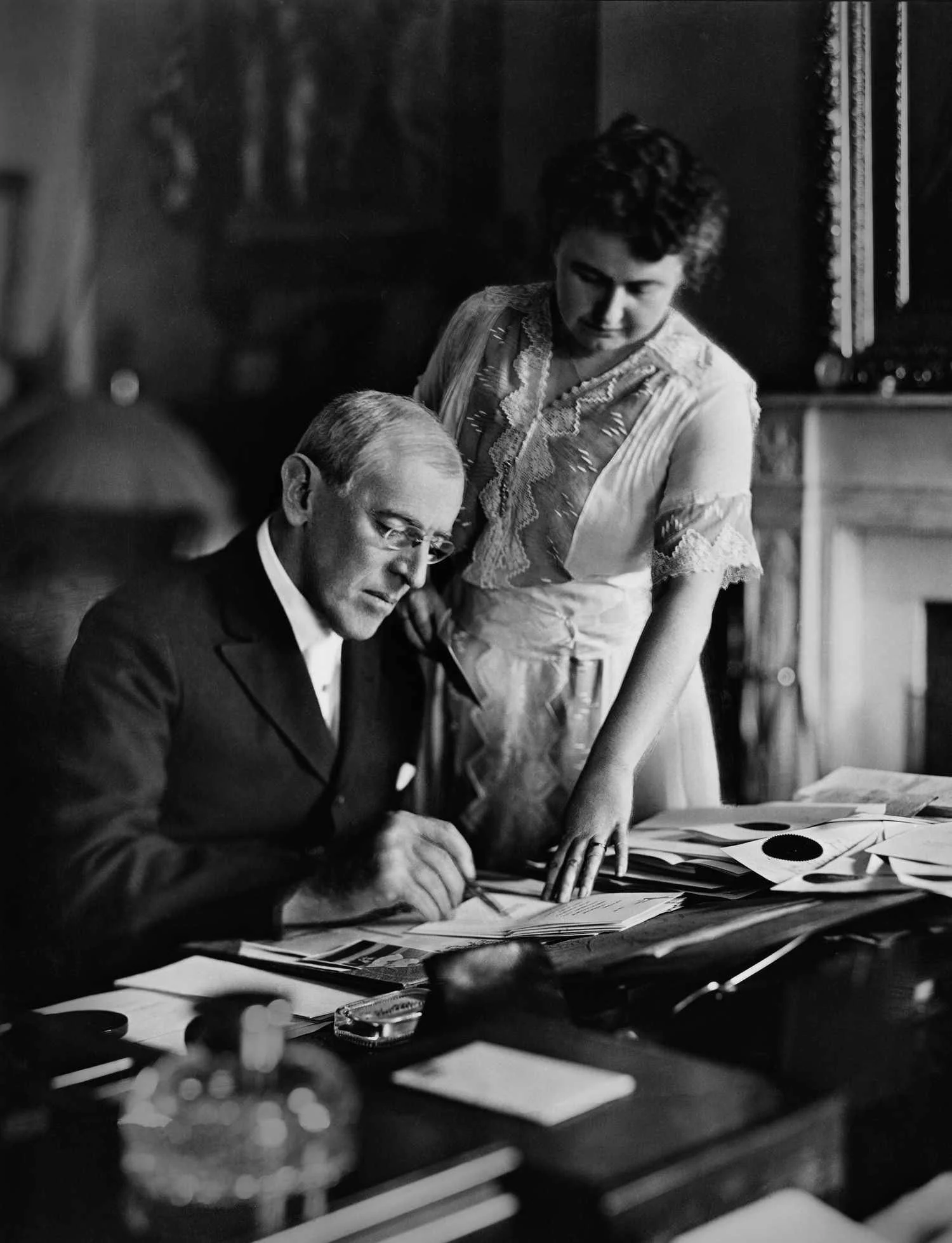
President Woodrow Wilson and First Lady Edith Wilson.
That chronological span is extraordinary. The girl photographed by Bell in nineteenth-century Washington had known a capital of horse-drawn carriages, gaslight, cabinet photographs, and glass negatives. In old age she lived in a world of television, jet aircraft, nuclear weapons, and the Cold War. She participated in John F. Kennedy's inaugural celebrations in January 1961 and later that year sat beside Kennedy at the White House when he signed legislation establishing the Woodrow Wilson Memorial Commission. It was a remarkable image: the widow of a president elected in 1912 beside the first president born in the twentieth century.
Edith died at the S Street house on December 28, 1961. The date carried an almost theatrical historical symmetry. December 28 was Woodrow Wilson's birthday. Had he lived, he would have been 105. Edith was eighty-nine. She was buried beside him at Washington National Cathedral.
In her will, she left the S Street house and its thousands of furnishings and objects to the National Trust for Historic Preservation, stipulating that it serve as a memorial to Wilson. The house opened to the public in 1963. In effect, Edith had preserved not merely her husband's papers but the physical setting of his final years. The National Trust has aptly described her as the house's first curator.
What, then, was Edith Wilson? Calling her "America's first female president" makes for a memorable headline, but it obscures as much as it reveals. She was not president. She did not constitutionally inherit Wilson's authority, and established scholarship does not support the claim that she personally made every major policy decision during his incapacity.
Something historically extraordinary nevertheless occurred. An unelected presidential spouse acquired the power to control access to an incapacitated chief executive. She filtered information. She determined what Wilson would confront and what would wait. She helped conceal the degree of his incapacity. She helped maintain a presidency whose constitutional ability to function was genuinely uncertain.
Historian Kristie Miller, drawing extensively upon Wilson-era manuscript material, places Edith between the extremes of heroic protector and usurping "shadow president." She did overstep the traditional role of a First Lady, Miller concludes, while acting according to what she believed her husband wanted and what she thought necessary to preserve him. John Milton Cooper's major biography of Wilson likewise treats the disability as central to the collapse of the president's final political hopes. The constitutional problem was larger than Edith Wilson.
In 1919 the United States had no reliable mechanism for temporarily transferring presidential authority when a president was alive but severely incapacitated. That vacuum allowed personal loyalty, medical discretion, political fear, and marital devotion to substitute for constitutional procedure. Nearly half a century later, the Twenty-Fifth Amendment provided the mechanism that Wilson's illness had shown was missing.
And that is where the Bell negatives become so compelling. They return us to a moment before anyone knew the ending. There is Edith Bolling, young and composed, photographed in Washington decades before the presidency. There is her mother, Sallie, another Virginia woman whose lifetime would stretch from before the Civil War to the aftermath of the First World War. Nothing in these fragile glass plates announces Versailles. Nothing suggests a presidential sickroom, a constitutional crisis, a battle with the United States Senate, or thirty-seven years spent guarding the reputation of a dead president.
Bell's camera could record the face. History would supply everything else.
Edith Bolling Wilson entered the C. M. Bell Studio as a young Virginia woman. She left history as one of the most consequential and controversial First Ladies the nation has ever known, a woman who never held presidential office but who, for an extraordinary season, stood at its very door.
****
Endnotes:
1. C. M. Bell, photographer, "Edith Bolling (married Woodrow Wilson)," between 1886 and 1896, glass negative, C. M. Bell Studio Collection, Prints and Photographs Division, Library of Congress, call no. LC-B5-309001.
2. Kristie Miller, Ellen and Edith: Woodrow Wilson's First Ladies (Lawrence: University Press of Kansas, 2010). Miller is particularly useful for Edith's Virginia upbringing, her first marriage, her relationship with Wilson, and her role during his incapacity.
3. John Milton Cooper Jr., Woodrow Wilson: A Biography (New York: Alfred A. Knopf, 2009). See especially Cooper's chapters on the League fight, Wilson's disability, and the collapse of his presidency after 1919.
4. Edith Bolling Galt Wilson, My Memoir (Indianapolis and New York: Bobbs-Merrill Company, 1939). This remains the essential primary source for Edith's own account of her marriage, the Paris Peace Conference, Wilson's stroke, and what she termed her "stewardship." It should be treated as testimony rather than a neutral account.
5. Arthur S. Link, ed., The Papers of Woodrow Wilson, 69 vols. (Princeton, N.J.: Princeton University Press, 1966-1994). Volumes 63 through 68 are particularly important for the peace negotiations, the League controversy, Wilson's illness, and the closing years of his presidency.
6. Woodrow Wilson Papers, Manuscript Division, Library of Congress, Washington, D.C. The collection contains approximately 280,000 documents, including Wilson's official papers, correspondence with Edith, material from the Paris Peace Conference, and records relating to his post-presidential years.
7. Edith Bolling Galt Wilson Papers, Manuscript Division, Library of Congress, Washington, D.C., MSS45930. The approximately 19,000-item collection is especially valuable for Edith's life after Wilson's death, including her correspondence, memoir drafts, financial and legal records, Wilson estate matters, and later Washington activities.
8. U.S. Senate Historical Office, "Senate Rejects the Treaty of Versailles." The Senate rejected the treaty on November 19, 1919, after Henry Cabot Lodge presented it with fourteen reservations. The official Senate history also recounts Edith Wilson's later refusal to welcome Lodge at Wilson's funeral.
9. U.S. Senate, "Rejected Treaties." The Treaty of Versailles failed again on March 19, 1920, leaving the United States outside the League of Nations.
10. Edith Bolling Galt Wilson and Woodrow Wilson correspondence, Woodrow Wilson Papers, Manuscript Division, Library of Congress. The collection includes Wilson's courtship correspondence and extensive material documenting Edith's increasing intimacy with both Wilson and the political affairs surrounding him.
11. Edwin Tribble, A President in Love: The Courtship Letters of Woodrow Wilson and Edith Bolling Galt (Boston: Houghton Mifflin, 1981). This published collection is useful for the unusually intense courtship of 1915 and the degree to which Wilson discussed political affairs with Edith before their marriage. (
12. Cary T. Grayson, Woodrow Wilson: An Intimate Memoir (New York: Holt, Rinehart and Winston, 1960). Grayson, Wilson's physician, provides an indispensable contemporary perspective on Wilson's health and the White House circle surrounding the president. ([The Library of Congress][4])
13. Josephus Daniels, The Cabinet Diaries of Josephus Daniels, ed. E. David Cronon (Lincoln: University of Nebraska Press, 1963). Daniels's contemporary Cabinet observations provide an important counterpoint to Edith Wilson's retrospective account of the period of presidential incapacity.
14. Library of Congress, "Edith Bolling Galt Wilson & the Wilson Family," American Women: Resources from the Manuscript Collections. The Library notes that most of Edith Wilson's surviving papers date from after her husband's death and that roughly another 10,000 items concerning her appear in the Woodrow Wilson Papers.
15. C. M. Bell Studio Collection, Prints and Photographs Division, Library of Congress. The collection consists of roughly 30,050 glass negatives made between 1873 and about 1916, including portraits of political figures, diplomats, First Ladies, Washington families, and other residents and visitors to the capital.