
Reverend William Hammett Hunter: A Life of Faith in the Service of Freedom
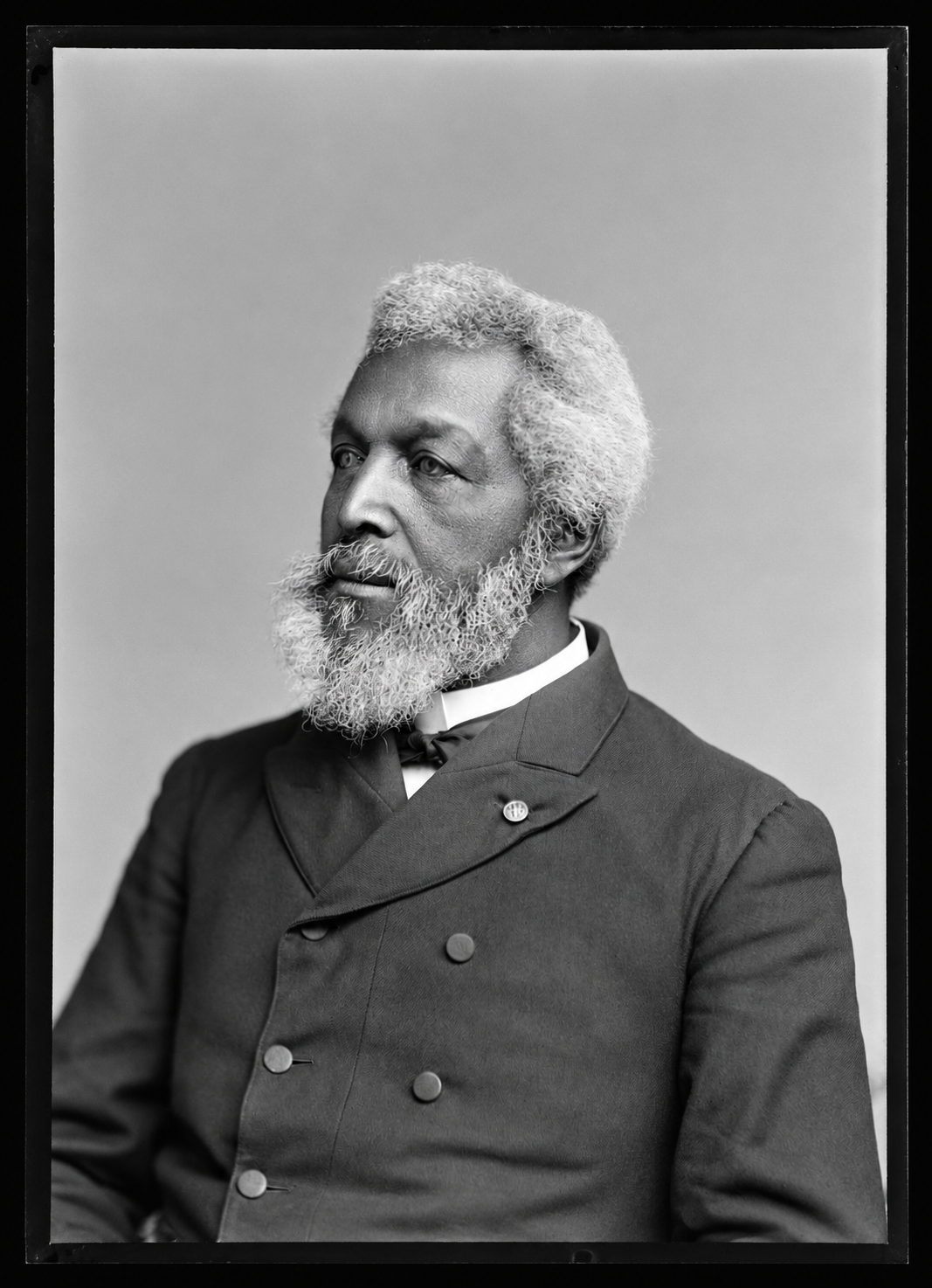
Reverend William Hammett Hunter, photo by C.M. Bell
When Charles Milton Bell welcomed the Reverend William Hammett Hunter into his Washington studio near the close of the nineteenth century, the photographer was recording far more than another distinguished visitor. Bell had spent decades photographing presidents, generals, senators, inventors, Native American leaders, artists, and reformers, assembling through his camera a remarkable portrait of the nation's public life. Yet among the thousands who sat before his lens, few embodied the sweeping transformation of nineteenth-century America more completely than Hunter.
The portrait itself rewards careful attention. Hunter is turned slightly from the camera, his gaze directed beyond the viewer rather than toward the lens. His silver hair and full white beard frame a face marked not by theatrical intensity but by quiet assurance. There is a composure that suggests years spent listening as much as speaking, years of carrying responsibilities that demanded patience more than applause. Bell understood that character often revealed itself in restraint, and nowhere is that more evident than in this photograph. It is the face of a man who had lived through slavery, civil war, emancipation, Reconstruction, and the uncertain dawn of a new century, never abandoning the conviction that faith and education were indispensable companions to freedom.
William Hammett Hunter's story began under circumstances that offered little promise of such distinction. Born in Virginia around 1831 to enslaved parents, he entered a world in which the law recognized neither his liberty nor his future. The institution of slavery sought to deny more than physical freedom. It denied education, family security, and the hope that one's children might inherit a better life.
Hunter's father refused to accept those limits. Through determination and sacrifice, he accomplished what countless enslaved fathers dreamed but never achieved. He purchased his family's freedom and led them north to Brooklyn, New York, where William spent his childhood. That journey from Virginia to New York represented more than a change of geography. It carried the family from bondage into possibility, placing young William in a community where churches, schools, and Black institutions were beginning to flourish despite persistent discrimination.
The African Methodist Episcopal Church became the center of that world. Founded by Richard Allen in 1816 after Black worshippers experienced racial discrimination within white Methodist congregations, the AME Church stood as one of the earliest and most successful expressions of African American self-determination. Long before emancipation, it had become a refuge where Black Americans governed their own affairs, educated their children, published their own literature, and nurtured leaders capable of guiding communities through extraordinary challenges.
It was within this tradition that Hunter discovered his life's calling. As a young man, he supported himself by working in a jewelry establishment in New Jersey, but his ambitions reached beyond commerce. He possessed a disciplined mind and an evident gift for learning, qualities that eventually led him to Wilberforce University in Ohio. Founded through the cooperation of the Methodist Episcopal and African Methodist Episcopal Churches, Wilberforce was unlike any institution in America. It was the first university owned and operated by African Americans, established with the belief that education and Christian faith together could prepare a generation of leaders equal to the demands of a changing nation.
Hunter remained there for several years, studying theology, literature, and the liberal arts before entering the ministry. Those years proved formative, not simply because they prepared him to preach, but because they immersed him in an intellectual community convinced that Christianity required active engagement with society. Ministers were expected to do far more than deliver sermons. They were educators, organizers, publishers, counselors, and advocates for justice. By the opening years of the Civil War, Hunter had accepted a pastorate at Water's Chapel in Baltimore. Maryland occupied an uneasy place within the Union. It remained a slave state while supporting the Federal government, and Baltimore itself was a city where divided loyalties often erupted into violence. Hunter ministered to a congregation living amid uncertainty, where every military victory or defeat carried immediate consequences for families whose relatives remained enslaved or served in uniform.
The war transformed his ministry in ways no one could have anticipated. President Abraham Lincoln's Emancipation Proclamation, issued on January 1, 1863, altered both the purpose of the conflict and the composition of the Union Army. African American men began enlisting by the tens of thousands, forming what became known as the United States Colored Troops. These regiments fought with extraordinary courage despite unequal pay, inadequate equipment, and the ever-present threat that capture might mean execution or re-enslavement rather than imprisonment.
Such soldiers required more than military leadership. They required spiritual leadership from someone who understood their experiences. In September 1863, Lincoln appointed William Hammett Hunter chaplain of the 4th United States Colored Troops, making him the first African American to receive a commission as an Army chaplain. The appointment carried profound symbolic weight. Only months earlier, Black men had struggled simply to secure the right to bear arms for the Union. Now, one had entered the commissioned officer corps as the spiritual leader of his regiment. Hunter reported to Fort Yorktown in Virginia in October. The location itself was rich with American memory. It was there, more than eighty years before, that George Washington's army had secured the decisive victory ending the Revolutionary War. Now Yorktown served as an important Union post supporting military operations throughout southeastern Virginia. History had returned to the same ground under entirely different circumstances.
The men Hunter served represented the hopes and sacrifices of a people determined to claim citizenship through military service. Many had escaped slavery only months before. Others had left wives, parents, and children still living in bondage behind Confederate lines. Some had never learned to read because the law had forbidden their education. All understood that their service carried consequences extending far beyond the battlefield. Hunter's work embraced every aspect of their lives. He preached regularly, conducted funerals, visited hospitals, comforted the wounded, and strengthened those preparing for combat. Equally important, he taught soldiers to read and write, recognizing that literacy itself was an instrument of freedom. To place a Bible in a man's hands was meaningful. To teach him to read the words independently was transformative. Education became another form of emancipation.
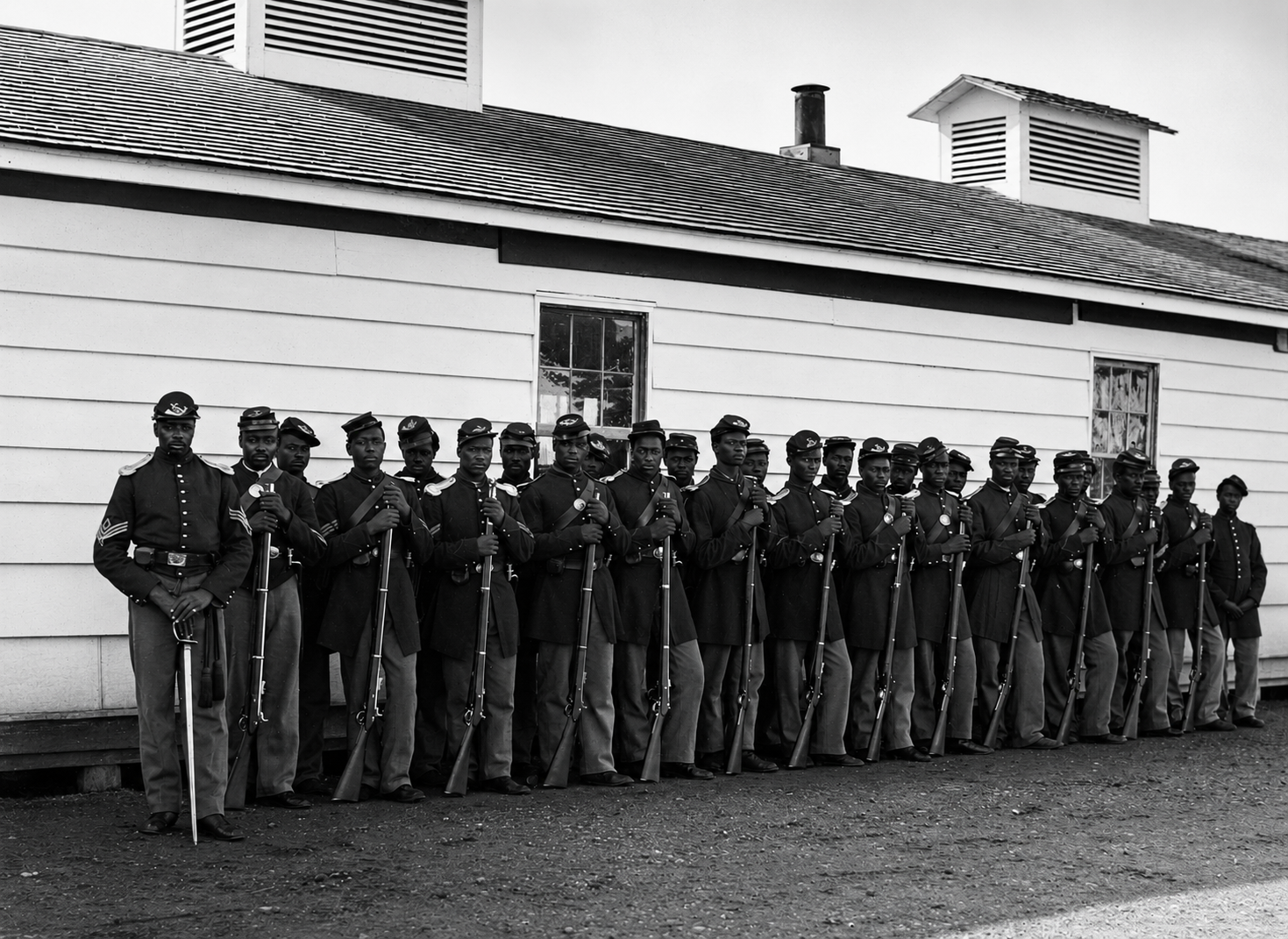
Company E, 4th US Colored Troops, Fort Lincoln, Nov. 11, 1865, photo by William Morris Smtih
His ministry continued through the end of the war and into the early months of Reconstruction, concluding only in May 1866. By then, the Union had been preserved, slavery abolished, and nearly 180,000 African American soldiers had served in the Federal Army. Hunter had witnessed not only military victory but the birth of a new constitutional order. Returning to civilian life, he entered an African Methodist Episcopal Church undergoing extraordinary expansion. Throughout the South, formerly enslaved families established new congregations almost as quickly as Federal troops secured the countryside. Churches became schools, meeting halls, employment centers, and political forums. Ministers occupied positions of influence unmatched in any previous generation of African American history.
Hunter's wartime service had earned him respect throughout the denomination, but it was his wisdom and administrative ability that sustained his influence. During the following decades, he served several of the church's leading congregations in Washington, Maryland, and Pennsylvania, acquiring a reputation as a thoughtful pastor whose leadership rested upon quiet confidence rather than dramatic oratory.
His gifts soon carried him beyond the pulpit. In 1872, the General Conference elected Hunter Business Manager of the AME Book Concern, the church's publishing ministry. To modern readers, the title may sound administrative, but in the nineteenth century, it represented one of the denomination's most consequential offices. The Book Concern produced hymnals, theological works, Sunday school lessons, newspapers, biographies, devotional literature, and educational materials, which were distributed throughout a rapidly growing national church. Publishing possessed enormous significance within African American life. Control of the printed word meant control of one's own story. Black churches no longer depended upon outside publishers to define their theology, record their achievements, or preserve their history. Hunter's stewardship of the Book Concern strengthened an institution that shaped religious and intellectual life for generations.
As his reputation continued to grow, the church entrusted him with broader responsibilities, including representing the First Episcopal District at international Methodist gatherings. Such appointments reflected not only personal esteem but recognition that Hunter embodied the maturity and stability of a denomination increasingly respected throughout the Methodist world. He lived long enough to witness both remarkable progress and painful disappointment. Reconstruction's promise gradually yielded to the realities of segregation, disfranchisement, and racial violence. Many of the gains secured after the Civil War were systematically dismantled across the South. Yet the institutions Hunter had helped strengthen endured. Churches continued to educate children, care for families, publish books, and prepare future leaders who would carry the struggle for equality into the twentieth century.
When William Hammett Hunter died in 1908, newspapers remembered him as one of the African Methodist Episcopal Church's most respected ministers. His influence, however, cannot be measured solely by the offices he held. It lives equally in the thousands of soldiers he encouraged, the congregations he shepherded, the books he helped place into circulation, and the generations of ministers who followed the path he helped establish.
That is why Charles Milton Bell's portrait remains so compelling today. It does not present a celebrity seeking attention or a politician courting public favor. Instead, it preserves the likeness of a man whose greatness emerged through decades of faithful service. Bell's camera captured the serenity of someone who understood that lasting change is rarely accomplished through dramatic moments alone. More often, it is built patiently, sermon by sermon, student by student, book by book, and life by life.
In the end, William Hammett Hunter's life reflected one of the central truths of the American experience. Freedom, once won, must be nurtured by institutions, sustained by education, and guided by moral conviction. Hunter devoted every chapter of his remarkable life to that work. Born into slavery, he became a commissioned officer of the United States Army, a trusted leader of the nation's oldest Black denomination, and an architect of institutions that continued shaping American life long after his own voice had fallen silent. His story deserves to be remembered not merely because he was the first, but because he understood that true leadership consists not in opening a single door, but in holding it open for those who follow.