
The Legacy of Senator James Henderson Kyle
(Adapted and interpreted from Aberdeen Magazine)
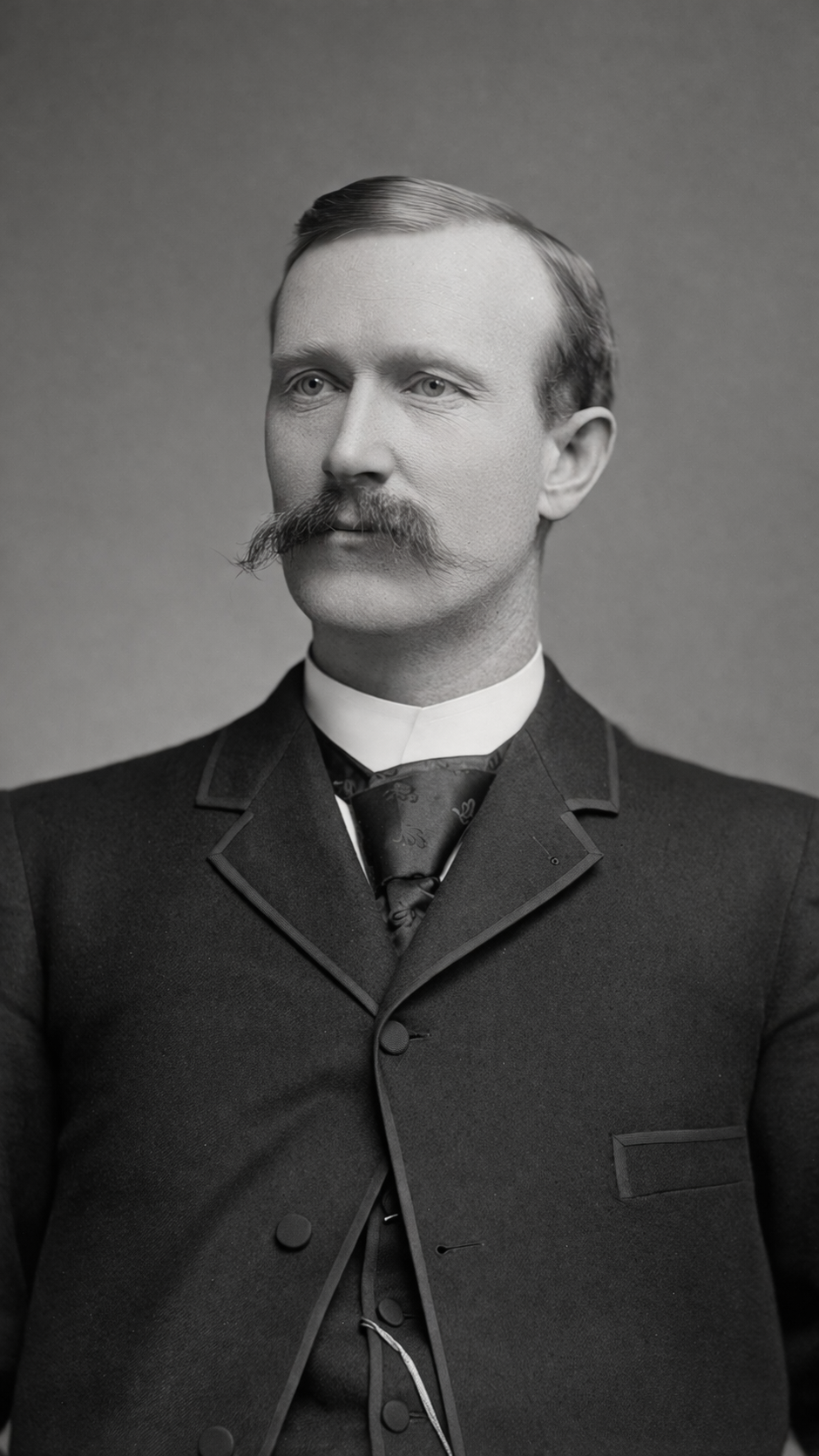
Senator Kyle
There are men in American history who arrive with force, who bend events around them, and leave behind monuments of unmistakable consequence. And then there are those who move more quietly, whose influence is measured less in spectacle than in steadiness. James Henderson Kyle belonged to the latter company. He was not a man of grand gestures. He did not seek the theater of public life. Yet he stepped into it at a moment when the country itself was uncertain of its direction, and he carried with him something that would define his brief career, a sense that public service was, at its core, a moral undertaking.
Beginnings on the Edge of a Nation
Kyle was born in 1854, in a nation still testing its boundaries and its identity. His early life unfolded in the years before the Civil War, and his youth came of age in its aftermath, when the United States was attempting to reconstruct not only its political order but its sense of purpose. He was educated for the ministry, a path that required discipline, study, and a careful shaping of thought. The work of a minister was not simply to speak, but to persuade, to guide, and at times to stand firm when conviction demanded it. These habits would follow him into every room he entered thereafter. When Kyle made his way west to South Dakota, he entered a landscape that was still in the process of becoming. The Dakota Territory, and later the state itself, was a place where institutions were built in real time, where towns rose quickly and tested their endurance just as quickly.
In such a place, a man's character was often as important as his credentials. There was little room for pretense. Communities were small, expectations were direct, and leadership was often judged not by rhetoric but by presence. Kyle found his footing there, not as a political figure at first, but as a minister, a teacher of sorts, shaping minds and communities in ways that rarely drew attention beyond the immediate circle. Yet it was precisely this grounding that would later define his approach to politics.
Entering Public Life
By the early 1890s, the United States had entered a period of extraordinary change. Industry had transformed the economy. Railroads stretched across the continent. Cities grew at a pace that unsettled those who remembered a more agrarian past. But alongside that growth came tension. Farmers found themselves burdened by debt and fluctuating markets. Laborers faced long hours and uncertain conditions. Wealth, increasingly concentrated, seemed to pull the nation in directions that left many behind. It was in this climate that Kyle entered the United States Senate. Elected as a representative of a young state, he carried with him the concerns of those who had not yet benefited from the promises of industrial America. He found common cause with the Populist movement, though he never fit neatly within its boundaries.
The Populists, drawn largely from rural communities, sought to rebalance a system they believed had tilted too far toward financial and industrial power. They spoke of fairness, of opportunity, of restoring a measure of control to those who worked the land and sustained the country. Kyle listened to these concerns not as an ideologue, but as someone who had lived among them. The Gilded Age was a time of contradiction. It celebrated progress while exposing inequality. It produced innovation while deepening divisions. For many in public life, the challenge was not simply to choose a side, but to understand how to navigate a landscape that resisted easy answers. Kyle's approach was measured. He did not seek to inflame. He sought, instead, to persuade.
The Influence of the Pulpit
What distinguished Kyle in Washington was not only what he believed, but how he carried those beliefs into debate. Before he was a senator, he was a minister. And the habits of that calling never left him. There was a cadence to his speech, a deliberateness that reflected years spent addressing congregations rather than crowds. He did not rush to conclusions. He built them, step by step, appealing not only to logic but to a shared sense of right and wrong. To Kyle, politics was not separate from morality. It was, in many respects, an extension of it. This did not make him naïve. He understood the realities of political life, the negotiations, the compromises, the competing interests. But he approached those realities with a framework that was uncommon even in his own time, a belief that public decisions should be anchored in something more durable than convenience. That belief shaped his work in the Senate. It informed his positions, his alliances, and his willingness to stand apart when necessary.
A Voice Without Theater
Kyle's career unfolded without the kind of dramatic moments that often define historical memory. There were no towering speeches that entered the national canon, no singular piece of legislation that bore his name and altered the course of the country. And yet, to measure his significance by those standards alone would be to miss the point. Kyle represented a different model of public life, one that valued consistency over visibility. He worked within the system, not to dominate it, but to influence it in ways that aligned with his understanding of justice and responsibility. He was, in many respects, a bridge between worlds, between the rural communities of the plains and the increasingly complex machinery of national government, between the moral language of the pulpit and the pragmatic demands of politics. Such figures rarely command headlines. But they often shape the tone of the institutions they inhabit.
An Early Ending
In 1901, at the age of 47, Kyle's life came to an abrupt end. He died while still serving in the Senate, his work unfinished, his future unrealized. There is a particular weight to lives cut short in this way. They leave behind not only a record of what was done, but a lingering sense of what might have been. Had he lived longer, Kyle might have deepened his influence. He might have taken on greater leadership within the movements he supported. He might have adapted, as so many politicians must, to the changing currents of a new century. But history offers no such extensions. What remains is the impression he left during his brief time in office, a record of steady engagement, of thoughtful participation, and of a commitment to principles that did not waver with circumstance.
The Quiet Measure of Legacy
Legacy is often misunderstood. It is easy to equate it with scale, with visibility, with the kind of impact that can be easily named and cataloged. But there is another kind of legacy, one that resides in example. Kyle's life offers that quieter measure. He reminds us that public service, at its best, is not performance. It is not a pursuit of recognition or permanence. It is a willingness to step into responsibility with seriousness, to engage with the questions of one's time without surrendering to their pressures. In an era that often rewards volume, his steadiness stands apart. In a political culture that can drift toward expediency, his grounding in principle feels, if not distant, then at least uncommon. And yet, it is precisely this kind of example that endures, not because it demands attention, but because it offers something to return to. A way of thinking about leadership that is less concerned with dominance than with duty. A way of engaging the public square that does not separate belief from action. A way of moving through one's time that, even if brief, leaves behind a sense that something was carried forward with care.
________
This article is an original interpretation based on “The Legacy of Senator James Kyle” by Troy McQuillen, originally published in Aberdeen Magazine (March/April 2021).
Read the original: https://aberdeenmag.com/2021/03/the-legacy-of-senator-james-kyle/