The Life of General Nelson A. Miles
Nelson Appleton Miles was a quintessential 19th-century American figure, representing the transition from a local amalgam of American communities to a global military power. His life, spanning from 1839 to 1925, encompassed the most transformative eras of American history-the Civil War, the Indian Wars, and the Spanish-American War.
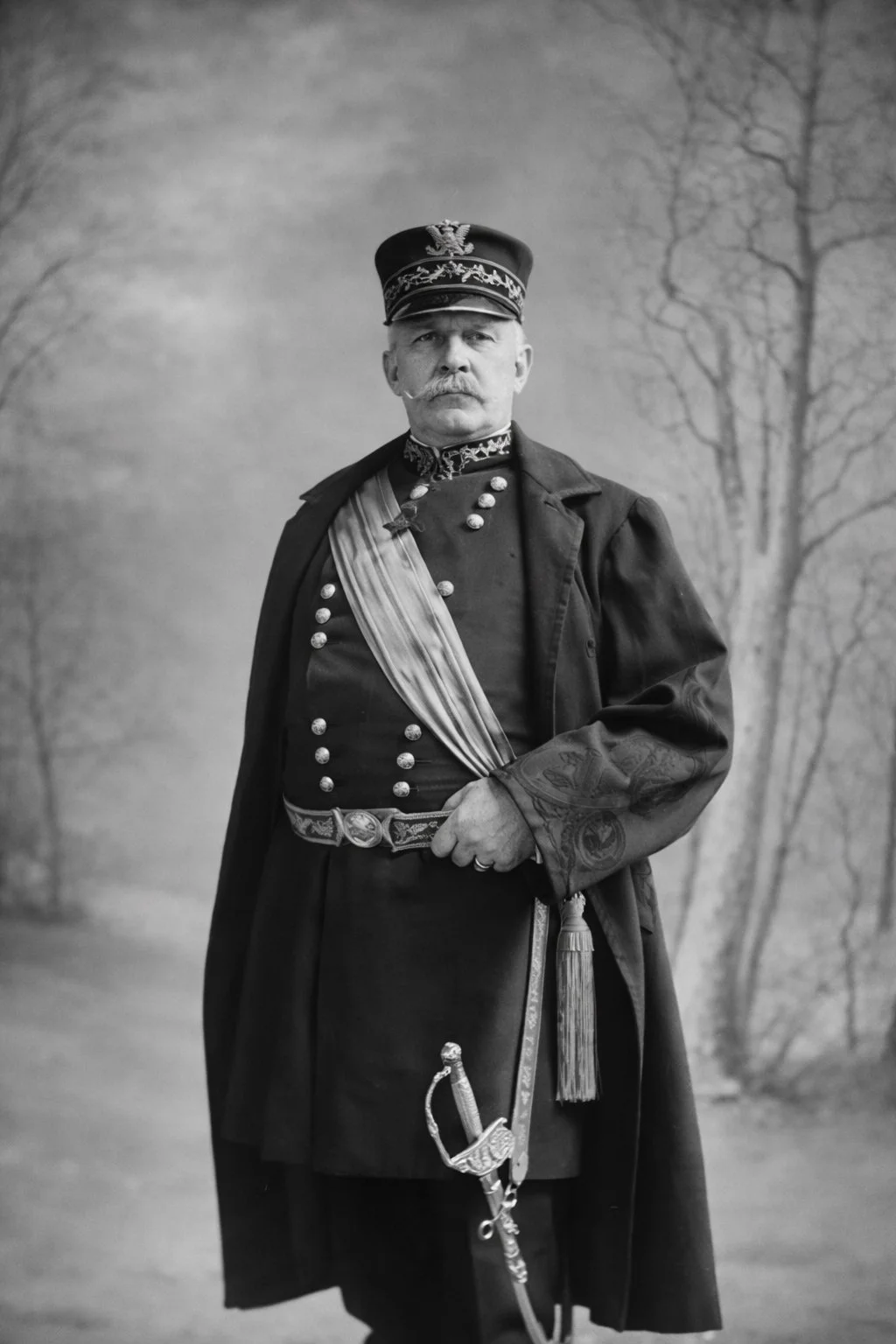
General Miles, photo by C.M. Bell
Early Life and Upbringing
Nelson Appleton Miles was born on August 8, 1839, on his family's farm near Westminster, Massachusetts. He was the youngest child of Daniel Miles and Mary Curtis Miles. His family had deep roots in New England; he was a descendant of the Reverend John Myles, who founded the first Baptist church in Massachusetts in the 17th century.
Growing up in a Baptist household of modest means, Nelson's early years were shaped by the physical labor of the farm. His father, Daniel, was a farmer who also had some involvement in local commerce, and Nelson was expected to contribute to the family's livelihood from a young age. Despite the rural setting, Miles was an active and adventurous child, often engaging in games that foreshadowed his future career, such as simulated war and adventure.
Education and Early Career
Miles received his primary education in the local schools of Westminster, where he completed grammar school. He later attended John R. Galt's Academy, a private institution in Westminster that provided a more rigorous academic curriculum than the public schools.
At the age of 17, seeking greater opportunities than the farm could offer, Miles moved to Boston to pursue a business career. He found employment as a clerk at John Collamore & Company, a prominent crockery and glassware store. While working during the day, he was determined to improve his prospects through self-study. He enrolled in night courses at Comer's Commercial College, where he studied business principles and accounting.
Informal Military Training
As the sectional tensions in the United States escalated toward the Civil War, Miles's interests shifted from commerce to military affairs. Lacking the opportunity to attend West Point, he took it upon himself to acquire a military education through unconventional means. He spent his evenings reading extensively on military history, strategy, and tactics.
Crucially, he sought out professional instruction, hiring Eugene Salignac, a retired French officer living in Boston. Salignac, who claimed to be a veteran of the French army, taught Miles and a group of other young men the fundamentals of drill, ceremony, and command. This rigorous, albeit informal, training provided Miles with a solid foundation that would enable him to excel upon entering active service.
Civil War Service
When the Civil War broke out in 1861, Miles committed himself and his resources to the Union cause. Using $1,000 provided by his father and borrowing an additional $2,500, he helped raise a company of volunteers in Roxbury, Massachusetts. Although his men elected him captain, political maneuvers led to his initial commission as a first lieutenant in the 22nd Massachusetts Volunteer Infantry.
Miles's rise was rapid. He served as an aide-de-camp to General Oliver O. Howard and saw his first major action at the Battle of Seven Pines, where he was wounded. By the Battle of Antietam in September 1862, he was a lieutenant colonel commanding the 61st New York Volunteers after his superior was wounded. He was promoted to colonel shortly thereafter.
His most celebrated action occurred at the Battle of Chancellorsville in May 1863. While holding an advanced position against repeated Confederate assaults, Miles was severely wounded by a bullet that struck his belt plate and deflected into his abdomen. Doctors initially believed the wound to be fatal, but he recovered and returned to command. For his gallantry at Chancellorsville, he was eventually awarded the Medal of Honor in 1892.
By the end of the war, at the age of 26, Miles was a major general of volunteers, commanding the II Corps of the Army of the Potomac during the final campaigns against Robert E. Lee.
Post-War and the Sherman Connection
Following the war, Miles was appointed commander of Fort Monroe, Virginia, where he was tasked with overseeing the incarceration of former Confederate President Jefferson Davis. During this period, he became a prominent figure in Washington society, frequently attending gatherings at the home of Senator John Sherman.
It was there that he met Mary Hoyt Sherman, the daughter of Judge Charles Taylor Sherman and the niece of both Senator Sherman and the legendary General William Tecumseh Sherman. The two married on June 30, 1868, in Cleveland, Ohio. This marriage was not only a personal success-the two were known as "the handsomest pair in the army"-but it also provided Miles with significant political and military connections that would aid his career.
Family Life
Nelson and Mary Miles had two children who survived to adulthood:
Cecelia Sherman Miles (1869-1952) married Samuel Reber, a prominent Army officer.
Sherman Miles (1882-1966), who followed in his father's footsteps to become a major general in the U.S. Army, served as the head of Military Intelligence at the time of the attack on Pearl Harbor.
Mary Miles was a devoted and adventurous partner, often accompanying Nelson to his frontier postings. She was known for being an expert horsewoman and was frequently close enough to the front lines of his Indian campaigns to hear the firing of the guns. She remained by his side during his subsequent diplomatic missions to Europe until her death in 1904.
Later Military Career and Commanding General
Miles spent the 1870s and 1880s as one of the Army's most effective field commanders in the West. He led successful campaigns against the Kiowa, Comanche, and Southern Cheyenne. He played a pivotal role in the Great Sioux War after the Battle of Little Bighorn and accepted the surrender of Chief Joseph of the Nez Perce in 1877. In 1886, he replaced George Crook in Arizona and secured the surrender of the Apache leader Geronimo.
In 1895, Miles was named Commanding General of the U.S. Army, the last person to hold this specific title before the office was replaced by the Chief of Staff system. During the Spanish-American War, he personally led the invasion of Puerto Rico in 1898, establishing the military government there. He was promoted to lieutenant general in 1900.
Retirement and Death
Miles's career was also marked by high-profile disputes with political leaders, most notably Theodore Roosevelt, who famously referred to the dapper and highly decorated general as a "brave peacock". He retired in 1903 upon reaching the mandatory retirement age.
Nelson Appleton Miles died on May 15, 1925, at the age of 85. In a fittingly dramatic end for a man of action, he suffered a fatal heart attack while standing during the national anthem at a circus in Washington, D.C., where he had taken his grandchildren. He was buried in a grand mausoleum at Arlington National Cemetery, one of the few private mausoleums allowed on the grounds.
Would you like more details on his Civil War battles or his specific tactical innovations during the Indian Wars?