
March Light on Glass: Susan B. Anthony, 125 Years On
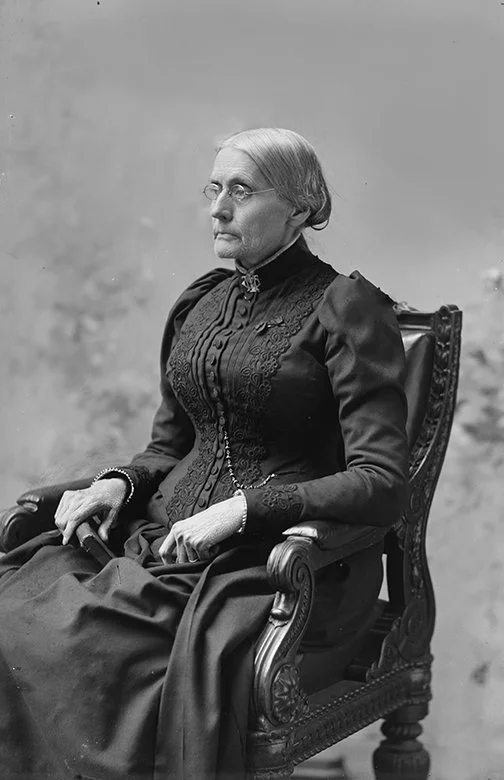
Susan B. Anthony, 1890 in C.M. Bell Studios
There are certain figures in American life who seem, even in stillness, to press forward. Susan B. Anthony was one of them. In every photograph that survives, the set of her shoulders suggests motion held in check, as if the long work of persuasion had only briefly paused for the camera. By the 1890s, she was no longer the young agitator moving town to town by rail and carriage, but neither was she finished. The cause had lengthened into a lifetime, and she remained at its center, steady as the principle she had spent decades defending.
Born in 1820 in Adams, Massachusetts, Anthony came of age in a household shaped by discipline, moral conviction, and a belief in equality that, at the time, carried consequences. Her father, a Quaker and a reform-minded man, raised his children to think independently and to measure society against a higher standard. It was in that atmosphere that she first encountered the contradictions of American life, the language of liberty set against the practice of exclusion.
Her early years were not spent in politics, at least not in the formal sense. She worked as a teacher, where she quickly learned that even in a profession dominated by women, authority and compensation belonged to men. That imbalance sharpened her sense of injustice. It was not an abstract grievance. It was lived, daily, and personal. From there, her path widened into reform movements that defined the mid-19th century. She aligned first with temperance advocates, then with abolitionists, forming one of the most consequential partnerships in American reform with Elizabeth Cady Stanton.
Together, Anthony and Stanton reshaped the argument for women's rights. Stanton, the writer and theorist, framed the ideas; Anthony, the organizer and strategist, carried them outward into the country. It was Anthony who traveled, who spoke, who endured the resistance of audiences and the indifference of institutions. She had a particular gift for persistence. Where others faltered, she remained. Where doors closed, she returned.
The Civil War and its aftermath complicated the movement. The passage of the 14th and 15th Amendments, which extended citizenship and voting rights to Black men but not to women, forced difficult choices and, at times, bitter divisions among reformers. Anthony stood firm in her belief that the principle of universal suffrage could not be partial. The Constitution, she argued, already contained the promise of equality. It needed only to be recognized and enforced. That conviction led to one of the defining acts of her life. In 1872, Anthony voted in the presidential election in Rochester, New York. It was a deliberate act, carefully considered, meant to test the law itself. She was arrested, tried, and fined. The outcome was never in doubt, but the act reverberated. It reframed the question. Voting was no longer theoretical. It had been done.
By the time Anthony entered the 1890s, the movement had endured decades of slow progress. There had been conventions, petitions, speeches, and setbacks. Yet she remained visible, not as a relic of an earlier phase, but as an active presence. In 1890, the suffrage movement consolidated into the National American Woman Suffrage Association, bringing together factions that had once diverged. Anthony served as its president, guiding it with the same disciplined resolve that had defined her earlier work.
It was in this period, as photography itself matured into a more deliberate art, that she sat for portraits that would come to define her public image. Among those who worked in Washington, D.C., was Charles Milton Bell, whose studio had become one of the capital's respected rooms for portraiture. Bell's work carried forward a tradition that linked him to earlier masters of the medium, but it also reflected the evolving expectations of the late 19th century, a time when the photograph was no longer a novelty but a record.
One can imagine Anthony entering such a studio not as a subject eager for likeness, but as a participant in something larger. She understood the power of image. She had spent years shaping not only arguments, but impressions. The photograph would travel where she could not, carrying with it a presence that might persuade in quieter ways than speech.
The studio itself would have been carefully arranged. Light, always the central element, was controlled through skylights and reflectors. The chair, the drape, the placement of the hands, none of it accidental. Bell, attentive to detail, would have sought not merely to capture a face, but to suggest character. And Anthony, accustomed to scrutiny, would have offered a composure that revealed little yet conveyed much. In the resulting image, she appears as she had become: older, certainly, but not diminished. The lines of her face are not softened. They are evidence. The glasses, practical and unadorned, suggest clarity rather than ornament. The posture remains upright, the gaze direct. It is not the portrait of a woman at rest. It is the portrait of a life in motion, paused. Photography, in this moment, served a particular function. It fixed the features of a movement that had, for so long, been carried in voice and print. It gave the public a face to associate with an idea that might otherwise seem distant. In Bell's studio, as in others, the camera became a kind of intermediary between the individual and the nation, translating presence into permanence.
Anthony continued her work into the final years of her life. She traveled, spoke, and organized, even as age made those efforts more demanding. She remained, to the end, committed to the belief that the arc of the nation could be bent, not by force, but by persistence. When she died in 1906, the right for which she had labored had not yet been secured. That would come fourteen years later, with the ratification of the 19th Amendment. And yet, to measure her life solely by that outcome is to misunderstand its significance. Anthony did not simply achieve a result. She altered the terms of the conversation. She made it possible to imagine a different arrangement of rights and responsibilities, one in which women were not peripheral, but central.
The photograph endures as part of that legacy. In it, we see not only the individual, but the accumulation of effort. The decades of travel, the arguments made and remade, the refusals and the returns. In the stillness of the image, there is, paradoxically, movement. A sense that what we are looking at is not concluded. There is a tendency, in looking back, to soften figures like Anthony, to place them safely within the past. But the image resists that. Whether taken in the studio of Charles Milton Bell or another of his contemporaries, it insists on something more immediate. It asks not for admiration alone, but for recognition.
She sits, as she must have on that day, composed and deliberate. The camera records. The light settles. And in that moment, preserved beyond her lifetime, the work continues.