A Capital Kiss: A Studio Image at the Edge of Its Time
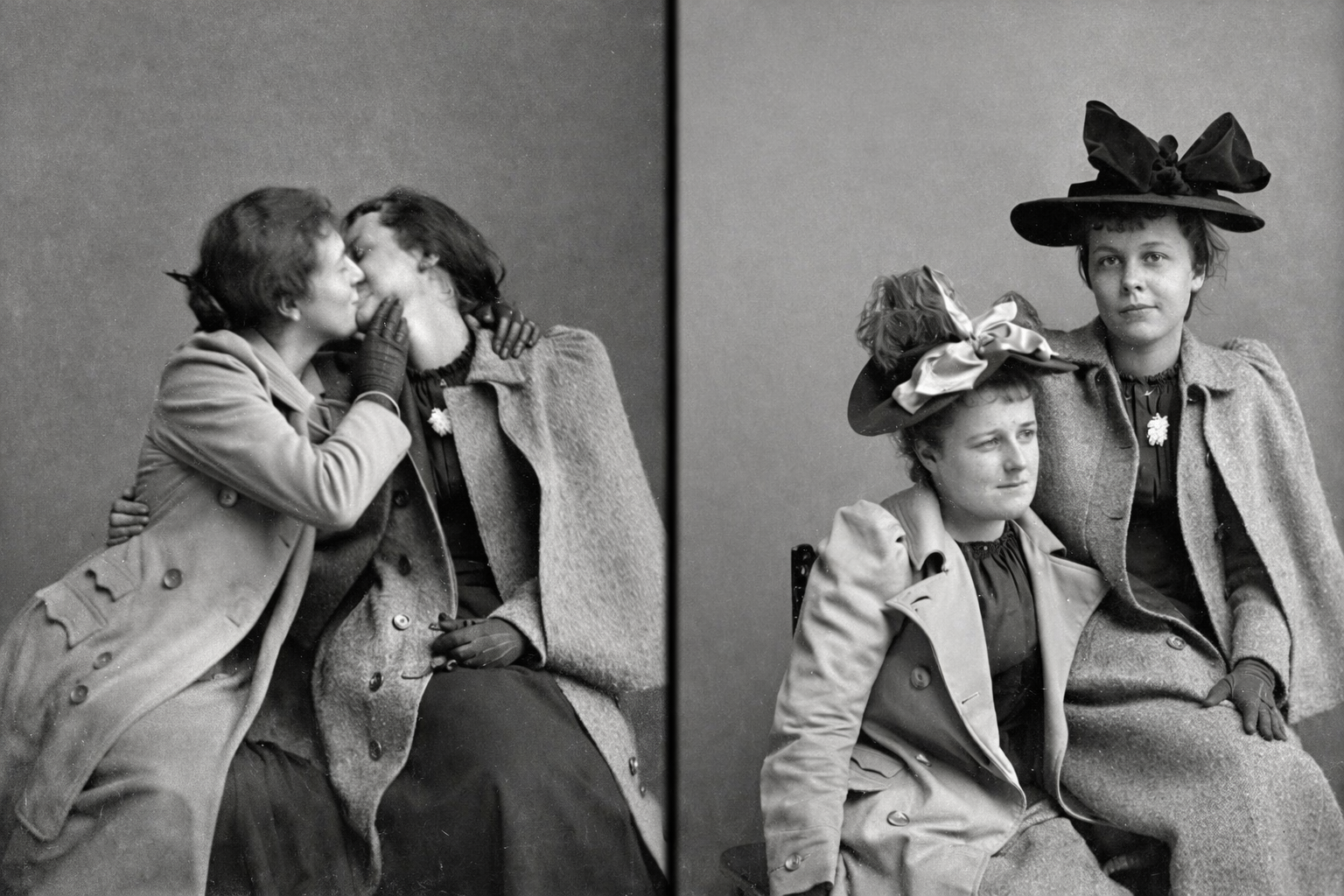
Two women, Washington, D.C., c. 1890s. A studio portrait that captures both public decorum and private truth.
At the close of the nineteenth century, Washington, D.C. was a city defined by presentation. It was a place where identity was not only lived but carefully arranged, observed, and recorded. In the decades following the Civil War, the capital had grown into a center of bureaucratic power and social aspiration. Government clerks, military officers, diplomats, and their families moved through a culture that placed a premium on respectability. Appearances mattered, often more than substance, and the ability to present oneself correctly, in dress, posture, and association, was essential to maintaining one's standing.
Photography played a central role in this world. Studios like that of Charles Milton Bell, situated along Pennsylvania Avenue, stood at the intersection of public life and private identity. These were not casual spaces. They were controlled environments where individuals submitted themselves to a process that transformed them into something fixed and legible. The backdrop, the lighting, the arrangement of hands and bodies, all were carefully considered. The resulting image was meant to endure. It could be shared, displayed, carried, and preserved, a visual statement of who one was, or perhaps more accurately, who one wished to be seen as.
Within this framework, the conventions of the late Victorian age imposed clear expectations, particularly upon women. They were to embody restraint, modesty, and moral clarity. At the same time, the period saw the expansion of women's roles in education, reform movements, and certain professions. This created a subtle but growing tension. Women were increasingly visible in public life, yet the standards governing their behavior remained rooted in older ideals. Emotional closeness between women, expressed through letters, shared spaces, and even physical proximity, was not uncommon. Indeed, what historians have often termed "romantic friendship" allowed for a degree of intimacy that could be openly acknowledged, so long as it remained within accepted boundaries.
It is against this backdrop that The Kiss takes on its full meaning. The photograph presents two panels, each depicting the same pair of women. In the right panel, they sit in composed dignity. Their clothing, coats, hats, and gloves, signals a careful adherence to contemporary fashion and social expectation. Their posture is measured, their expressions controlled. This is the image that Washington society would recognize and accept. It is a portrait of propriety, one that affirms the structures of class, gender, and decorum that governed the era.
The left panel, however, introduces a rupture in that carefully ordered world. Here, the same women lean toward one another. One lifts her hand to the other's cheek, and their lips meet in a kiss. The gesture is direct and unambiguous. It is not framed as playful or accidental. It is held, intentional, and quietly assured. In a photographic context that required stillness and preparation, this moment cannot be dismissed as spontaneous. It is a decision, made by the sitters and, by extension, permitted by the photographer.
That permission is significant. The nineteenth-century studio was a space of negotiation, but also of control. Photographers guided their subjects, corrected their posture, and ensured that the final image conformed to acceptable standards. To allow, or at least not prevent, such a moment suggests that the boundaries of the studio were not entirely rigid. Within its walls, there existed the possibility, however limited, for individuals to step beyond the expectations imposed upon them.
The power of The Kiss lies in the relationship between its two panels. Viewed together, they reveal a duality that was central to life in late Victorian America. The right panel presents the public self, composed, respectable, and fully legible within the norms of the time. The left panel reveals something more private, a relationship that exists outside, or perhaps alongside, those norms. It is this juxtaposition that transforms the photograph from a simple portrait into a complex statement about identity and experience.
In Washington, where social and political scrutiny was constant, such a duality would have been particularly pronounced. The city was not only the seat of government but also a stage upon which individuals performed their roles within a highly visible hierarchy. For women, the stakes were especially high. Reputation could determine opportunity, and any deviation from accepted behavior risked social consequence. That these two women chose to record such an intimate moment suggests a level of trust, not only in one another but in the space of the studio itself.
As the nineteenth century drew to a close, America stood on the threshold of change. Industrialization, urbanization, and shifting social dynamics were beginning to reshape the nation. The rigid structures of the Victorian era would gradually give way, though not without resistance, to new forms of expression and identity. Yet in this moment, captured within the confines of a Washington studio, we see both the persistence of those structures and the quiet ways in which individuals navigated them.
The Kiss endures because it preserves what was rarely allowed to be seen. It offers a glimpse into a private reality that existed beneath the surface of public life. The right panel assures us of conformity, of order, of a world that makes sense within its own rules. The left panel challenges that assurance. It reminds us that even in an age defined by restraint, there were moments when individuals stepped beyond the roles assigned to them, and that, on rare occasions, those moments were entrusted to the camera.
In the end, the photograph is not simply about two women or a single act of intimacy. It is about the tension between appearance and truth, between what society demanded and what individuals experienced. It is about the capacity of the photographic image, even within its constraints, to capture something that resists easy explanation. And it is about the enduring presence of lives and relationships that, though often unrecorded in written history, found their way, quietly and unmistakably, into the visual record.