
The Cluss Family in Washington: Architecture, Music, and Memory at the Turn of the Century
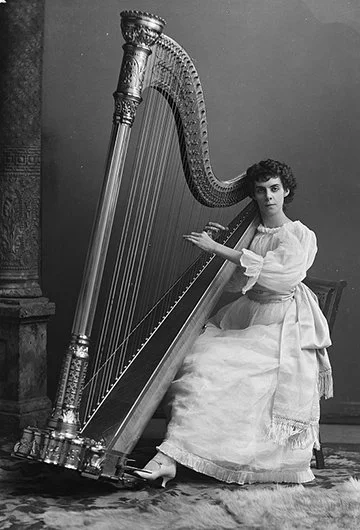
Anita Cluss in C.M. Bell’s studio (c. 1880)
In the decades after the Civil War, Washington, D.C. was not yet the polished capital we recognize today. It was a city in the act of becoming, dusty in summer, muddy in winter, and alive with ambition. Into that unsettled landscape came Adolf Cluss, a German immigrant who would leave a lasting mark not through monuments to power, but through the quiet infrastructure of civic life. Cluss built schools, markets, and institutions, the bones of a functioning city. His red-brick buildings rose with confidence, practical, durable, and unmistakably modern for their time. The Franklin School, the Eastern Market, and the Smithsonian Arts and Industries Building still stand as evidence of his vision. They were not decorative gestures. They were declarations that Washington would be more than a political outpost; it would be a lived-in, working capital.
Within that world, shaped in brick and mortar, his daughter Anita Cluss moved along a different line, not with drafting tools, but with strings.
Anita Cluss came of age in a household that balanced discipline and refinement. Her father's work was grounded in engineering and civic purpose, but the Cluss home carried something else, a distinctly European sensibility toward culture, education, and the arts. By the 1890s, Anita had established herself as a harpist, a role that carried both musical and social weight. The harp was no ordinary instrument. It was associated with elegance, restraint, and a certain visual poetry. To play it well required not only technical skill but also composure.
In Washington society, that mattered.
She performed in salons and private gatherings, spaces where politics softened into conversation and where music served as both entertainment and signal. A harpist did not dominate a room. She shaped it.
Through the lens of Charles Milton Bell, Anita's image survives. In his studio, she is poised beside her instrument, composed, deliberate, part artist, part emblem. Bell's portraits often captured more than likeness. They fixed identity. In those images, Anita Cluss becomes not only a musician but also a figure within the cultural fabric of her city.
To understand Anita Cluss is to understand the world she inhabited. By the late 19th century, Washington had begun to evolve into a more sophisticated social environment. The political class, diplomats, military officers, and an emerging professional elite formed a layered society. Formal dinners, receptions, and afternoon calls defined the rhythm of social life. Music played a central role. Before recorded sound, music was experienced live, in rooms filled with conversation and candlelight. The piano was common, but the harp was rare enough to command attention. A skilled harpist could move between intimacy and spectacle, providing a kind of sonic architecture to an evening. Women like Anita occupied a careful space. They were expected to be cultivated, but not ostentatious. Visible, but measured. The harp suited that balance perfectly.
Meanwhile, the city itself reflected similar tensions. Grand plans for Washington, influenced by European capitals, were beginning to take shape, yet much of the city retained its rough edges. It was a place where ambition outpaced polish, and where individuals like Adolf Cluss helped close that gap. Unlike her father, whose buildings remain fixed in the city's landscape, Anita’s later life becomes more difficult to trace with precision. This is often the case with artists of her kind, particularly women whose public roles were tied to performance rather than institutional power. Records suggest that Anita continued to live within the Washington area into the early 20th century, maintaining her connection to the cultural and social circles in which she had long moved. There is no strong evidence that she married or dramatically shifted her public identity, though, like many women of her time, her story fades from formal documentation as she aged. What remains are fragments: her association with Washington's musical life; her connection to a prominent architectural family; and most vividly, her image, preserved in Bell's studio
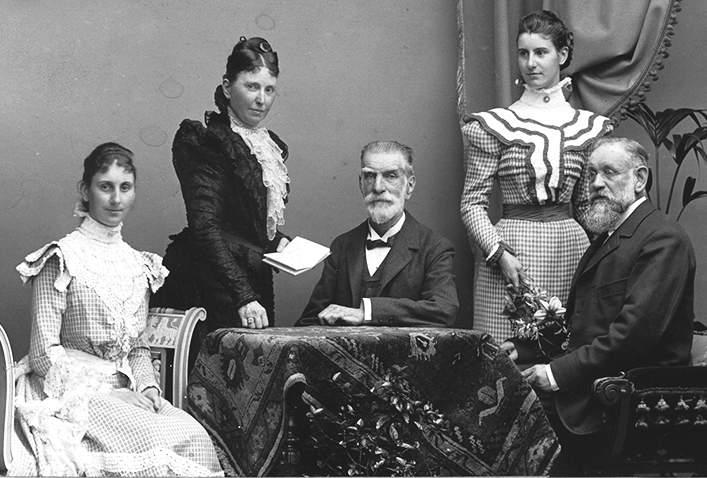
The family, 1898, in Germany. Anita is on the left with mother Rose, father Adolf, Julie de Milas, and Louis de Milas
As for her final resting place, the historical record is not entirely clear. Given the Cluss family's deep ties to Washington, it is likely that she is buried in one of the city's historic cemeteries, such as Oak Hill Cemetery or Rock Creek Cemetery, both of which hold many of the city's 19th-century families. Yet even here, the uncertainty tells its own story. Her father's buildings are mapped, cataloged, and preserved. Anita's legacy, by contrast, survives in quieter forms, photographs, references, and impressions.
The Cluss family offers a revealing contrast between permanence and ephemerality. Adolf Cluss built structures meant to endure. His work still shapes how Washington functions and how it is seen. His buildings anchor neighborhoods and define public space. Anita Cluss worked in a medium that vanishes the moment it is performed. Music, especially in that era, left no recordings. What she played, how she interpreted a piece, the atmosphere she created, all of it lived in the moment and then disappeared. What remains is indirect, the memory of presence, the suggestion of sound.
And yet, through the intervention of photography, something of her has lasted. Bell's portraits give us a way back. They do not let us hear her, but they let us see the conditions under which she played, the posture, the instrument, the composure. They remind us that cultural life is not set in stone. It is carried in people.
Washington, Then and Now
Today, visitors to Washington can walk past the buildings of Adolf Cluss without always knowing his name. The red brick of the Franklin School or the bustling aisles of Eastern Market continue their work, largely unchanged in purpose. Anita's world is harder to locate. The salons are gone. The private musical evenings were replaced by public performances and digital sound. The harp, once a centerpiece of refinement, is now a rarity. But the city still carries traces of both.
In its institutions, we see the work of her father. In its cultural memory, in archives, photographs, and the quiet persistence of stories like hers, we see Anita.
In the end, Anita Cluss stands as a reminder of a different kind of legacy. Not one built of brick, but of presence. Not one easily mapped, but still felt. In a city that was learning how to define itself, she contributed something less tangible, but no less important, the shaping of atmosphere, of refinement, of the inner life of a growing capital. And through the steady eye of Charles Milton Bell, she remains where she has always been: Seated beside her harp, poised in stillness, part of a Washington that was, and in some ways, still is.