Wah Shem Gah and the Kaw Nation: A Portrait of Leadership, Memory, and Survival
Few nineteenth-century photographs possess the quiet dignity found in the portrait of Wah Shem Gah by Washington photographer Charles Milton Bell. Standing before Bell's camera, dressed in traditional clothing adorned with intricate beadwork, a feathered headdress, and a prominent medallion, Wah Shem Gah appears confident, thoughtful, and resolute. His expression reveals little emotion, yet it invites endless reflection. More than a century later, viewers continue to ask a simple question: Who was this man?
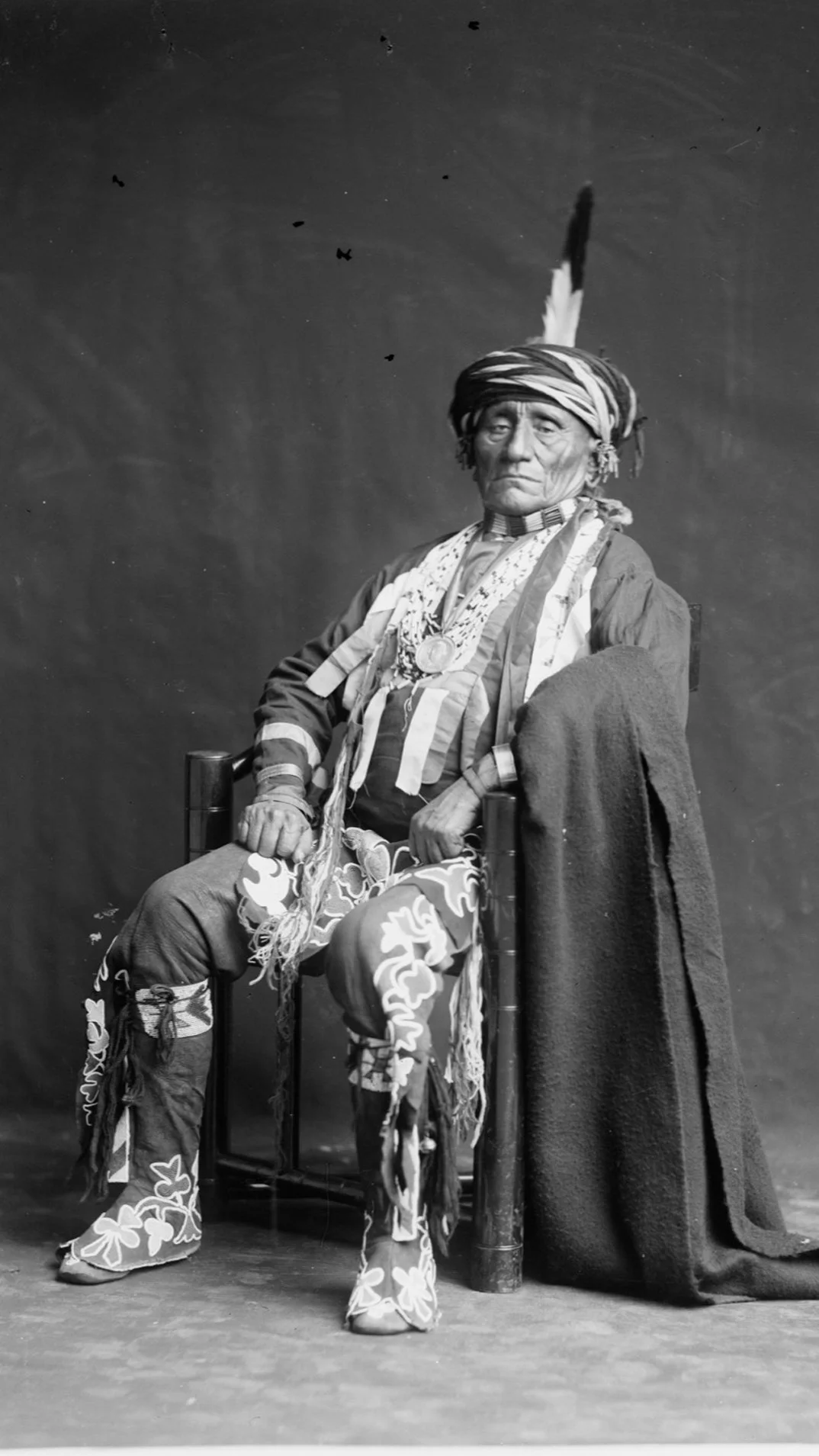
Wah Shem Gah, C. M. Bell
The answer is more complicated than historians might wish. While the photograph itself survives in remarkable detail, documentation surrounding Wah Shem Gah remains surprisingly sparse. Even his tribal identification has not been conclusively established in surviving records. Some modern sources associate him with the Kaw, or Kanza Nation, while others simply preserve his name without additional information. The uncertainty surrounding his identity is itself a reminder of a larger historical tragedy. Thousands of Native leaders were photographed during the nineteenth century, yet many of their stories were never fully recorded by the institutions that preserved their images.
Although we cannot reconstruct every detail of Wah Shem Gah's life, we can understand the world in which he lived and the people he almost certainly represented. His portrait becomes a doorway into the history of the Kaw Nation and the larger experience of Native Americans during one of the most transformative periods in American history.
The Kaw, also known as the Kanza or Kansa, are one of the Dhegiha-speaking peoples of the Siouan language family. Long before Europeans arrived on the Great Plains, the Kaw occupied lands stretching across what is now eastern Kansas, western Missouri, and portions of Nebraska. Their very name gave the state of Kansas its identity. "Kansas" is derived from "Kanza," often translated as "People of the South Wind."
For centuries, the Kaw lived in villages along fertile river valleys while also following seasonal buffalo hunts across the plains. Their economy blended agriculture with hunting. Women cultivated corn, beans, squash, and pumpkins, while men hunted buffalo, deer, and elk. Together, they built communities that balanced permanence with mobility, adapting to the rhythms of the prairie. The tribe maintained an elaborate social structure organized around clans, kinship, and ceremonial traditions. Leadership depended not simply upon inheritance but upon wisdom, generosity, courage, and the confidence of one's people. Chiefs served as diplomats, military leaders, and caretakers of tribal welfare rather than rulers in the European sense.
The eighteenth and nineteenth centuries brought profound changes. French traders first established commercial relationships with the Kaw, followed by Spanish administrators and, eventually, American explorers after the Louisiana Purchase in 1803. When Meriwether Lewis and William Clark journeyed westward in 1804, they encountered the Kaw and noted both their strategic location and growing challenges. Epidemics introduced by Europeans had already devastated Indigenous populations. Smallpox, influenza, and measles repeatedly swept across Native villages, killing thousands who possessed no natural immunity.
As American settlement accelerated, the pressure upon tribal lands intensified. Treaties negotiated with the United States steadily reduced Kaw territory. Each agreement surrendered additional acreage in exchange for promises of protection, supplies, schools, or financial compensation that frequently fell short of expectations. The Kaw found themselves caught between expanding American settlement, neighboring tribes displaced from the East, and a federal government increasingly determined to transform Native societies according to Euro-American ideals.
By the late nineteenth century, it became increasingly common for Native delegations to travel to Washington, D.C. These journeys served many purposes. Chiefs negotiated treaties, petitioned government officials, discussed annuity payments, protested broken promises, or simply attempted to preserve what remained of their nations. Washington itself became an unexpected crossroads of cultures. Delegations from dozens of tribes visited the capital, often staying for weeks while conducting official business with the Bureau of Indian Affairs or members of Congress. Photographers recognized the historical significance of these visitors.
Among them was Charles Milton Bell. Bell's Washington studio became one of the city's premier portrait establishments during the late nineteenth century. Unlike photographers who traveled west seeking dramatic scenes of frontier life, Bell waited for history to come to him. Senators, military officers, inventors, diplomats, judges, artists, foreign dignitaries, and Native leaders all sat before his camera. His portraits remain remarkable for their technical excellence and psychological depth. Rather than creating theatrical scenes, Bell focused attention upon the individual. Lighting emphasized facial features. Backgrounds remained restrained. Every wrinkle, every fold of clothing, every carefully chosen ornament became part of the historical record. Wah Shem Gah's portrait perfectly reflects this philosophy.
Although photographs cannot tell us everything, they reveal much. Wah Shem Gah stands with quiet confidence. His clothing displays exceptional craftsmanship. The intricate beadwork represents more than decoration. Such work often reflected family tradition, tribal identity, and artistic accomplishment. The feather rising from his headwear suggests honor and status. Across his chest hangs a large medallion, likely presented during diplomatic encounters or government ceremonies. Similar peace medals were frequently awarded to Native leaders throughout the nineteenth century, symbolizing official recognition while also reflecting the complicated relationship between tribal nations and the federal government.
Most striking, however, is his expression. He neither smiles nor poses dramatically. Instead, he meets the camera directly. It is the look of someone accustomed to responsibility.
If Wah Shem Gah belonged to the Kaw Nation, he lived during one of the tribe's most difficult eras. By the 1870s, repeated land cessions had reduced the Kaw homeland to a fraction of its former size. In 1873, the federal government removed the tribe from Kansas to Indian Territory, present-day Oklahoma. The removal represented far more than a change of geography. Ancient villages, burial grounds, ceremonial sites, and generations of memory remained behind. Entire communities were forced to begin again in unfamiliar surroundings. Yet the Kaw endured. Families rebuilt homes. Ceremonies continued. Language survived within households despite increasing pressure from federal boarding schools designed to replace Native languages and customs with English education and Euro-American culture. The resilience of the Kaw mirrored that of countless Indigenous nations across North America.
By the time Bell photographed Native leaders in Washington, federal policy had shifted away from treaty-making toward assimilation. The Dawes Act of 1887 divided communal tribal lands into individual allotments. Supporters argued this would encourage farming and citizenship. In practice, allotment dramatically reduced Native land ownership. Millions of acres passed into non-Native hands. Boarding schools sought to erase Indigenous identity altogether. Children were removed from their families. Hair was cut. Traditional clothing disappeared. Native languages were forbidden. Many suffered emotional and physical hardship while separated from their communities. Against this backdrop, portraits like Bell's acquire even greater significance. They preserve cultural identity at precisely the moment official policy attempted to eliminate it. Bell's Contribution to American History
Working in Washington between the Civil War and the early twentieth century, Bell created one of the nation's richest visual archives. His studio documented presidents, cabinet officials, military heroes, educators, clergy, reformers, scientists, suffragists, African American leaders, immigrants, and Native Americans. Bell approached portraiture with unusual consistency. Whether photographing a Supreme Court justice or a tribal chief, he afforded each sitter dignity. His photographs avoid caricature. They rarely exaggerate costumes or stereotypes. Instead, Bell trusted that character could be revealed through careful observation and exceptional craftsmanship.
His portrait of Wah Shem Gah beautifully demonstrates this philosophy. The image does not invite viewers to see an "exotic" figure. It invites them to see a man.
Historical honesty requires acknowledging uncertainty. Despite extensive photographic collections, census records, and government archives, definitive biographical information about Wah Shem Gah has yet to emerge. It remains possible that additional tribal records, Bureau of Indian Affairs correspondence, newspaper accounts, or family histories will eventually reveal more about his life. Such discoveries occur regularly. Names once forgotten become connected to descendants.
Photographs acquire new meaning. Archives continue to expand through collaboration with Native communities. For historians, unanswered questions are not failures. They are invitations to continue searching.
Today, the Kaw Nation is headquartered in Kaw City, Oklahoma. Tribal citizens continue to preserve their language, traditions, governance, and cultural heritage while building for the future through education, health care, historic preservation, and economic development.
Their survival represents one of the great stories of American resilience. Empires rose and fell. Borders shifted. Federal policies changed repeatedly. Yet the Kaw Nation endured. The same may be said of Wah Shem Gah's portrait.
What Bell captured was not merely the appearance of one individual. He preserved the humanity of a people who refused to disappear. Every generation discovers new meaning in historic photographs. Some see clothing. Others notice craftsmanship. Historians search for documentary evidence. Descendants search for ancestors.
But perhaps the greatest achievement of Bell's portrait lies in its ability to remind us that history is ultimately about people. Wah Shem Gah was not simply a representative of a tribe or a participant in federal negotiations. He was a son, perhaps a father, a leader within his community, and an individual whose life intersected with one of the most consequential chapters in American history.
Although much about him remains unknown, his portrait continues to speak across time. It asks modern viewers to look beyond stereotypes, beyond incomplete records, and beyond the silence of forgotten archives. Instead, it asks us to recognize the enduring dignity of a man whose steady gaze still meets our own, more than a century after Charles Milton Bell opened his camera shutter.